Electrolysis is a process in which electrical energy, from a direct current, DC supply, breaks down electrolytes in a solution. There are a variety of ways of carrying out electrolysis.
This investigation looks at what happens to aqueous solutions when they are electrolysed using inert electrodes. An aqueous solution is one in which the solvent is water.
In all cases where aqueous solutions are electrolysed, water will also be electrolysed, producing hydrogen ions and hydroxide ions.
Before you begin, you should always consider which ions are in the solution. Brine, for example, is an aqueous solution of sodium chloride, an ionic compound. The ions present when sodium chloride dissolves in water are: sodium ions, chloride ions, hydrogen ions and hydroxide ions.
There are various different ways of carrying out electrolysis. You could set it up like this, or use a Hoffman voltameter, or a microscope electrolysis set-up like this one.
You should be able to use your knowledge of the reactivity series to predict what forms at each electrode. For aqueous solutions, if the metal which forms the metallic ions is more reactive than hydrogen, for example sodium, hydrogen gas is formed at the cathode.
If the metal of the metallic ion is less reactive than hydrogen, like copper, pure metal will form.
While at the anode, if halide ions are present, molecules of the halogen will form. This might be, for example, chlorine, bromine or iodine.
When electrolysing brine, you will expect to see gases produced at the electrodes - hydrogen at the cathode and chlorine at the anode. This is because the positively charged ions will move towards the negatively charged cathode, and the negatively charged ions will move towards the positively charged anode.
To check your predictions, collect and test the gases produced. Hydrogen burns with a squeaky pop. Chlorine bleaches damp blue litmus paper.
Whatever method of electrolysis you are using, they all need:
- a supply of electrical energy
- two electrodes, an anode and a cathode - and remember these must be made of a material that conducts electricity
- and electrolytes - ionic compounds either molten or in a solution.
Video summary
A demonstration of the key points of the required practical to investigate electrolysis of aqueous solutions using inert electrodes for GCSE chemistry and combined science.
This short film shows that there are several ways to carry out electrolysis and highlights the common features of each method. It explores the science behind the practical method, including demystifying some of the key scientific terminology, and supports students to predict what will form at each electrode.
Teacher Notes
The practical allows development of Apparatus & Techniques Chemistry 3 and 7 (DfE GCSE subject content guidance, Appendix 4).
This short film could be used before or after the investigation is carried out. If used before, students should first study some of the theory behind electrolysis.
The film can then be used to rehearse some of the key elements and key terminology used in electrolysis.
If used after the investigation, it could be used to highlight a range of methods to investigate separation by electrolysis and to support predicting what will form at each electrode.
Points for discussion:Even where the process of electrolysis is familiar to students and they can recall the method, the purpose of the apparatus and method steps are often more challenging.
This film shares the common features of electrolysis systems which will support students it apply their knowledge to unfamiliar methods and contexts. If it is not possible to demonstrate micro-scale electrolysis or the Hofmann voltameter directly with students, this film could be used to introduce them to these methods.
Questions linked to the science behind the practical are also often challenging and this film highlights how to predict what will form at each electrode.
Students should be encouraged to draw the apparatus for electrolysis and to practise identifying the key elements in a variety of electrolysis methods.
Suggested activities:Students should practise explaining the purpose of the apparatus used in several different electrolysis systems so that they can apply key learning of the process.
Working scientifically criteria states that students should, ‘apply a knowledge of a range of techniques, instruments, apparatus and materials to select those appropriate to the experiment’ (DfE GCSE subject content guidance, Working scientifically).
Suitable for teaching chemistry and combined science at Key Stage 4 and GCSE in England, Wales and Northern Ireland, and at National 4 and 5 in Scotland.
Investigate osmosis in plant tissue. video
A demonstration of the key points of the required practical to investigate osmosis in plant tissue for GCSE biology and combined science.
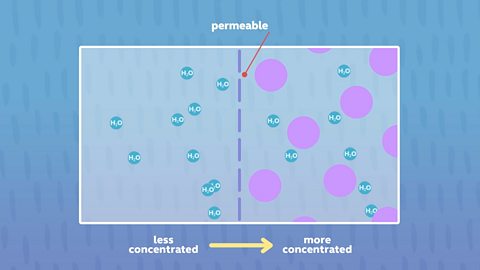
Investigate the effect of pH on enzyme activity. video
A demonstration of the key points of the required practical to investigate the effect of pH on enzyme activity for GCSE biology and combined science.
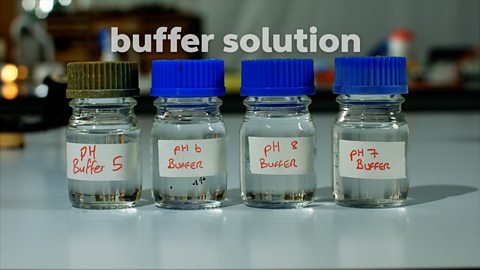
Investigate the effect of light intensity on the rate of photosynthesis. video
A demonstration of the key points of the required practical to investigate the effect of light intensity on the rate of photosynthesis for GCSE biology and combined science.
Prepare a pure, dry sample of a soluble salt from an insoluble oxide. video
A demonstration of the key points of the required practical to prepare a pure, dry sample of a soluble salt from an insoluble oxide for GCSE chemistry and combined science.
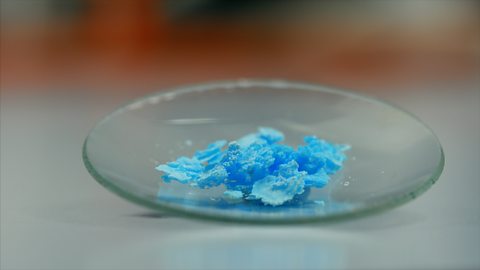
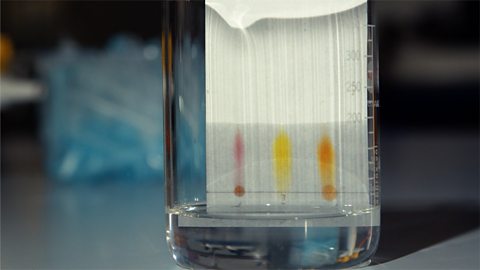
Investigate the separation of substances using paper chromatography video
A demonstration of the key points of the required practical to investigate the separation of substances using paper chromatography for GCSE chemistry and combined science.
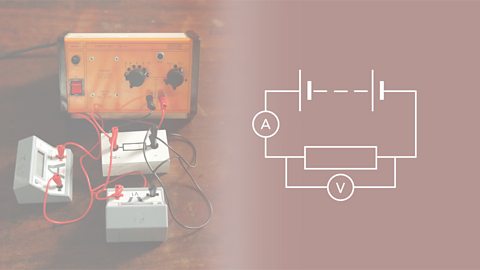
Investigate the I–V characteristics of circuit elements such as a filament lamp, diode and resistor at constant temperature. video
A demonstration of the key points of the required practical to investigate the I-V characteristics of circuit elements such as a filament lamp, diode and resistor at constant temperature.
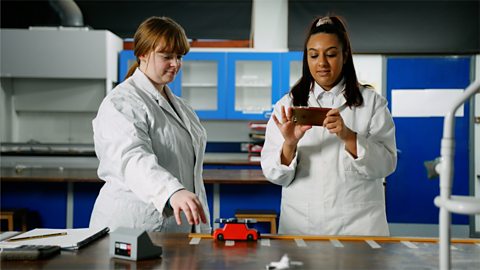
Investigate the effect of varying force or mass on the acceleration of an object. video
A demonstration of key points of the required practical to investigate the effect of varying force or mass on the acceleration of an object for GCSE physics and combined science.
Measure the frequency, wavelength and speed of waves in a ripple tank video
A demonstration of the key points of the required practical to measure the frequency, wavelength and speed of waves in a ripple tank for GCSE physics and combined science.