Osmosis is the scientific term for the movement of water across a partially permeable membrane. Overall water will move from a less concentrated solution to a more concentrated solution.This investigation looks at how osmosis happens in plant tissue. Most people use strips of potato, but the investigation works just as well with other plant tissues, carrots for example, maybe parsnip, or even swede!
In this experiment, we change the concentration of the solution we put the vegetable strips into. Concentration is a measure of the number of particles in a solution per unit volume. In coloured solutions, it is easy to see which is more concentrated and which is more dilute. In colourless solutions, like sodium chloride solution, we can't see the difference.
Concentration is usually measured in either moles per litre or grams per litre. The more moles per litre the solution has, the more concentrated it is. That means it has more sodium chloride, salt, particles per litre and therefore fewer water particles per litre.
If the solution inside the vegetable is more concentrated than the solution surrounding the vegetable, water will move into the vegetable.
It's mass will, therefore, increase.
If the solution inside the vegetable is less concentrated than that in the solution surrounding it, water will move out of the vegetable - so the mass will decrease.
You should record your results as the percentage change in mass. This means converting the change in mass you measure into a percentage of the starting mass of the vegetable strips. Some of our vegetable strips increased in mass, some decreased in mass.
These results tell us about the concentration of sodium chloride inside the vegetable cells. Where we see zero percentage change in mass, the concentration inside the cells is the same as the concentration of the surrounding solution.
Repeat measurements so that you can identify and ignore any anomalous results. This increases the validity of the investigation. Follow up the experiment by narrowing the range of concentrations of sodium chloride. Focus around the zero percentage change in mass to increase the accuracy of your predictions.
Video summary
A demonstration of the key points of the required practical to investigate osmosis in plant tissue for GCSE biology and combined science.
Osmosis is a challenging concept, and this investigation is also challenging in terms of the manipulation, organisation and number of practical skills needed. This film helps to ensure the concept itself is understood as well as how to generate and interpret the data collected.
Teacher Notes
This practical supports Development of Apparatus & Techniques Biology 1, 3 and 5 (DfE GCSE subject content guidance, Appendix 4).
Osmosis and concentration are both challenging and abstract concepts. Osmosis does not feature in the KS3 programme of study and so may be a new concept at KS4.
Using this short film in chunks could help to create understanding of these principles before moving on to explaining the data and observations. Having a secure understanding of osmosis and concentration will help students to explain observations of increasing and decreasing mass in plant tissue.
Following the investigation by students, this film can reinforce how to manipulate and interpret the data generated and how to make improvements to increase accuracy and validity.
Points for discussion:This film is used to explain the science behind the required practical, before focusing on analysis of the data produced and then suggesting ways to improve accuracy of the data.
It is important that students understand the concept of osmosis and how the process is affected by concentration in order to explain the observations in the investigation.
Students often find it challenging to suggest specific ways to improve the outcome of a required practical. This film explores how to change the range of measurements to increase accuracy of prediction and also explains why repeating measurements can be useful.
Suggested activities:Students could practise manipulating unfamiliar data from similar investigations, calculating percentage change and analysing what is a relatively difficult graph.
Students could design an improved investigation, applying what is suggested about narrowing the range of concentrations investigated.
Allowing students to investigate osmosis in different tissues, or to see data involving other tissues, could help to dispel any misconception that osmosis is specific to potato cells.
Suitable for teaching biology and combined science at Key Stage 4 and GCSE in England, Wales and Northern Ireland, and at National 4 and 5 in Scotland.
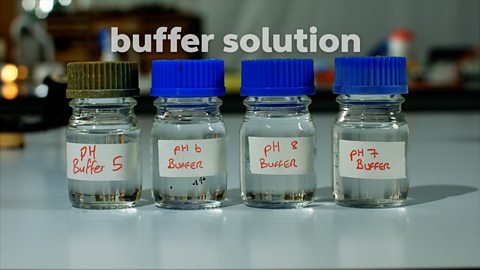
Investigate the effect of pH on enzyme activity. video
A demonstration of the key points of the required practical to investigate the effect of pH on enzyme activity for GCSE biology and combined science.
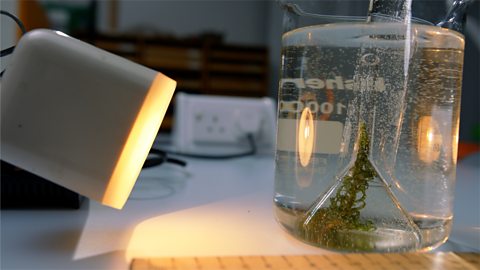
Investigate the effect of light intensity on the rate of photosynthesis. video
A demonstration of the key points of the required practical to investigate the effect of light intensity on the rate of photosynthesis for GCSE biology and combined science.
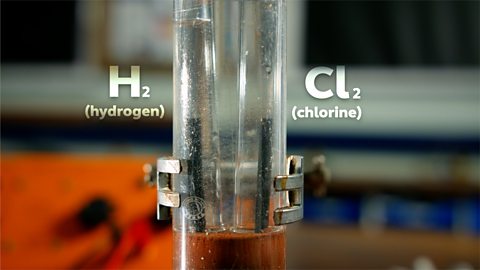
Investigate electrolysis of aqueous solutions using inert electrodes. video
A demonstration of the key points of the required practical to investigate electrolysis of aqueous solutions using inert electrodes for GCSE chemistry and combined science.
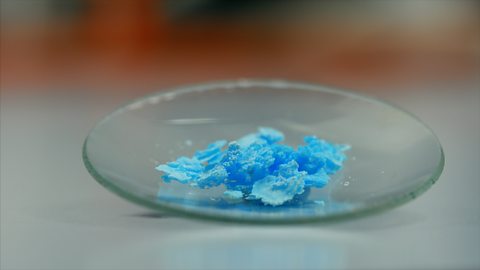
Prepare a pure, dry sample of a soluble salt from an insoluble oxide. video
A demonstration of the key points of the required practical to prepare a pure, dry sample of a soluble salt from an insoluble oxide for GCSE chemistry and combined science.
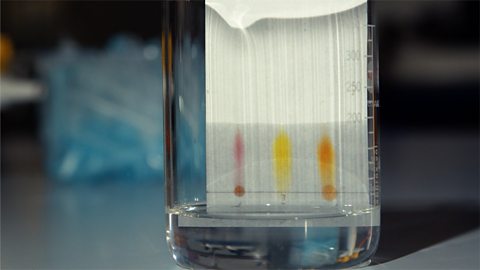
Investigate the separation of substances using paper chromatography video
A demonstration of the key points of the required practical to investigate the separation of substances using paper chromatography for GCSE chemistry and combined science.
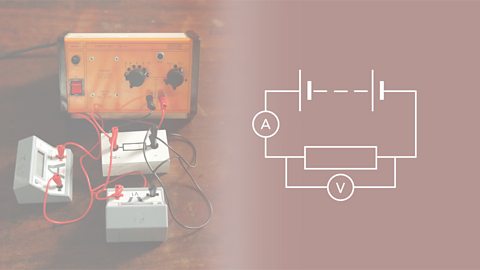
Investigate the I–V characteristics of circuit elements such as a filament lamp, diode and resistor at constant temperature. video
A demonstration of the key points of the required practical to investigate the I-V characteristics of circuit elements such as a filament lamp, diode and resistor at constant temperature.
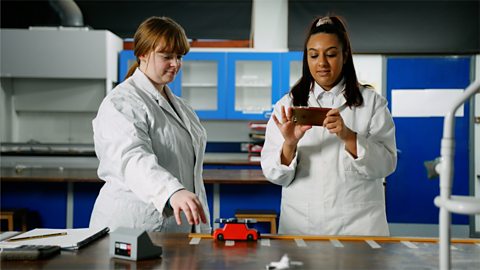
Investigate the effect of varying force or mass on the acceleration of an object. video
A demonstration of key points of the required practical to investigate the effect of varying force or mass on the acceleration of an object for GCSE physics and combined science.
Measure the frequency, wavelength and speed of waves in a ripple tank video
A demonstration of the key points of the required practical to measure the frequency, wavelength and speed of waves in a ripple tank for GCSE physics and combined science.