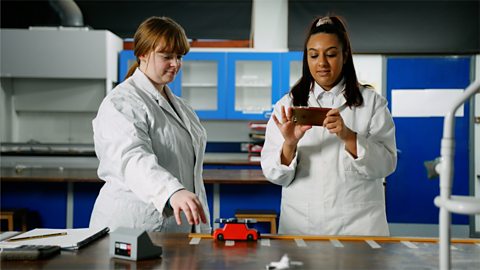
Waves in water are transverse. This means that the vibrations causing the waves are perpendicular to the direction of energy transfer.
As this little boat demonstrates, you can see that the waves are moving it up and down as well as forwards.
The equation needed when studying waves is: wave speed = frequency x wavelength.
A ripple tank allows you to study transverse waves in water. Ripple tanks vary a lot in how they look, but usually have these features:
a motor, which is used to dip the block into the water creating waves. If there isn't a motor, you can do this manually.
a lamp to create shadows of the waves, so they can be observed.
and some ripple tanks also have a signal generator, to control what frequency you're setting the waves to.
You will also need a metre rule and a stop clock.
There are a number of measurements you can take.
1: Frequency of waves: if the ripple tank you are using has a signal generator, you will be able to read the frequency directly from this.
To calculate it manually, observe a fixed point and count how many waves pass this point in a measured time, for example 30 seconds.
Record the frequency in Hertz. Hertz is a measure of how often something happens in one second. To calculate in Hertz, divide the number of waves you've counted by the time in seconds. Repeat this and then take an average.
2: Wavelength: measure the distance between wave fronts. When looking at the shadows created by the ripple tank, this is the distance between the centre of the bright strips. It's best to measure this over several waves and then divide by the number of waves, particularly when you are working with small measurements.
Taking a photo is also a good way to make your measurements easier. Just make sure your metre rule is in the picture.
You should record your measurement in metres.
3: Wave speed: calculate this by multiplying the frequency of the waves by the wavelength.
Alternatively, you can time how long it takes for one wave front to move across the screen, measure the distance travelled across the screen and calculate using the familiar speed equation: speed = distance/time.
A demonstration of the key points of the required practical to measure the frequency, wavelength and speed of waves in a ripple tank for GCSE physics and combined science.
Students are unlikely to have come across a ripple tank before KS4 so this short film explores its key features and how they can be used to measure the characteristics of waves in water. It demonstrates how each of the factors can be measured and/or calculated.
The film also highlights the equation v=f λ which students need to make their calculations and will need be able to recall and apply.
Teacher Notes
The practical allows development of Apparatus & Techniques Physics 4 (DfE GCSE subject content guidance, Appendix 4).
This short film can be used before or after introducing students to a ripple tank. It highlights the main features of a ripple tank and the information might have to be applied slightly differently depending on the ripple tank available in school.
The film demonstrates how to calculate frequency, wavelength and speed. Variations in how to make each measurement are highlighted, e.g. using the equation v=f λ rather than direct measurements to calculate wave speed.
Points for discussion:
Ripple tanks often vary in the way that they look, so this film highlights the key features common to all that are needed to measure frequency, wavelength and speed. This should help students to apply this knowledge to situations where the apparatus looks slightly different.
As this is often a demonstration rather than hands on practical activity in schools, students can find questions about the apparatus and suitability of the apparatus challenging.
Students must be able to recall and apply the equation v=f λ and the film provides opportunities to apply it using measurements taken from the ripple tank.
Suggested activities:
*Using a slightly different set up of ripple tank will help students to apply the learning about common features and ways to measure variables to different situations. *
Students should practise calculating frequency, wavelength and speed using different given measurements and by manipulating the equation where appropriate.
Curriculum Notes
Suitable for teaching physics and combined science at Key Stage 4 and GCSE in England, Wales and Northern Ireland, and at National 4 and 5 in Scotland, and Cambridge IGCSE Physics.

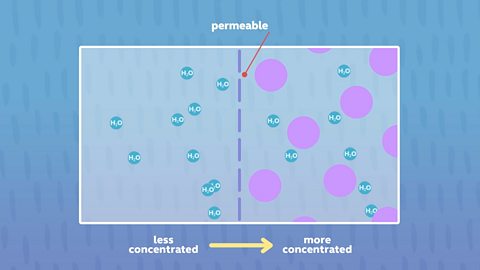
Investigate osmosis in plant tissue. video
A demonstration of the key points of the required practical to investigate osmosis in plant tissue for GCSE biology and combined science.
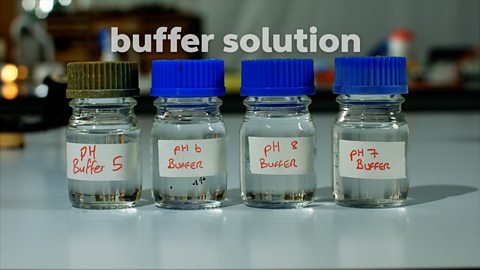
Investigate the effect of pH on enzyme activity. video
A demonstration of the key points of the required practical to investigate the effect of pH on enzyme activity for GCSE biology and combined science.
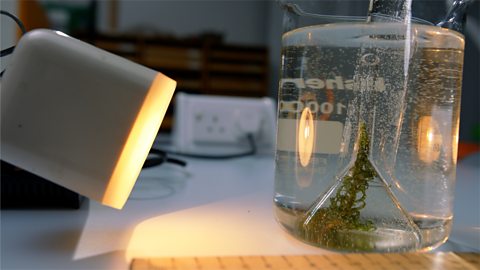
Investigate the effect of light intensity on the rate of photosynthesis. video
A demonstration of the key points of the required practical to investigate the effect of light intensity on the rate of photosynthesis for GCSE biology and combined science.
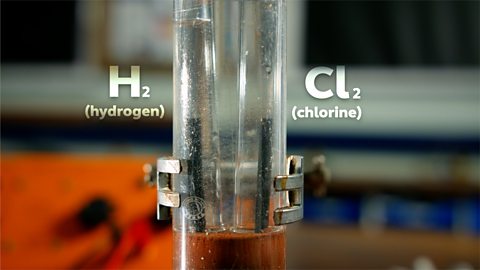
Investigate electrolysis of aqueous solutions using inert electrodes. video
A demonstration of the key points of the required practical to investigate electrolysis of aqueous solutions using inert electrodes for GCSE chemistry and combined science.
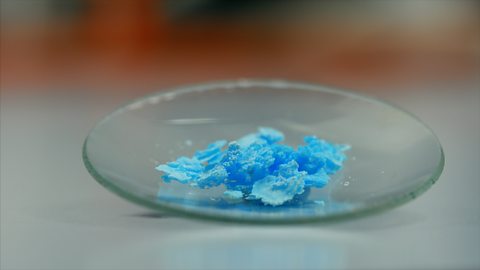
Prepare a pure, dry sample of a soluble salt from an insoluble oxide. video
A demonstration of the key points of the required practical to prepare a pure, dry sample of a soluble salt from an insoluble oxide for GCSE chemistry and combined science.
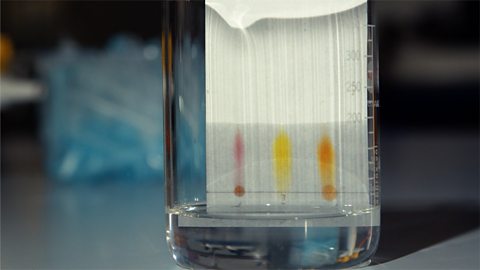
Investigate the separation of substances using paper chromatography video
A demonstration of the key points of the required practical to investigate the separation of substances using paper chromatography for GCSE chemistry and combined science.
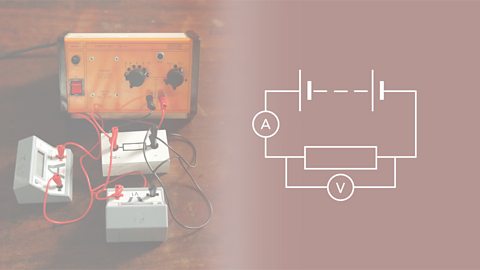
Investigate the I–V characteristics of circuit elements such as a filament lamp, diode and resistor at constant temperature. video
A demonstration of the key points of the required practical to investigate the I-V characteristics of circuit elements such as a filament lamp, diode and resistor at constant temperature.
Investigate the effect of varying force or mass on the acceleration of an object. video
A demonstration of key points of the required practical to investigate the effect of varying force or mass on the acceleration of an object for GCSE physics and combined science.