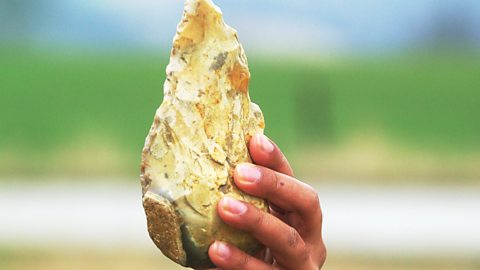
RAKSHA DAVE: A very long time ago in ancient Britain, there were no written words. This was the time before history was recorded. It's prehistory. The only clues to life back then come from the objects, burials, cave paintings, and monuments which speak to us about Britain's ancient past. My name is Raksha Dave. I'm an archaeologist and I'm in search of Britain's Ancient Voices.
This may look like an odd-shaped hill, but, in fact, it's what's left of an Iron Age hillfort, built 2,500 years ago. This is Maiden Castle. At this time, people in Britain lived in tribes, but as land began to be used up, tribes started to fight each other, so some built hillforts to defend their territories. This is the largest hillfort of them all. In fact, it's as big as 50 football pitches. It's incredibly steep, so must have been really difficult to attack. This is hard work. Oh, and once you think you've got to the top, there's another ridge to get over. Maiden Castle isn't built from stone, but carved from the hill. To make the hillfort hard to enter, banks were built all around it. These banks, known as ramparts, are built out of chalk, dug from the ditches down here, which were much deeper in the Iron Age. And, of course, there were no mechanical diggers back then, so digging this by hand was hard, physical work. The ramparts would have been a brilliant chalky white and visible from a long way away. Finally, I've reached the top, and up here is where the tribe would have lived.
Here at the hillfort's entrance, you'd have a bird's-eye view of who was arriving, and if any enemies were spotted, they would be lobbed with stones kept in large pits here. And we know this because 20,000 of them, like these, were found at the eastern entrance just for that purpose, and they could be deadly. The tribe must have felt very protected living here, on top of the hillfort. Just imagine the roundhouses here in neat little rows, with sheep outside bleating in their pens…
SHEEP BLEATS
…children practising with their slingshots, their parents warning them to be careful, people sharing stories and food around the campfire, tribal elders calling them for a meeting. Maiden Castle was also a safe place to buy and sell crops, pots, weapons, and jewellery. And to pay for these goods, they used grain, which they kept in special pits on top of the hillfort. And they used metal ring money, too. These are actual Iron Age coins, about 2,500 years old. They look very different from the flat coins that we use today. The bigger the ring, the more it weighed, and the greater the value of the coin. It's amazing to think that on top of this hill, inside these walls, that this was a place teeming with life, where people were busy going about their daily activities - working, trading and meeting people, and keeping an eye on the crops and animals in the fields below Maiden Castle. No wonder it's called 'Mai-dun' - the Iron Age words for 'great fort'.
Video summary
Archaeologist Raksha Dave explores Maiden Castle – the biggest Iron Age Hill Fort in Britain.
We find out how it was built - with a succession of steeply-rising ramparts and ditches - and about the weapons they used to defend the entrance.
We discover what Iron Age people used for money, as well as the crops they grew and the animals they kept.
Perhaps the most surprising thing is the amount of effort they went to in order to remain safe from their enemies.
This clip is from the series Ancient Voices.
Teacher Notes
Could be used to explore Iron Age life by asking the question, ‘Why did this tribe take so much trouble to make Maiden Castle so secure?’
Could also be used to compare and contrast life between the Stone Age and the Iron Age – what has changed and what has stayed the same?
Children could use toy building tools to construct their own fort defenses using Iron Age techniques.
This clip will be relevant for teaching History and Social Studies at KS2 in England, Wales and Northern Ireland and 2nd Level in Scotland.
What does Stonehenge Gold tell us about the Bronze Age? video
Raksha explores Maiden Castle – the biggest Iron Age Hill Fort in Britain. We find out how it was built and about the weapons they used to defend the entrance.
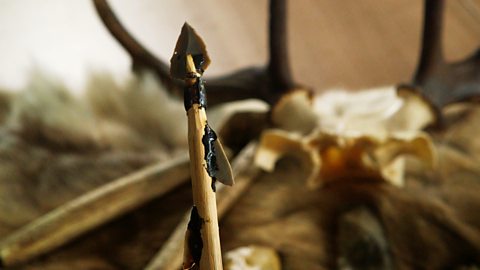
Discovering iron in Iron Age Britain. video
Raksha visits an Iron Age mine in the Forest of Dean and explores iron mining. Iron mining in the Forest of Dean dates back nearly 2,500 years where iron ore was found near the surface.
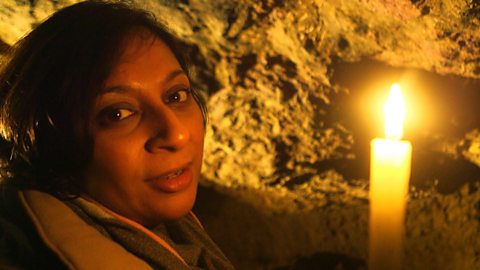
Iron Age daily life video
Archaeologist Raksha Dave explores Maiden Castle, the biggest Iron Age Hill Fort in Britain, to try and piece together what it would have looked like 2,500 years ago.
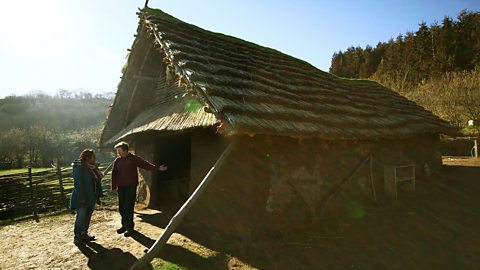
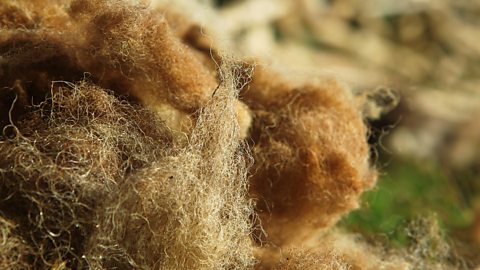
Discovering wool in Bronze Age Britain. video
Raksha visits Butser Ancient Farm and learns how woollen cloth was made in the Bronze Age, a re-enactor at the farm shows her how to use a spindle and loom.
Discovering metalwork in Bronze Age Britain. video
Raksha visits Butser Ancient Farm to look at the beginning of the Bronze Age and construct a Bronze Age axe head in exactly the same way Bronze Age man would have done.
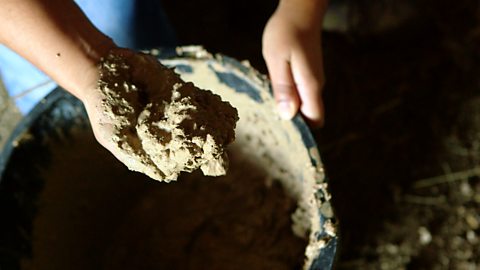
Stone Age farming and homes. video
Raksha explores life in Britain during the Stone Age first by looking at hunter-gatherers who lived by hunting animals and collecting fruit and nuts, and then moves on to explore the first farmers
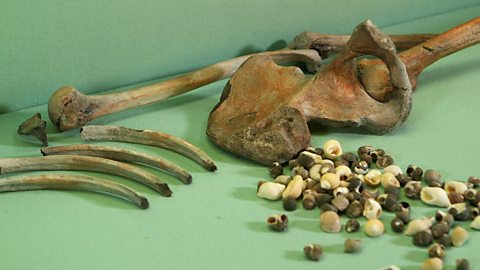
What do ancient bones tell us about the Stone Age? video
Raksha gives us a real insight into the life and times of higher status hunter-gatherers in the Old Stone Age by looking at The Red Lady of Paviland, one of the oldest skeletons found in Britain.
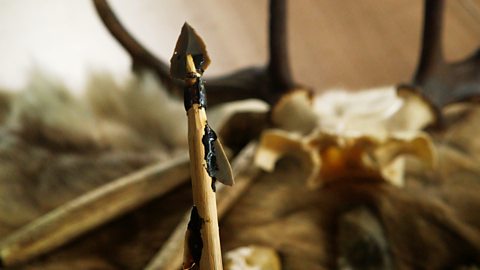
Discovering Stone Age tools made of flint video
Raksha explores the importance of flint to Stone Age man. A modern day worker makes a replica of a Stone Age arrow, showing us how skilled Stone Age people were in their use of flint.