BLEATING
RAKSHA DAVE: A very long time ago in ancient Britain, there were no written words. This was the time before history was recorded. It's prehistory. The only clues to life back then come from the objects, burials, cave paintings, and monuments which speak to us about Britain's ancient past. My name is Raksha Dave. I'm an archaeologist and I'm in search of Britain's Ancient Voices.
Today, we can still find evidence of the places our Stone Age ancestors came to. I've come to a very important place in Gower, South Wales. Although the sea stretches all the way to Devon today, back then, this would have been a shallow river with plenty of fish and lots of animals roaming around - a perfect place for hunting. But animals in the early Stone Age were very different from the ones that live here today. There were massively woolly mammoths, huge woolly rhinos, and even supersized lions.
MAMMOTH SNORTS
People came here too. We know this because about 200 years ago, an amazing discovery was found in the Goat's Hole Cave below. Inside the cave, the remains of a 30,000-year-old skeleton was found. The Victorian fossil hunter Reverend William Buckland thought he'd discovered the bones of a woman, so he called her the Red Lady of Paviland. We don't have any written evidence to tell us the story about the Red Lady of Paviland, but by examining the bones and the objects that have been left behind, we can begin to understand how our Stone Age ancestors used to live and even a little about how they used to think. The Red Lady turned out to be a man, and this is a model of what he may have looked like.
At Swansea Museum, they have a replica of the ancient skeleton, and it gives us some clues about how early Stone Age people lived. As you can see, there's quite a bit of it missing, but what's very noticeable is that the bones are painted red. So why is he painted red?
PHIL TRESEDER: Well, he's not really painted red. When the body was buried, they sprinkled a substance called ochre on it, and it, over thousands of years, has stained red.
RAKSHA: Ochre comes from rocks which contain a mineral known as iron oxide.
PHIL: We don't really know why they did that. It might have been some kind of religious thing, or some kind of spiritual thing, that they felt would protect the body in some way.
RAKSHA: By using scientific techniques to study the bones, we can find out some really fascinating details about the Red Man.
PHIL: He was over 21 years old, he was quite healthy, and he had a lot of fish in his diet.
RAKSHA: We think Stone Age people believed his grave was a magical place, and visited the cave from miles around.
PHIL: He was obviously, you know, a person of some importance because of the way he was buried. It was a very early religious kind of burial, I suppose, some of the earliest human remains found in Britain.
RAKSHA: The skeleton was found surrounded by over 4,000 objects made from animal bones, ivory, and even teeth.
PHIL: The actual skeleton, when it was discovered, had a necklace made of periwinkles. This made the Reverend William Buckland assume that the body was a woman, whereas in reality, it's actually a male skeleton.
RAKSHA: Using scientific techniques to study the skeletons from our ancient past is real detective work, and provides us with fascinating information about how our ancestors lived, and how they thought at a time before history was written down.
Video summary
The Red Lady of Paviland is one of the oldest skeletons found in Britain, dating from around 30,000 years ago.
The fossil hunter who found her in Goat Hole Cave thought she was a woman as she was wearing a shell necklace, but it turned out to be a healthy man who ate a lot of fish.
The skeleton was surrounded by around 4000 artefacts which gives us a real insight into the life and times of higher status hunter-gatherers in the Old Stone Age.
Some questions still remain, such as ‘why was the skeleton covered in red ochre on burial?’
This clip is from the series Ancient Voices.
Teacher Notes
Could be used to explore the world of archaeology and the use of artefacts.
You could ask the questions: what can we tell about the Old Stone Age from a burial? What can’t we tell?’ What else might we want to know? Where might we find out? How much of what we know is fact and how much is opinion?
Children could draw their own version of the animals in the Stone Age, such as a massive woolly mammoth or a supersized lion.
They could write imaginary stories about the life of the Red Lady of Paviland.
This clip will be relevant for teaching History and Social Studies at KS2 in England, Wales and Northern Ireland and 2nd Level in Scotland.
What does Stonehenge Gold tell us about the Bronze Age? video
Raksha explores Maiden Castle – the biggest Iron Age Hill Fort in Britain. We find out how it was built and about the weapons they used to defend the entrance.
Discovering iron in Iron Age Britain. video
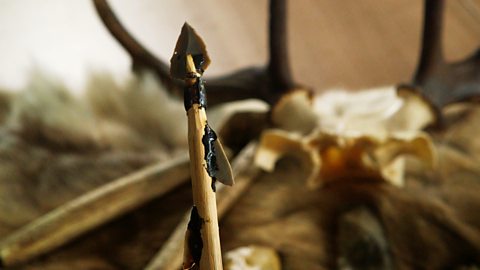
Raksha visits an Iron Age mine in the Forest of Dean and explores iron mining. Iron mining in the Forest of Dean dates back nearly 2,500 years where iron ore was found near the surface.
Iron Age daily life video
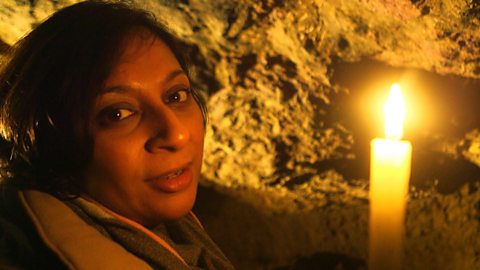
Archaeologist Raksha Dave explores Maiden Castle, the biggest Iron Age Hill Fort in Britain, to try and piece together what it would have looked like 2,500 years ago.
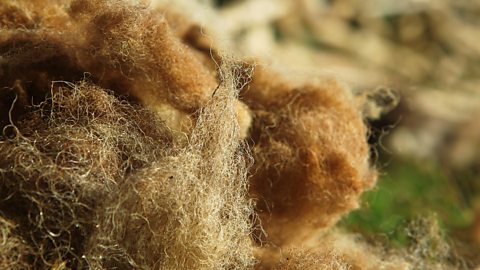
Discovering wool in Bronze Age Britain. video
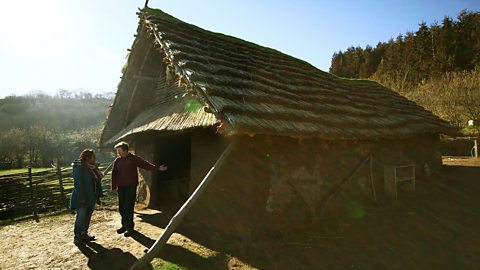
Raksha visits Butser Ancient Farm and learns how woollen cloth was made in the Bronze Age, a re-enactor at the farm shows her how to use a spindle and loom.
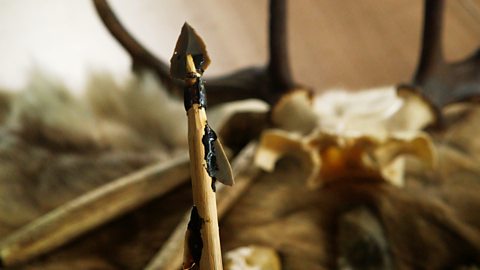
Discovering metalwork in Bronze Age Britain. video
Raksha visits Butser Ancient Farm to look at the beginning of the Bronze Age and construct a Bronze Age axe head in exactly the same way Bronze Age man would have done.
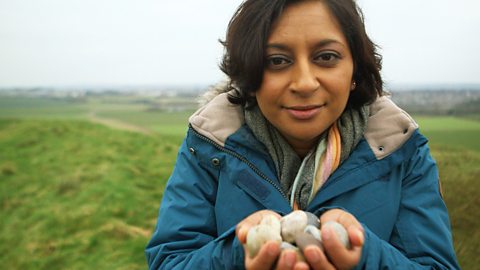
Iron Age forts and tribes. video
Raksha explores Maiden Castle – the biggest Iron Age Hill Fort in Britain.We find out how it was built and about the weapons they used to defend the entrance.
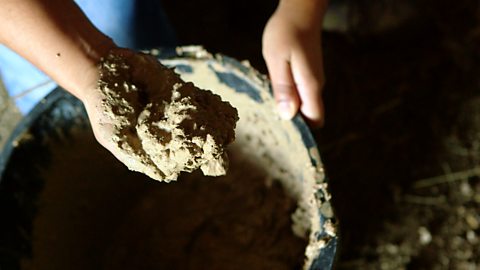
Stone Age farming and homes. video
Raksha explores life in Britain during the Stone Age first by looking at hunter-gatherers who lived by hunting animals and collecting fruit and nuts, and then moves on to explore the first farmers
Discovering Stone Age tools made of flint video
Raksha explores the importance of flint to Stone Age man. A modern day worker makes a replica of a Stone Age arrow, showing us how skilled Stone Age people were in their use of flint.