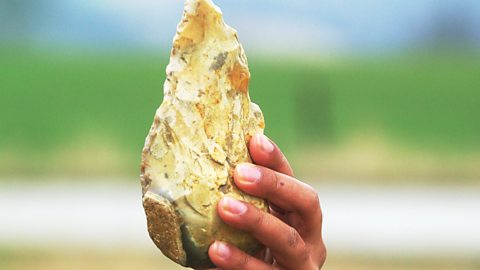
RAKSHA DAVE: A very long time ago in ancient Britain, there were no written words. This was the time before history was recorded - it's prehistory. The only clues to life back then come from the objects, burials, cave paintings, and monuments which speak to us about Britain's ancient past. My name is Raksha Dave. I'm an archaeologist and I'm in search of Britain's ancient voices.
Thousands of years ago, back in the early Stone Age, people were what we call hunter-gatherers. They hunted animals and used their skin for clothing, their bones for tools, and of course, ate what was left over. But their diet mainly consisted of nuts, berries, fruit, and wild plants that they gathered in the forest. Then, towards the end of the Stone Age, a new idea began to spread across Britain… farming.
SHEEP BLEAT
Instead of following or tracking animals over long distances, people began to settle and stay in one place. People from Europe brought new animals such as goats and sheep, like this rare breed. They're much smaller than the ones that we see today. People also started clearing trees from the forest to create areas to grow wheat and barley. Up until now, people had lived in caves or tents made out of animal skins and wood, which could be broken down and transported easily. Now they were settling in one place, they began to build homes which were meant to last.
This is a replica Neolithic house from over 4,500 years ago, but how do we know they looked like this?
MAUREEN PAGE: When you excavate, you find marks in the ground - postholes, where the posts that support the house have been in the past. We don't find any evidence above ground, but from that, we can put together a picture of how we think the house would have looked.
RAKSHA: Oh, wow, I didn't expect it to be so big inside. It's very dark in here, isn't it?
MAUREEN: It is quite dark. You get the light from the fire, but of course, there aren't any windows.
RAKSHA: Being able to light a fire was something really important, which Stone Age people had learned. Not just to keep them warm, but for cooking food as well. The walls are made from wattle and daub.
MAUREEN: This is wattle, the woven wood. That's very strong, and then we cover it with daub. This is daub, and that's going to be a draught excluder, to keep the cold air out and keep the warmth in the house, and you just push it on and smooth it on.
RAKSHA: The daub is made out of animal manure, mud, hay, and water. It's not very smelly, though, is it?
MAUREEN: No, no, once it's been lying in the field for a while, the manure doesn't really smell very much, and once it's dried on the wall it doesn't smell at all.
RAKSHA: It's quite weird. It's like having pebbly mud in your hand that you're just flinging at a wall. But not all Neolithic homes would have looked like this. In Skara Brae, a settlement on the Orkney Islands in Scotland, homes were made out of stone because there were no trees for wood. They even had stone cupboards and beds. The Stone Age lasted for nearly three and a half million years. By the end of this period, people had come a really long way.
SHEEP BLEAT
They had invented farming, lived in proper homes, and they used fire for cooking and keeping themselves warm. This was a tremendous achievement, and essential to their future survival.
Video summary
Archaeologist Raksha Dave explores life in Britain during the Stone Age.
We begin in the Old Stone Age by looking at hunter-gatherers who lived by hunting animals and collecting fruit and nuts, and then move on to explore the first farmers, who imported new animals and crops and cleared fields from the forest.
We explore the inside of a replica Stone Age house and cover the walls in wattle and daub.
This clip is from the series Ancient Voices.
Teacher Notes
Could be used to explore continuity and change between the Old Stone Age and the New Stone Age – what changed and what stayed the same?
Could also be used as a stimulus for initially finding out about Stone Age, and raising the question of what else we need to know about the period. In other words, what does the clip not tell us?
This clip will be relevant for teaching History and Social Studies at KS2 in England, Wales and Northern Ireland and 2nd Level in Scotland.
What does Stonehenge Gold tell us about the Bronze Age? video
Raksha explores Maiden Castle – the biggest Iron Age Hill Fort in Britain. We find out how it was built and about the weapons they used to defend the entrance.
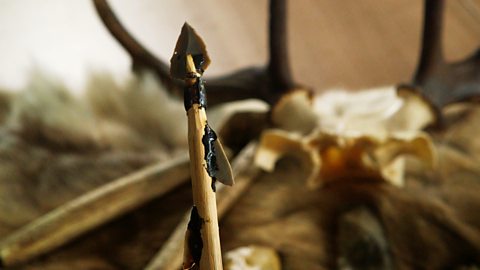
Discovering iron in Iron Age Britain. video
Raksha visits an Iron Age mine in the Forest of Dean and explores iron mining. Iron mining in the Forest of Dean dates back nearly 2,500 years where iron ore was found near the surface.
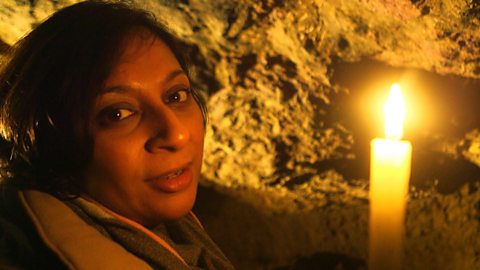
Iron Age daily life video
Archaeologist Raksha Dave explores Maiden Castle, the biggest Iron Age Hill Fort in Britain, to try and piece together what it would have looked like 2,500 years ago.
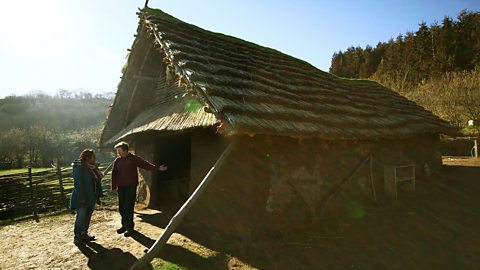
Discovering wool in Bronze Age Britain. video
Raksha visits Butser Ancient Farm and learns how woollen cloth was made in the Bronze Age, a re-enactor at the farm shows her how to use a spindle and loom.
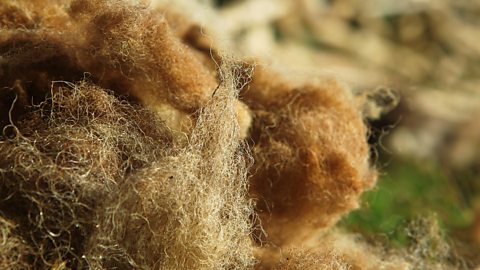
Discovering metalwork in Bronze Age Britain. video
Raksha visits Butser Ancient Farm to look at the beginning of the Bronze Age and construct a Bronze Age axe head in exactly the same way Bronze Age man would have done.
Iron Age forts and tribes. video
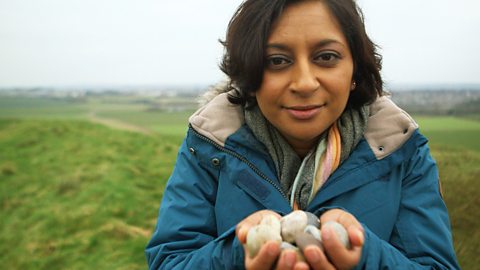
Raksha explores Maiden Castle – the biggest Iron Age Hill Fort in Britain.We find out how it was built and about the weapons they used to defend the entrance.
What do ancient bones tell us about the Stone Age? video
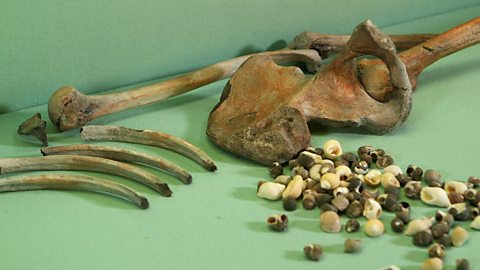
Raksha gives us a real insight into the life and times of higher status hunter-gatherers in the Old Stone Age by looking at The Red Lady of Paviland, one of the oldest skeletons found in Britain.
Discovering Stone Age tools made of flint video
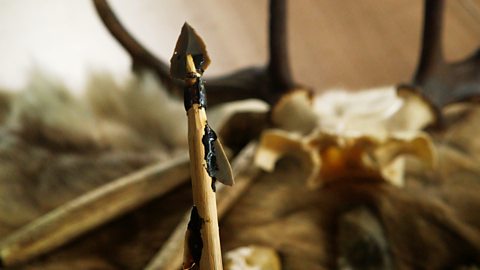
Raksha explores the importance of flint to Stone Age man. A modern day worker makes a replica of a Stone Age arrow, showing us how skilled Stone Age people were in their use of flint.