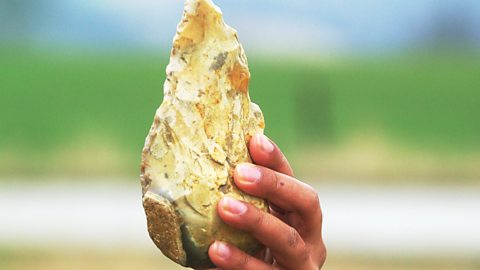
BLEATING
RAKSHA DAVE: A very long time ago in ancient Britain there were no written words. This was the time before history was recorded. It's prehistory. The only clues to life back then come from the objects burials cave paintings and monuments which speak to us about Britain's ancient past. My name is Raksha Dave. I'm an archaeologist and I'm in search of Britain's Ancient Voices. During the late Stone Age and Bronze Age huge monuments were being built all over Britain. They were places to trade meet and worship. But ONE was more spectacular and more important than the rest. This is Stonehenge.This gigantic stone circle was created here around 4 500 years ago. The big question is what was it for? Because nothing was written down at the time we don't really know why Stonehenge was built. Some believe it was a place of healing or where ancestors were worshipped. But most archaeologists believe that because the seasons were so important to farming these stones were arranged to celebrate the movement of the sun which would provide them with good harvests. But whatever the reason we know that this place is really important. People made a huge effort to build Stonehenge. These tall standing stones were brought an incredible 48km from Marlborough Downs in the north. With the biggest stone weighing around 40 tonnes - that's about the weight of 26 cars - it has been estimated that it would've taken ten years to transport them here. It's incredible to think they moved these stones here at all let alone understand how they got those horizontal ones up there. And they're not just balancing either they have specially carved bumps and grooves which slot the stones together -a bit like Lego. Over the years the weather has turned the stones dark and rough. But when Stonehenge was first built this would have been a glistening white monument. Stonehenge is also surrounded by a number of Bronze Age barrows - special man-made mounds where people have been buried. Archaeologists have found these people to be buried with an astonishing amount of gold. In fact more gold has been found here than anywhere in prehistoric Britain. In the Bronze Age Stonehenge was at its richest and most powerful and to be buried in a barrow nearby meant that you were very very important. I've come to the Wiltshire Museum to see a replica of the most spectacular one of all and this is it. This is the Bush Barrow man and he was buried near Stonehenge just under 4000 years ago. And these are the real objects found in his barrow. He seems to have been buried with a lot of gold.
DAVID DAWSON: He was wasn't he? Look at this gold lozenge. That was on his chest.
RAKSHA: This was either a pendant or a cloak fastener.
DAVID: You see the straight and zigzag lines? Imagine how that would have just shone in the sunlight. But the most amazing thing is this dagger. It was probably made in Brittany in France.
RAKSHA: Oh so are we saying that Bronze Age people travelled long distances to and from Stonehenge?
DAVID: They must have done because there are objects like amber which comes all the way from Denmark so right the way from across the other side of Europe. But look at the handle at the bottom of it. It was ornamented with absolutely tiny gold studs and you can see some here. There were something like 140000 of them.
RAKSHA: It must have taken extraordinary skill to actually make these. They're absolutely tiny.
DAVID: They're thinner than a human hair and they must have been put in place by children because only children have fantastic eyesight and the skill with their hands to be able to put those in place one by one.
RAKSHA: We don't know the real name of the Bush Barrow man but his place of burial at Stonehenge and the objects he left behind help to tell us about the kind of man he was.
DAVID: Well look at the evidence. He's rich isn't he? He must have been a chieftain. He must have been in charge at Stonehenge.
RAKSHA: Archaeological evidence helps provide us with many clues about Stonehenge and the people who are buried here. And one thing is very clear - Stonehenge was a very important religious ceremonial and burial place for the people who built this amazing monument and left clues for us thousands of years ago.
Video summary
Archaeologist Raksha Dave visits Stonehenge and a barrow burial to explore life in the Bronze Age.
What we can still see is used to explore how, when and why Stonehenge was built, and why it was such an important centre for people at the time. Differing theories and contradictions in the evidence are discussed.
There are also lots of barrow burials around Stonehenge and one of them, Bush Barrow Man, now in the Wiltshire Museum, is used to find out about the Bronze Age.
The Bush Barrow Man was buried surrounded by artifacts, including a gold cloak fastening, a dagger from Brittany and amber from Denmark, indicating that perhaps he was a very important person.
This clip is from the series Roman Voices.
Teacher Notes
Could be used to explore Iron Age life by asking the question, ‘Why did this tribe take so much trouble to make Maiden Castle so secure?’
Could also be used to compare and contrast life between the Stone Age and the Iron Age – what has changed and what has stayed the same?
Children could use toy building tools to construct their own fort defenses using Iron Age techniques.
This clip will be relevant for teaching History and Social Studies at KS2 in England, Wales and Northern Ireland and 2nd Level in Scotland.
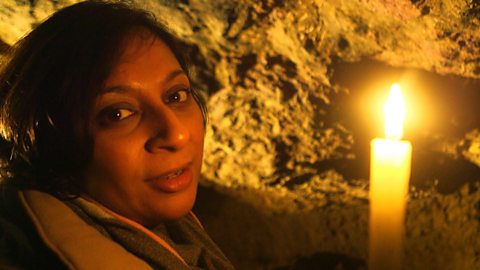
Discovering iron in Iron Age Britain. video
Raksha visits an Iron Age mine in the Forest of Dean and explores iron mining. Iron mining in the Forest of Dean dates back nearly 2,500 years where iron ore was found near the surface.
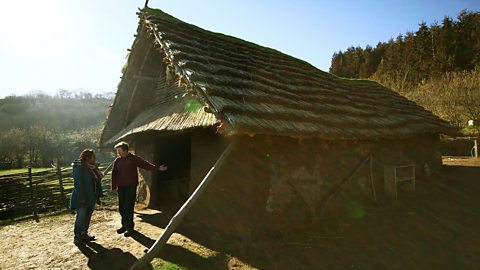
Iron Age daily life video
Archaeologist Raksha Dave explores Maiden Castle, the biggest Iron Age Hill Fort in Britain, to try and piece together what it would have looked like 2,500 years ago.
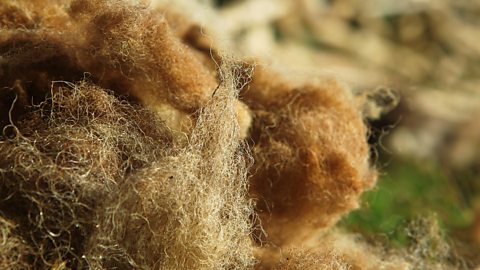
Discovering wool in Bronze Age Britain. video
Raksha visits Butser Ancient Farm and learns how woollen cloth was made in the Bronze Age, a re-enactor at the farm shows her how to use a spindle and loom.
Discovering metalwork in Bronze Age Britain. video
Raksha visits Butser Ancient Farm to look at the beginning of the Bronze Age and construct a Bronze Age axe head in exactly the same way Bronze Age man would have done.
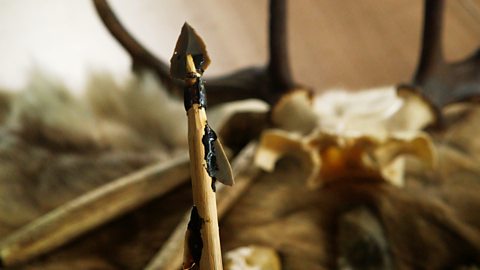
Iron Age forts and tribes. video
Raksha explores Maiden Castle – the biggest Iron Age Hill Fort in Britain.We find out how it was built and about the weapons they used to defend the entrance.
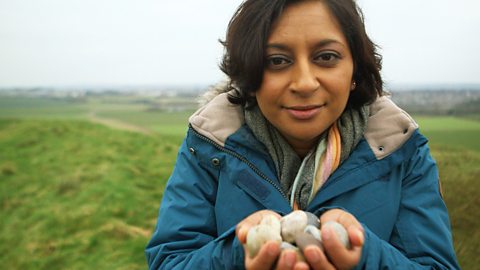
Stone Age farming and homes. video
Raksha explores life in Britain during the Stone Age first by looking at hunter-gatherers who lived by hunting animals and collecting fruit and nuts, and then moves on to explore the first farmers
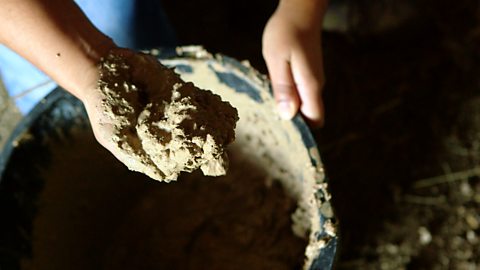
What do ancient bones tell us about the Stone Age? video
Raksha gives us a real insight into the life and times of higher status hunter-gatherers in the Old Stone Age by looking at The Red Lady of Paviland, one of the oldest skeletons found in Britain.
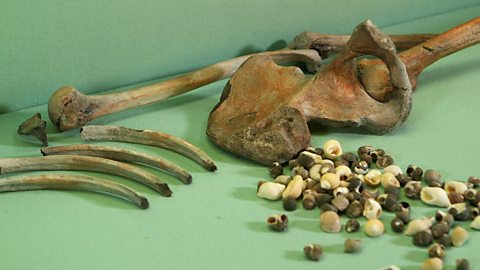
Discovering Stone Age tools made of flint video
Raksha explores the importance of flint to Stone Age man. A modern day worker makes a replica of a Stone Age arrow, showing us how skilled Stone Age people were in their use of flint.