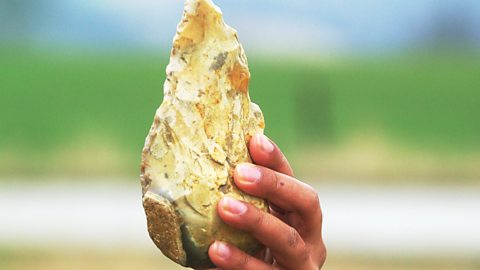
SHEEP BLEAT
RAKSHA DAVE: A very long time ago in ancient Britain there were no written words. This was the time beforehistory was recorded. It's prehistory. The only clues to life back then come from the objects burials cave paintings and monuments which speak to us about Britain's ancient past. My name is Raksha Dave. I'm an archaeologist and I'm in search of Britain's Ancient Voices. It might be difficult to work out what this object is because all of the wooden bits that these metal objects were once stuck to have since rotted away. This is an ancient bucket which is over 2000 years old. It's definitely the poshest bucket I've ever seen. So this bucket wasn't used for cleaning floors or carrying water. This was used for special occasions like feasting and carried wine or beer in it. We have this lovely face peering out here but what I really really love is this elegant horse that's just coming through here. These weird and wonderful designs are made out of bronze. But these handles and the hoops that once held this bucket together are made of a new harder stronger metal - iron. It marked the beginning of the Iron Age around 2500 years ago. To show how long ago that was I'm going to walk back in time. This is today. Imagine if every stride I took was equal to 100 years then to go back to the Iron Age I'd have to take 25 steps. One two three four five… After taking 20 steps I've gone back 2000 years. This is the first time that history was written down. and now I'm going back into prehistory. And now I've gone back 2500 years. Back there is the Stone Age. That is the Bronze Age. But here is the Iron Age. The rock used to make iron was easier to find in Britain than the copper and tin needed to make bronze. Iron could be bashed into different shapes and it was stronger. I'm going to the Forest of Dean just outside Wales where back in the Iron Age people mined iron ore to make this amazing new metal. Because iron ore can be found near the surface people could mine down for it in open pits. This is one of those pits and it's massive! This one hasn't been touched since the Iron Age and that's why it's so overgrown. It's covered with moss and trees. But back in the Iron Age these would have been a hive of activity with people mining at these open pits all over the Forest of Dean. Just look how far they've mined down. The miners even went in search of iron… …underground. This is Clearwell Caves. And these are the tools they would have used to dig it out. They're normally made out of bone or deer antler. Can you imagine doing this all day every day?
SHE GROANS
The iron ore would have been ground down and then heated until it was extremely hot and turned into liquid iron ready to be made into tools weapons and ornaments. And there's something else that can be mined here too. It's from the same rock. It's called ochre and it's found here. It was used for drawing and for religious ceremonies. The colour is different depending on how much water it contains. People think that ochre is just a yellow colour but actually here at Clearwell we get four distinct separate colours. It's like a prehistoric paint box. Although ochre was very special to people back then the most important reason for mining in the Forest of Dean was iron. For this reason it's believed that iron mining here was kept a closely guarded secret so secret that outsiders were forbidden from coming into the wood in case they learned how to make metal - because knowing how to make ironwas incredibly powerful and selling it was big business.
Video summary
A 2,000 year old bucket, used on special occasions, or what remains of it, gives us a clue to the nature of the Iron Age, although most of the bucket was still made from wood and bronze.
Archaeologist Raksha Dave looks into iron mining in the Forest of Dean which dates back nearly 2,500 years where iron ore was found near the surface.
Later, pits such as Clearwell Caves, went deeper underground as demand rose for the newer, lighter but stronger metal.
People tried to keep the process of making iron secret to preserve their power. It was often regarded as magic.
This clip is from the series Ancient Voices.
Teacher Notes
You could compare the impact of iron weapons and tools with that of bronze. Which, in your opinion, had the biggest impact or made the biggest changes?
You could ask the children to describe what it would be like to mine iron ore 2,000 years ago before showing them the clip, then asking them how realistic their version was.
You could compare iron mining in the Iron Age with mining today, when huge machines are used.
You could show them the ochre used to create prehistoric drawings and let the children use the ochre to make their own drawings.
This clip will be relevant for teaching History and Social Studies at KS2 in England, Wales and Northern Ireland and 2nd Level in Scotland.
What does Stonehenge Gold tell us about the Bronze Age? video
Raksha explores Maiden Castle – the biggest Iron Age Hill Fort in Britain. We find out how it was built and about the weapons they used to defend the entrance.
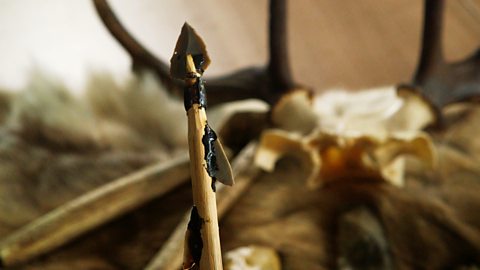
Iron Age daily life video
Archaeologist Raksha Dave explores Maiden Castle, the biggest Iron Age Hill Fort in Britain, to try and piece together what it would have looked like 2,500 years ago.
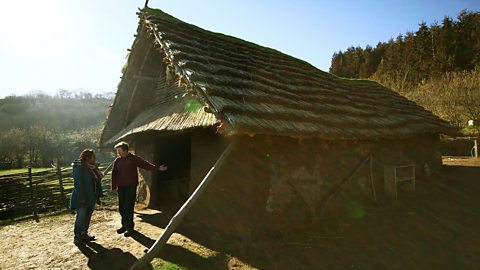
Discovering wool in Bronze Age Britain. video
Raksha visits Butser Ancient Farm and learns how woollen cloth was made in the Bronze Age, a re-enactor at the farm shows her how to use a spindle and loom.
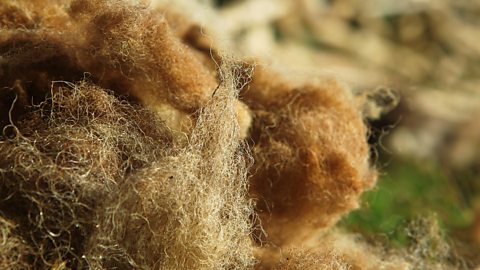
Discovering metalwork in Bronze Age Britain. video
Raksha visits Butser Ancient Farm to look at the beginning of the Bronze Age and construct a Bronze Age axe head in exactly the same way Bronze Age man would have done.
Iron Age forts and tribes. video
Raksha explores Maiden Castle – the biggest Iron Age Hill Fort in Britain.We find out how it was built and about the weapons they used to defend the entrance.
Stone Age farming and homes. video
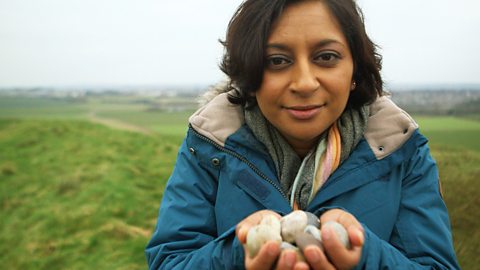
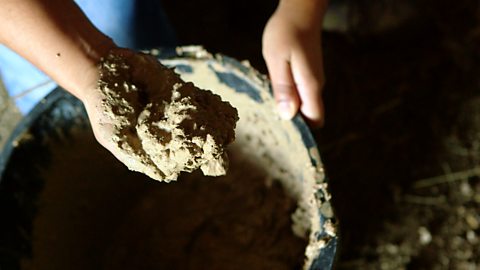
Raksha explores life in Britain during the Stone Age first by looking at hunter-gatherers who lived by hunting animals and collecting fruit and nuts, and then moves on to explore the first farmers
What do ancient bones tell us about the Stone Age? video
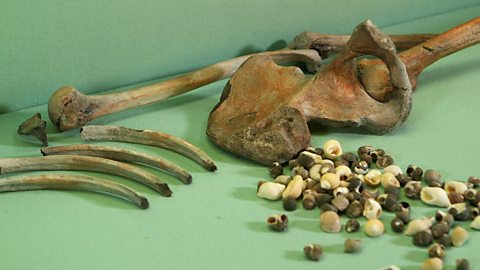
Raksha gives us a real insight into the life and times of higher status hunter-gatherers in the Old Stone Age by looking at The Red Lady of Paviland, one of the oldest skeletons found in Britain.
Discovering Stone Age tools made of flint video
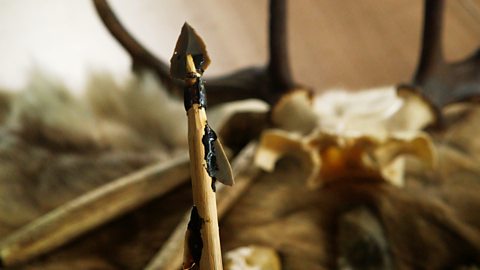
Raksha explores the importance of flint to Stone Age man. A modern day worker makes a replica of a Stone Age arrow, showing us how skilled Stone Age people were in their use of flint.