Teacher:
In Sikhism there are loads of famous stories about the ten gurus and their teachings. They help us to find out more about what it means to be a good Sikh.
Students:
[FOREIGN DIALOGUE]
Teacher:
Okay. Who can tell me who Bhai Kanhaiya[ji] was?
Ramjul:
Bhai Kanhaiya[ji] he help people in battle. He, he, he even helped his enemy. He did this because he saw good in everyone.
Teacher:
The story of Bhai Kanhaiya, he served water to wounded enemy soldiers, is just one of the many stories passed down over the years to help explain Sikh values. But some of the most famous are about Guru Nanak, the first guru and the founder of Sikhism.
Teacher:
Butta Singh visits schools all over Birmingham, passing on the wisdom from stories.
Butta Singh:
[FOREIGN DIALOGUE]
Teacher:
This one is Guru Nanak And The Boulder. It's a story about a a man Guru Nanak met during his travels. The man was refusing to share water from his well, even though the rest of his village desperately needed it.
Butta Singh:
Now Guru Nanak knew how to solve this problem. He told his companion, Mardana to go and fetch a bucket of water from the well. When he reached his destination he did come across this very, big, strong man. Mardana, he says, "Look, I've come for some water. I can see you're standing here and guarding it. But please have mercy." This huge, strong, man began to shoutat Mardana and say, "How dare you come here. You know full well the villagers can do things for me but they don't. So why should I give them water? Tell the villagers, if they want some water from my well, then serve me. I will be their master."
Teacher:
Guru Nanak sent Mardana back up the hill three times to ask for water. But the man refused.
Butta Singh:
And Guru Nanak knew it was time to teach a lesson so then Guru Nanak removed a rock that was nearby. All of a sudden a spring of water came out and all the villagers were so delighted to see that, they all started to share in that water and take that water home.
Teacher:
At the same at the top of the hill, the man's well began to run dry.
Butta Singh:
And he says, "What miracle has this man done?" I will teach him a lesson. He got this rock nearby and he took it to the end of the cliff and he aimed at Guru Nanak and he rolled it down. And as it rolled down and down, the villagers said, "Guru Nanak, save yourself. Guru Nanak, please." Guru Nanak said, "Rest assured, you carry on taking your water. And I will stop this." He puthis hand out and he stopped that rock.
Teacher:
When the man saw this he felt humbled.
Butta Singh:
All of a sudden something hit his heart. And he realised, what have I done? I have done something wrong. He ran down and he asked for forgiveness. He said, "I didn't realise but my heart was like stubborn like stone. And now it has melted like wax."
Teacher:
It's the story all about ego and pride.
Butta Singh:
Guru Nanak and the Boulder is a story that teaches us about how to get rid of our pride and by taking the teachings of the scriptures, accepting them, following them, it will bring inside us compassion, humility, truth and contentment. And these are the virtues we all need to live an honest life.
Girl with blue scarf:
The story telling in Sikhism is very important 'cause you learn about your history and what's wrong and right.
Female with blue and white scarf:My mum and dad is quite religious and like, um, if we do something wrong he'll tell us a story.
Ramjul:
You get to know your history in-- if you learn stories.
Female with yellow cardigan:
I sit down with my dad sometimes and when we start to hear the stories, and every so often, like, when we heard the name of the story we'd be like, "Dad, mom, I don't know all about this story," they'll explain it to us.
Teacher:
The more stories I hear about Guru Nanak, the more I wish I'd known him.
Female with yellow cardigan:
It would be amazing to meet Guru Nanak [UNSURE OF WORD] because, um, of amazing things that I've heard is just, it'll be [UNSURE OF WORD].
Video summary
The Gurus of the Sikhs are founders and leaders within the religion.
Simran explains how the gurus are honoured and their teaching is passed on through stories. Butta Singh, a Sikh storyteller from Birmingham, tells the story of Guru Nanak and the boulder.
Teacher Notes
In the story of Guru Nanak and the Boulder there’s a lesson about selfishness and pride and how these attitudes can be challenged or changed.
Many children are more familiar with Disney’s stories than those from any religion, but the stories of faith have power which has lasted for centuries.
Point this out to pupils. Ask them to think about the movies they like: examples could include A Bug’s Life, Monsters Inc, Toy Story and many others. Are the characters either all good or all bad? Or can they think of a time in these movies where someone changes from selfish to kind?
Religious stories often draw attention to how a person can change. Tell the pupils that Guru Nanak taught: feed the poor. Care for the unwanted. Think about others. Search for God. Care about the truth. What would his message be to the characters in the Disney movies?
The Ten Gurus left their teaching in the Guru Granth Sahib, which is the ‘living Guru of the Sikhs’ today (not just a book!). Over 20 million Sikh people try to follow their Gurus.
Ask pupils: who do you like to try and follow and why? Make a class list. Also list all the qualities that make a persona good leader. Then apply the list to the Gurus. Were they brave, kind, wise, open-hearted? Did they serve others, sort out problems, show strength? How? (Pupils may find it useful to hear a wider range of stories and sayings from the Gurus for this activity.)
This topic will be relevant to teaching Religious Education at KS2 or KS3 in England, Wales and Northern Ireland and National 2 or 3 in Scotland.
What is Sikhism? video
Eleven-year-old Simran introduces the Sikh religion and describes the key beliefs and practices in following the Sikh way of life.
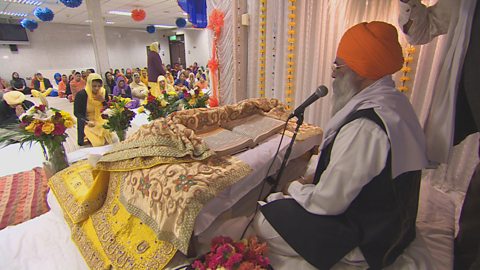
Taking Amrit. video
Two Sikh boys called Taren and Jovan join the Sikh Khalsa by taking part in the special Sikh ceremony, which is called taking Amrit.
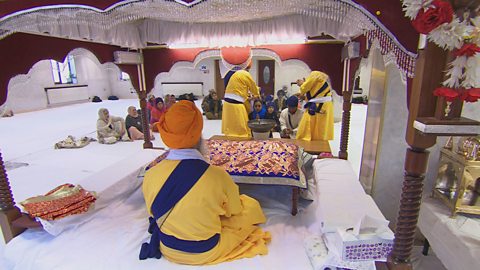
The Five Ks of Sikhism. video
Two Sikh boys called Taran and Joven explain the five Ks that they wear as members of the Sikh Khalsa.
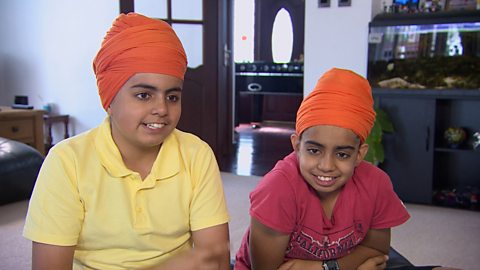
The Gurdwara. video
Simran, aged 11, describes the Sikh place of worship which is called the Gurdwara.
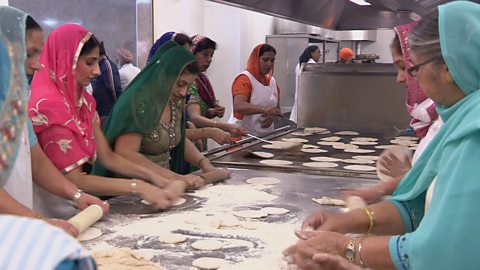
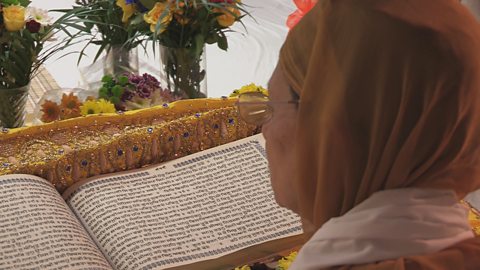
The Guru Granth Sahib. video
Simran, aged 11, explains the importance of the Sikh holy book, the Guru Granth Sahib.
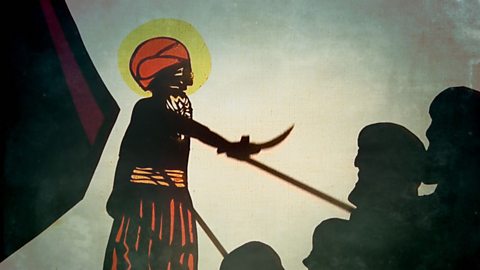
The Khalsa. video
Simran, aged 11, tells the story of the founding of the Sikh Khalsa 300 years ago.
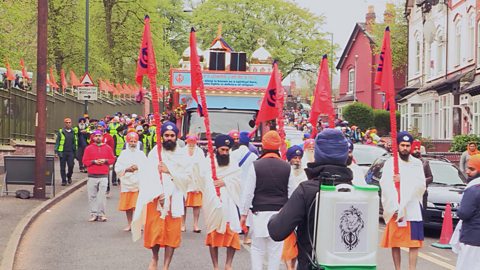
Vaisakhi. video
Simran, aged 11, takes us to the Vaisakhi celebrations and parade in her hometown of Birmingham.
Life as a young Sikh girl. video
A young British Sikh introduces herself, her family and some of the main beliefs of her religion.