Hello.
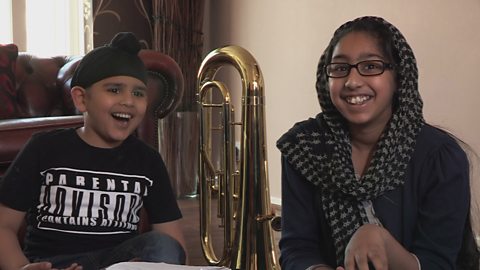
Hello. My name's Taran. This is my brother Joven. And we like trampolining. You can't beat me at table football.
Yeah I can.
No you can't.
Run at him! Attack!
Let's go!
Do do-do do-do!
SIMRAN: 11-year-old Taran and ten-year-oldJ oven are Khalsa Sikhs. They have dedicated themselves to Sikhism by joining the Sikh community the Khalsa. The word 'khalsa' means 'pure'.
See you later!
Alligator.
SIMRAN: Khalsa Sikhs wear five symbols called the Five Ks or Panj Kakka to show their devotion to Sikhism. The Five Ks are our uniform as baptised Sikhs. How people wear uniform to school we wear the uniform all the time.
SIMRAN: Kara is a bracelet worn on the wrist and is a reminder that we are connected to God. The circle doesn't have a beginningand doesn't have an end. It just keeps like going round so that kind of signifies that God has never had a beginningand he can't end.
SIMRAN: Kachera is long shortsworn under the clothes for modesty. And Kirpan is a very small sword. Kirpan symbolises that we defendpeople and we protect people. We never use it in a bad way. The Kirpan is an emblem of courage and self-defence. Khalsa Sikhs are alwaysready to defend the weak and fight against injustice. It should never be used as a weapon to attack people. The Kirpan is also usedto bless food.
At school people have found out that I'm wearing it and then like they're always like 'Oh do you have a knife?' Then you just haveto explain to people that it's only if someone's like attacking you seriously it's a life and death situation then you would use it. You wouldn't use it for a joke if someone's punchingyou at school or bullying you. You wouldn't use it for that kind of thing.
SIMRAN: Kesh is letting your hair growand never cutting it. We believe it's a gift from God. So if someone gives you a gift you wouldn't just throw it away you would appreciate it. Some Sikhs grow their hair so long it touches the floor.
CHUCKLING
DAD: How long is your hair?
To my shoulders.
Up to your shoulders?
If I stand up it's up to about here.
I think his hair's slightly longer.
SIMRAN: Finally Kanga is a small wooden comb used to keep the hair neat.
TARAN: We comb my hair twice as day. Once in the morning and then once in like the evening.
SIMRAN: After Taran and Joven have combed their hair they can tie their turbans.
TARAN: That's the first bit done. This one is like eight metres my one.
SIMRAN: It's up to Taran what style turban he ties. I like having it big. My brother now he's just going round.
I'm going to be doing weird and wonderful stuff. Before there was like 'Something's missing' kind of thing. Now it's just like ready.
Video summary
Taran and Joven are two young members of the Sikh Khalsa and they show their commitment to Sikhism by wearing the 5 Ks, which are symbols of Sikh ideals.
Khalsa Sikhs wear five symbols – called the five Ks, or Panj Kakka - to show their devotion to Sikhism. The boys outline the 5 Ks and what they signify. They are Kara, Kachera, Kirpan, Khalsa, Kesh and Kanga.
Teacher Notes
Some people say that school uniform makes everyone equal. Others think it stops pupils expressing themselves through their own chosen clothes.
What do the class think? Discuss some reasons for and against school uniform.
The Sikh 5 Ks are like a uniform in some ways: but they express beliefs. After pupils have seen this clip; ask them to connect up Sikh beliefs to the different items Khalsa Sikhs wear:
- God has no end, no beginning and we are all connected to God.
- It’s good to be modest.
- Only fight to defend the weak.
- God gives us gifts, and we should accept them thankfully.
- Neat and tidy, clean and calm, that is how to come to God.
Ask pupils if they agree or disagree with these beliefs. You could start a class discussion about how the symbolic dress of the 5 Ks is linked to deep beliefs. What deep beliefs do pupils express through what they do?
This topic will be relevant to teaching Religious Education at KS2 or KS3 in England, Wales and Northern Ireland and National 2 or 3 in Scotland.
What is Sikhism? video
Eleven-year-old Simran introduces the Sikh religion and describes the key beliefs and practices in following the Sikh way of life.
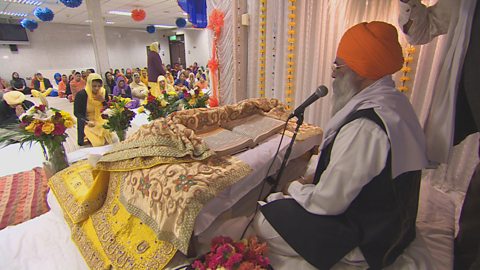
Taking Amrit. video
Two Sikh boys called Taren and Jovan join the Sikh Khalsa by taking part in the special Sikh ceremony, which is called taking Amrit.
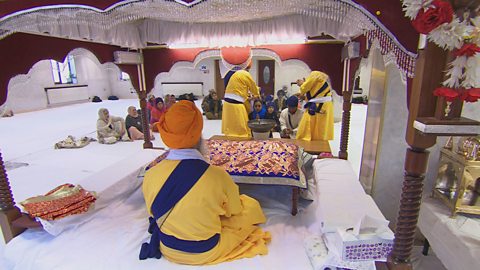
The Gurdwara. video
Simran, aged 11, describes the Sikh place of worship which is called the Gurdwara.
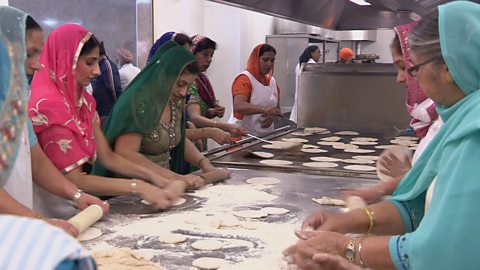
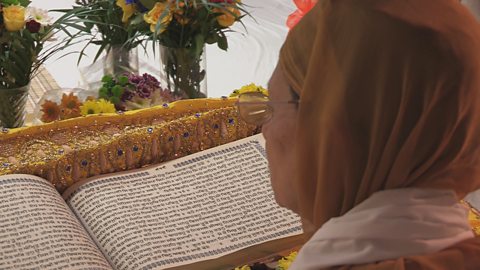
The Guru Granth Sahib. video
Simran, aged 11, explains the importance of the Sikh holy book, the Guru Granth Sahib.
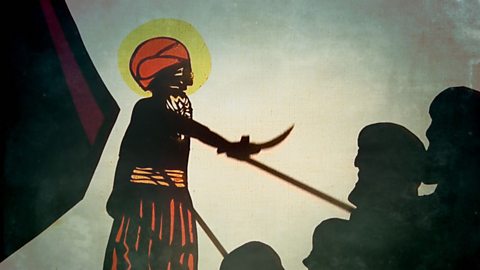
The Khalsa. video
Simran, aged 11, tells the story of the founding of the Sikh Khalsa 300 years ago.
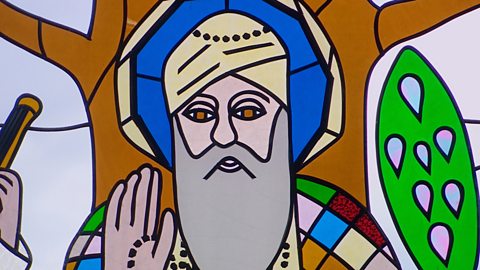
The Ten Gurus. video
Simran, aged 11, explains who the Ten Gurus are and why they are important to those who follow Sikhism.
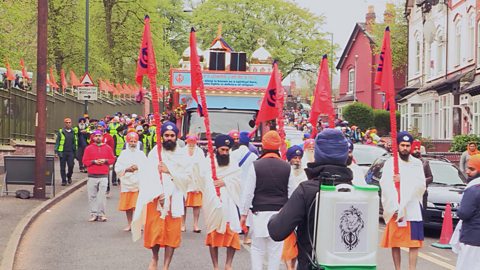
Vaisakhi. video
Simran, aged 11, takes us to the Vaisakhi celebrations and parade in her hometown of Birmingham.
Life as a young Sikh girl. video
A young British Sikh introduces herself, her family and some of the main beliefs of her religion.