SIMRAN: The gurdwarais where we come to worship. Gurdwara is a Punjabi word that means 'home of the guru' or 'the door that leads to the guru'. Everyone is welcome here. As soon you enter the gurdwara you should take your shoes off and put them on the shelf. Then you should wash your hands because your hands have been touching your shoes. You also need to cover your head with a scarf or something that can keep your hair neat. We cover our heads out of respect to the guru. It is the same rule for everyone even if you are famous. When the Prince of Wales went to a gurdwara in Pakistan he covered his head just like everyone else. The gurdwara is at the heart of the Sikh community. There are around 300 in the UK. This is the place we come to pray think about God hang out with our mates…
TARAN: Go go go go! Watch out!
SIMRAN: …and eat together. One of my favourite things about going to the gurdwara is the langar. The aim of langar is to feed people that aren't like… That don't have enough money or anything and when you eat your langar you should be sitting on the floor to show that even if you are rich or poor a man or a woman it breaks all like all those different barriers and you are all equal. It is cooked by volunteers. All the funding it's all done by voluntary funding. Everything is literally free. Some gurdwaras even bring langar to the streets serving food to people who need it. In the eyes of God we are all equal. So we serve the congregation as we would serve the guru. On a busy day there could be hundreds of people to feed. That is a lot of food to prepare.
SIMRAN'S MUM: It's busy today so we've offered to help out haven't we?
SIMRAN: I can't make them round! It's not like they do it!
MUM: Let the rolling pin do the work.
SIMRAN: Working in the kitchens shows sewa - selfless service to others. Sewa is something all Sikhs do as part of their religion.
When I do sewa or things to help others it makes me feel more relaxed more spiritual. By the end of it you just feel a bit more of a happier more content person.
How do I get them round? They won't go round.
A bit more practice I think is needed where Simran's concerned!
Video summary
Simran explains that the word ‘Gurdwara’ means the ‘home of the Guru’, or the ‘door to the Guru’.
She describes what happens at the Gurdware and the many symbols of respect they show when they are there. These include: taking off your shoes, washing your hands, covering your head, sitting down on the floor to eat, expressing equality through sharing food without taking notice of differences of gender, wealth, age or any other differences.
Simran explains that every Gurdwara has a kitchen - the famous ‘Langar’ - where anyone can eat; so long as they are willing to eat with everyone else. This helps to feed the poor and needy – and to challenge the wealthy and proud. Some Sikhs even take langar onto the streets as well to feed the homeless.
Simran has a go at helping to make food for everyone, but her skills are not perfect yet. Still, it is the intention that matters!
Teacher Notes
Guru Nanak taught that the mouth of a hungry person is the treasure chest of God. What do pupils think he meant?
Simran makes lots of connections between the kitchen and the scriptures. Ask your pupils to find two pictures, one of the langar and one of the dais where the Guru Granth Sahib is read. Get them to think about how these two are connected.
For Sikhs, the duty to serve others and the duty to remember God are linked in every way. Can pupils write some connections between the two pictures?
Here are some examples:
- (i) “Religion is about food for the body and food for the soul.”
- (ii) “If you believe God sees all humans equally, then you should try to see them in the same way.”
- (iii) “It is good to worship God by what you do as well as what you say.”
- (iv) “If God can be found in every other person, then feeding the poor is the same as serving God.
This topic will be relevant to teaching Religious Education at KS2 or KS3 in England, Wales and Northern Ireland and National 2 or 3 in Scotland.
What is Sikhism? video
Eleven-year-old Simran introduces the Sikh religion and describes the key beliefs and practices in following the Sikh way of life.
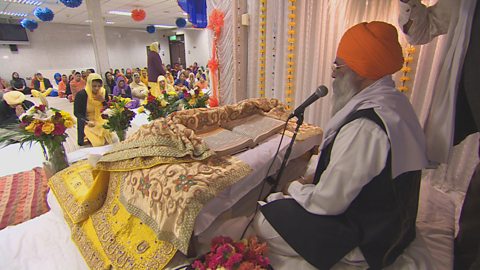
Taking Amrit. video
Two Sikh boys called Taren and Jovan join the Sikh Khalsa by taking part in the special Sikh ceremony, which is called taking Amrit.
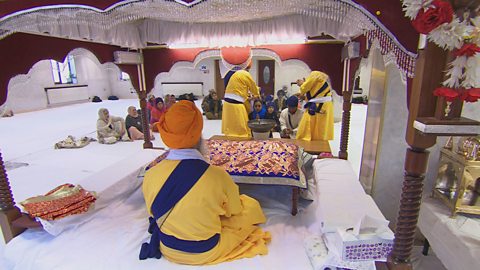
The Five Ks of Sikhism. video
Two Sikh boys called Taran and Joven explain the five Ks that they wear as members of the Sikh Khalsa.
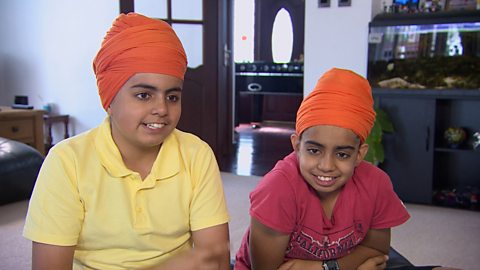
The Guru Granth Sahib. video
Simran, aged 11, explains the importance of the Sikh holy book, the Guru Granth Sahib.
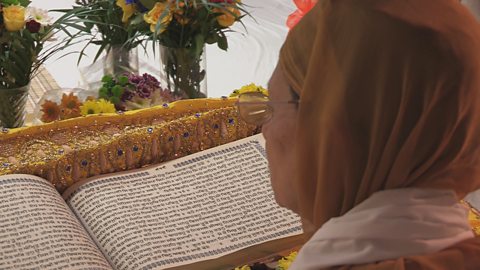
The Khalsa. video
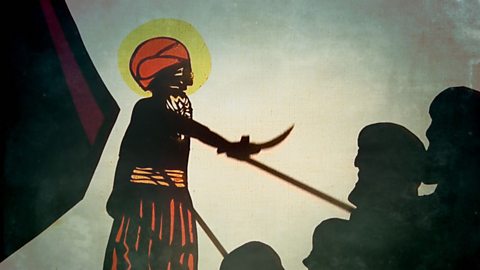
Simran, aged 11, tells the story of the founding of the Sikh Khalsa 300 years ago.
The Ten Gurus. video
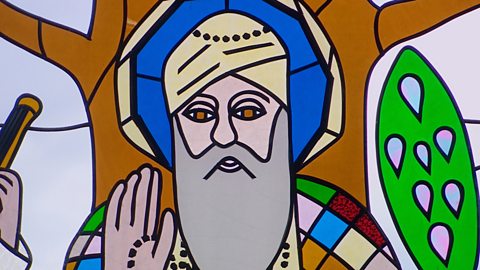
Simran, aged 11, explains who the Ten Gurus are and why they are important to those who follow Sikhism.
Vaisakhi. video
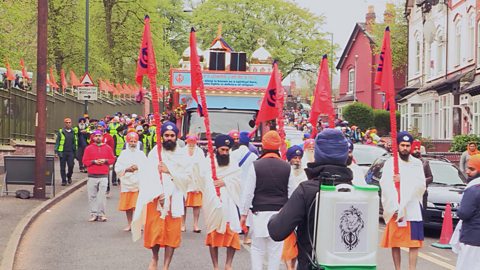
Simran, aged 11, takes us to the Vaisakhi celebrations and parade in her hometown of Birmingham.
Life as a young Sikh girl. video
A young British Sikh introduces herself, her family and some of the main beliefs of her religion.