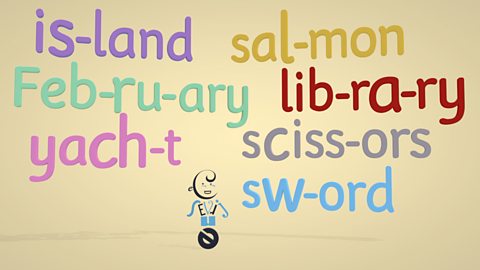
Letter Character:Learning the rules for adding suffixes can help you become better spellers.
So here’s a quick recap of the ‘Rules for adding the suffixes-ment and –ly’
VO:
Both –ment and -ly are suffixes that start with a consonant letter…
… and the Rule for consonant suffixes says that they can usually be added to a root word without the need to make any changes to that root word.
So that’s ‘good’ spelling news isn’t it? But there are exceptions to this rule that world class spellers need to know. Let’s start with the exceptions for –ment.
Exception 1 is for root words which have more than one syllable like mer/ry …
… and which end with a consonant followed by a y.
For root words like this the y is changed to an i before –ment is added.
Exception 2 is that you must always remember to drop the ‘e’ from the root word argue … there it goes
… before you add the suffix-ment.
That’s the way argue likes it! Remember that and you will always spell it just fine!
Well, that’s the exceptions for the suffix –ment. Time to move on to the exceptions for –ly.
There are four exceptions for
-ly so prick up your ears and I’ll tell you all about them.
Exception 1 is for root words which have more than one syllable like hap/py …
… and which end in a consonant followed by a y …
For root words like this the y is changed to an i before the suffix –ly is added.
Exception 2 is for when a root word ends in l e. When this happens the l and the e are removed completely to make way for the suffix –ly.
Exception 3 tells us that when adding –ly to the root words true, due and whole the e is removed before adding the -ly
…truly…
…duly …
…wholly.
Exception 4 is that if the root word ends with i, c; like the word music …
… then –ly can’t attach without some help.
-ly has to become –ally to attach to root words ending with i, c.
But, my friends, there is an exception to this exception!
For some mysterious reason the word public; which quite clearly ends in i, c, has always been happy to be spelt with –ly.
All the other words ending in i,c need –ly to become –ally. But not public! So I’d like you all to join me in publicly thanking public for being one of a kind.Bravo public - Bravo! Well done, jolly good!
It's explained that both suffixes 'ment' and 'ly' start with a consonant, which means they can usually be added to the root word without having to make any changes.
For example, adding the suffix 'ment' to 'place' gives us 'placement', with the root word remaining the same.
There are exceptions to this rule, such as, when adding the suffix 'ment' to root words that have more than one syllable and end in a consonant followed by a 'y', like 'merry', the 'y' is changed to an 'i', giving us 'merriment'.
Also, when adding the suffix 'ment' to 'argue', you must remove the 'e', giving us 'argument'.
The focus then turns to the suffix 'ly' and the four exceptions that have to be considered.
This short film is from the BBC series, Wonderful Words, a series of animated clips to support vocabulary knowledge.
Teacher Notes
This short film could be used to introduce a greater understanding of suffixes and how they are added to words.
Pupils could be given a passage of text and asked to add the correct suffix.
This short film is relevant to teaching English at KS2 level in England and Northern Ireland and Second Level in Scotland.
Suffixes - part 1 of 4 video
A fun, animated guide to the rules for adding the suffixes 'er', 'ing', 'ed', 'est' and 'y'.
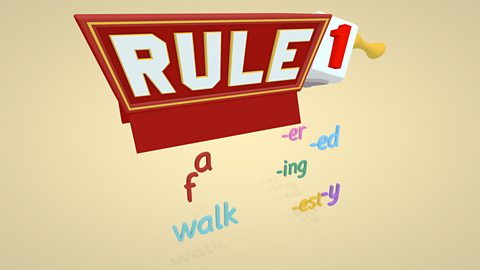
Suffixes - part 3 of 4. video
A fun, animated guide to the rules for adding the vowel suffix 'ation'.
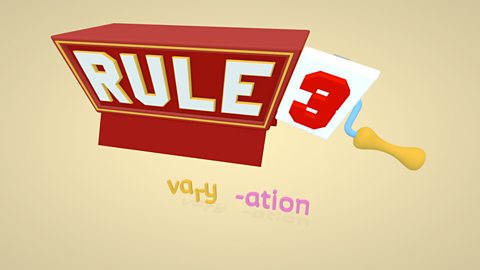
Suffixes - part 4 of 4. video
A fun, animated guide to the rules and exceptions for adding the vowel suffix 'ous' to root words.
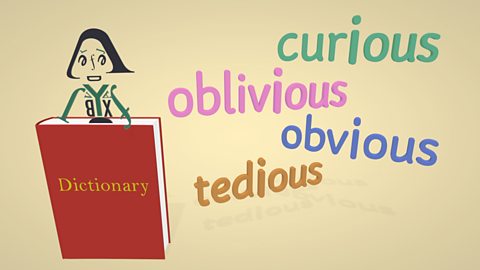
Prefixes. video
A fun, animated guide explaining how prefixes can usually be added to the beginning of words.
Homophones. video
A fun, animated guide explaining that homophones are two or more words that sound the same but have different meanings and often different spellings.
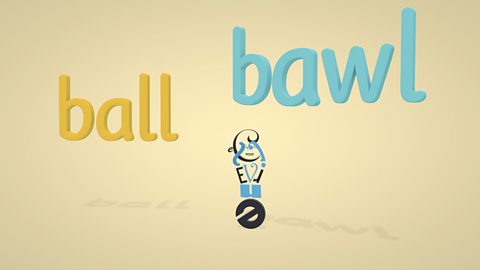
Homophone sentence show. video
A fun, animated introduction to homophones, which are similar sounding words that have different meanings and are often spelled differently.
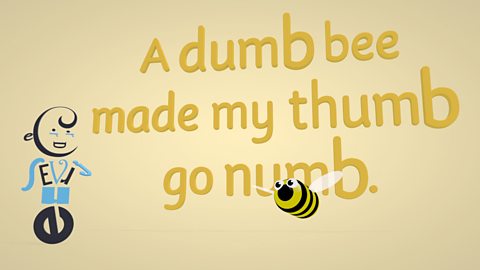
Silent letter b. video
A fun, animated guide explaining that silent letters are found in lots of English words.
Silent letters. video
An animated guide to words containing silent letters.