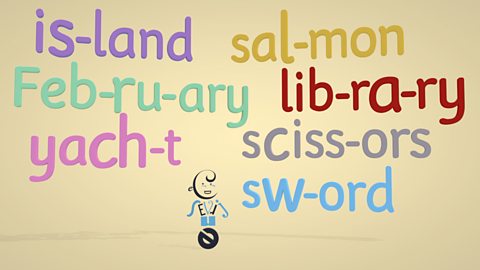
Letter Character:Learning the rules for adding suffixes can help you become better spellers.
So here’s a quick recap of the ‘Rules for adding the suffixes–er, -ing, -ed, -est and –y.’
VO:Rule 1 is that for any word that ends in two consonants you just add the suffix. Words like fast and walk each end with two consonants…
…so for these words and all the others like them the rule tells us just add the suffix!
Rule 2 helps us with words which end with a short vowel sound – a, e, i o, u followed by a consonant, such as the word hop.
The rule for these types of words is that we double the last letter before we add the suffix.
So, if you’ve a rabbit called Hoppy this rule helps you to remember that Hoppy is spelt with two p’s!
Rule number 3 is for words that end in a consonant followed by an e; like the word hope.
The rule for this kind of word is that the e must be removed before the suffix is added.
Finally rule 4 reminds us that if the word you’re working with…
…ends in a consonant followed by a y …
… then you change the y to an i before you add the suffixes.
LC: To avoid ending up with lots of double i’s in our new words it makes sense to have an exception to this rule and to just keep the y when adding –ing.
I’ve nothing against the odd double i myself and when a root word ends in an i; like ski, taxi and safari …
…I love seeing –ing just doing its thing!
doing its thing - i, i, i, i doing its thing …
Video summary
Rule 1 is to add the suffix to any word that ends in two consonants, which is demonstrated by adding the suffix 'er' to 'walk' giving us 'walker', and adding 'est' to 'fast' giving us 'fastest'.
Rule 2 explains how any words with a short vowel sound followed by a consonant, such as 'hop', should have the last letter doubled before adding the suffix. Shown by adding the suffix 'ing' to 'hop' and giving us 'hopping'.
Rule 3 concerns words that end in a consonant followed by an 'e', such as 'hope'. With these words the 'e' must be removed before adding the suffix, making 'hope' into 'hoped, and 'hoping'.
The final rule reminds us that if the word ends in a consonant followed by a 'y', then you change the 'y' into an 'i'. For example, adding the suffix 'er' to 'cry' gives us 'crier'. The exception to this rule is to avoid double 'i', when adding the suffix 'ing', keep using the 'y', so 'cry' becomes 'crying'.
This short film is from the BBC series, Wonderful Words, a series of animated clips to support vocabulary knowledge.
Teacher Notes
This short film could be used to introduce suffixes and how they are added to words.
Pupils could be given a passage of text and asked to add the correct suffix.
This short film is relevant to teaching English at KS2 level in England and Northern Ireland and Second Level in Scotland.
Suffixes - part 2 of 4 video
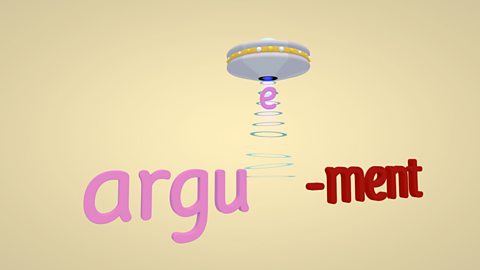
A fun, animated guide to the rules for adding the suffixes 'ment' and 'ly'.
Suffixes - part 3 of 4. video
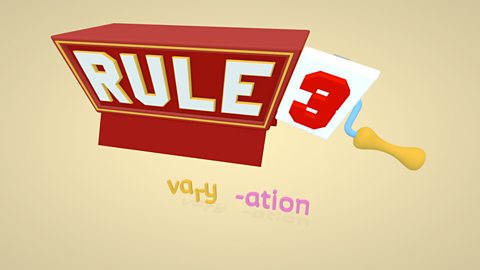
A fun, animated guide to the rules for adding the vowel suffix 'ation'.
Suffixes - part 4 of 4. video
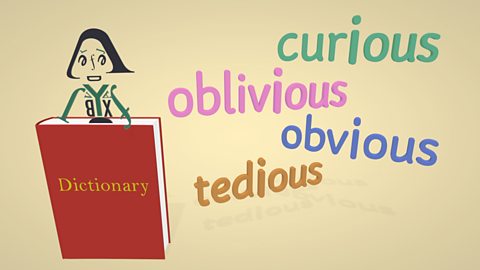
A fun, animated guide to the rules and exceptions for adding the vowel suffix 'ous' to root words.
Prefixes. video
A fun, animated guide explaining how prefixes can usually be added to the beginning of words.
Homophones. video
A fun, animated guide explaining that homophones are two or more words that sound the same but have different meanings and often different spellings.
Homophone sentence show. video
A fun, animated introduction to homophones, which are similar sounding words that have different meanings and are often spelled differently.
Silent letter b. video
A fun, animated guide explaining that silent letters are found in lots of English words.
Silent letters. video
An animated guide to words containing silent letters.