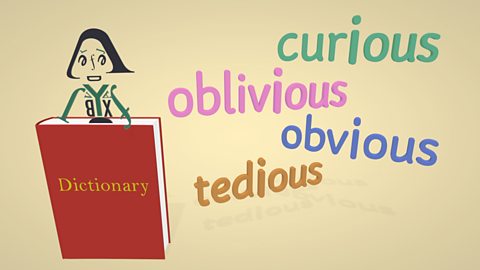
Letter Character:Learning how to add prefixes can help you become better spellers.
So here’s a quick reminder of the ‘Rules for adding the prefixes un-, dis-, mis- and in-‘
VO:These are prefixes; each with their own shape and sound …
Prefixesun-, dis-, mis-, in-
VO:…and ready to do what all prefixes do best.
When the right word comes along a prefix can attach to the beginning of the root word and change its meaning.
Adding the prefix un- to the root word popular has created a new word with a negative meaning.Just like un-, the prefixes dis- and mis- also have negative meanings.
Although adding un-, dis- and mis- to the root words changes their meaning, remember that the spelling of the root word never changes.
It’s a very simple process.
Like the others in- can have a negative meaning too
But of all these prefixes in- is the most interesting and remembering the three rules for how this prefix behaves when it’s attached to certain words can really help you get better at spelling.
The prefix in- can’t attach to the l of the word legal but…
… it has a superpower which allows it to change the n- into l-, r-, or m-. For example the n- of in- will change to an l- when attaching to words that start with l.
Knowing this rule helps us to remember why illegal is spelt with a double l. One l belongs to the prefix il- and the second l belongs to the root word legal. And because the spelling of the root word is never changed when the prefix is added - the double l is the correct spelling.
With words beginning with r the solution is just as easy.
The prefix in- cannot attach to the r of regular so it uses its superpower to change its n- into r-.
Knowing this rule helps us to remember why irregular is spelt with a double r. One r belongs to the prefix ir- …
…and the second r belongs to the root word regular. And because the spelling of the root word is never changed when the prefix is added - the double r is the correct spelling.
Finally for words beginning with p or m the prefix in- finds it impossible to attach to them.
So this time n- is changed into an m-
Knowing this rule helps us to remember why immature is spelt with a double m. One m belongs to the prefix im- and the second m belongs to the root word mature. And because the spelling of the root word is never changed when the prefix is added - the double m is the correct spelling.
LC:It’s worth remembering that it’s always easy to remove the prefix to rediscover the original root word.
Making the impossible; possible!
Video summary
A fun, animated guide explaining how prefixes can usually be added to the beginning of words without any changes to the spelling of the root word.
Examples are given of the prefixes 'un-', 'dis-' and 'mis-' being added to the beginning of different root words to create a new word with a negative meaning.
The different spelling rules that need to be remembered for adding the prefix 'in-' are demonstrated; explaining that the 'n-' can change into 'l', 'r' or 'm', depending on the initial letter of the root word.
Rule 1 explains that for words beginning with 'l', the prefix 'in' changes to 'il-'.
Rule 2 explains that for words beginning with 'r', the prefix 'in-' changes to 'ir-'.
Rule 3 explains that for words beginning with 'm' or 'p', the prefix 'in-' changes to 'im-'.
The rules are visually demonstrated to help pupils remember them.
This short film is from the BBC series, Wonderful Words, a series of animated clips to support vocabulary knowledge.
Teacher Notes
This short film could be used when introducing the spelling rules for adding the prefix 'in-' to root words.
It could be used in a lesson on opposites / antonyms to show how words with opposite meanings can be created by adding prefixes.
This short film is relevant to teaching English at KS2 level in England and Northern Ireland and Second Level in Scotland.
Homophones. video
A fun, animated guide explaining that homophones are two or more words that sound the same but have different meanings and often different spellings.
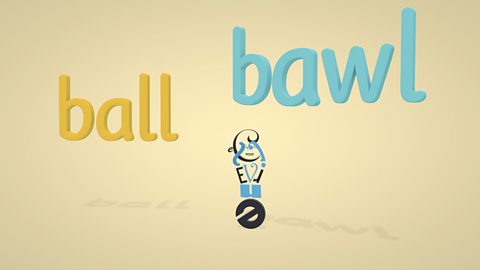
Homophone sentence show. video
A fun, animated introduction to homophones, which are similar sounding words that have different meanings and are often spelled differently.
Silent letter b. video
A fun, animated guide explaining that silent letters are found in lots of English words.
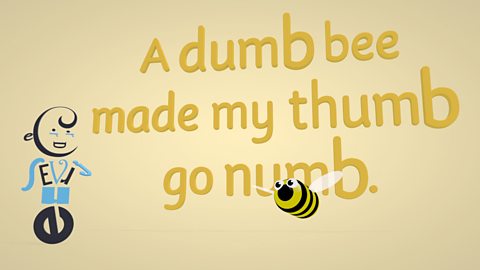
Silent letters. video
An animated guide to words containing silent letters.
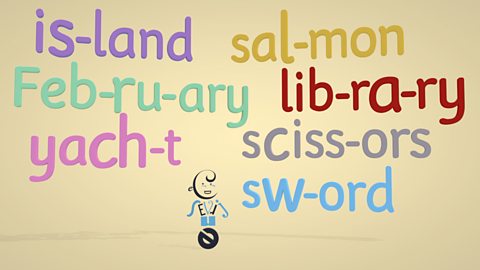
Suffixes - part 1 of 4 video
A fun, animated guide to the rules for adding the suffixes 'er', 'ing', 'ed', 'est' and 'y'.
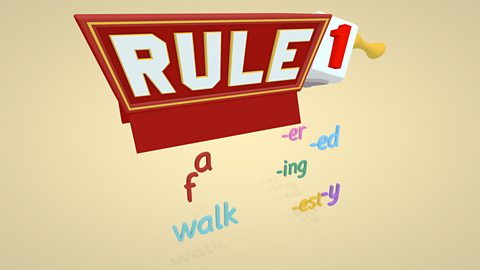
Suffixes - part 2 of 4 video
A fun, animated guide to the rules for adding the suffixes 'ment' and 'ly'.
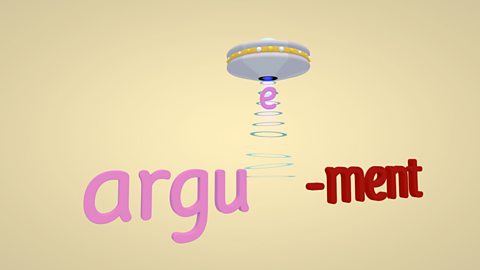
Suffixes - part 3 of 4. video
A fun, animated guide to the rules for adding the vowel suffix 'ation'.
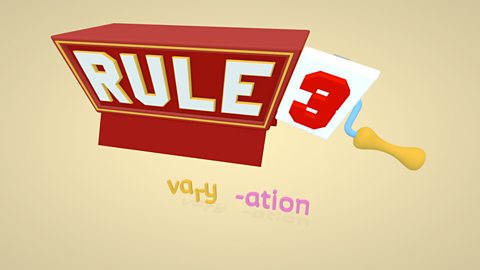
Suffixes - part 4 of 4. video
A fun, animated guide to the rules and exceptions for adding the vowel suffix 'ous' to root words.