Letter Character:
Learning the rules for adding suffixes can help you become better spellers. The good news is that the rules we use for adding the suffix –ation mostly work for the vowel suffix –ous as well.
So let’s run through the ‘Rules for adding the vowel suffix-ous.’
So when the root word ends in two consonants …
… you know Rule 1 tells us to just add the suffix.
And if you know rule 2 then you’ll know that when the root word ends in a consonant followed by an e…
… then e must be removed before the suffix is added.
And with Rule 3 in your head you’ll always know that when the root word ends in a consonant followed by a y …
… you must change the y to an i before adding the suffix.
However with –ous there are a couple of exceptions to the rules.
Exception 1 - is that if your root word ends in o,u,r; words like humour and odour; if they end like that …
… you must change that o, u, r, ending to o, r before you add the -ous suffix.
Exception 2 is that when adding –ous to root words like courage and advantage which end in the letters ge …
… you ignore the rule to remove the e when the ‘g’ keeps its ‘j’ sound.
And that’s the rules and exceptions for –ous! However, words that end in -ous are often tricky to spell because they don’t have clear root words. So it’s worth knowing that the /i/ sound you often hear before the suffix –ous, is occasionally spelt with an unexpected ‘e’. This happens in words like hideous which sounds like it should be spelt with an i but is actually spelt with an e. The same is true of courteous, simultaneous and spontaneous.
On the other hand: curious, oblivious, obvious and tedious …
…are all spelt just as they sound, with an i.
LC:
With words you don’t know the temptation is to spell out what you hear so keep your wits about you …
…and when in doubt - check it out!
Video summary
It is explained that the rules we use for adding the suffix 'ation' mostly work for the vowel suffix 'ous'.
However, there are a couple of exceptions, for example, when the root word ends in 'our', such as 'humour', then before adding the suffix you must change it to 'or', giving us 'humorous'.
The second exception tell us that with words that end in 'ge', you ignore the rule to remove the 'e' when the 'g' keeps it's 'j' sound.
This is demonstrated using the root word 'courage' which, when adding 'ous', becomes 'courageous'.
Finally, it is demonstrated how words that end in 'ous' are often tricky to spell because they don't have clear root words.
So it's worth knowing that the 'i' sound you often hear before the suffix 'ous', is occasionally spelt with an unexpected 'e', such as with hideous.
This short film is from the BBC series, Wonderful Words, a series of animated clips to support vocabulary knowledge.
Teacher Notes
This short film could be used to focus on the suffix 'ous' and how it is added to words.
Pupils could write a short story that includes a variety of 'ous' suffixes, or be asked to take a passage of text and add the correct suffix to the root words.
This short film is relevant to teaching English at KS2 level in England and Northern Ireland and Second Level in Scotland.
Suffixes - part 1 of 4 video
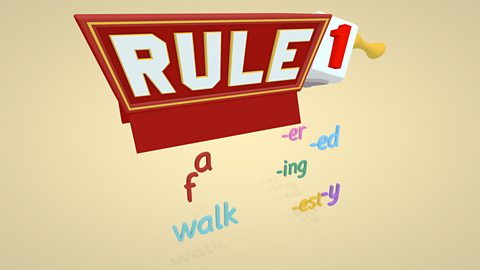
A fun, animated guide to the rules for adding the suffixes 'er', 'ing', 'ed', 'est' and 'y'.
Suffixes - part 2 of 4 video
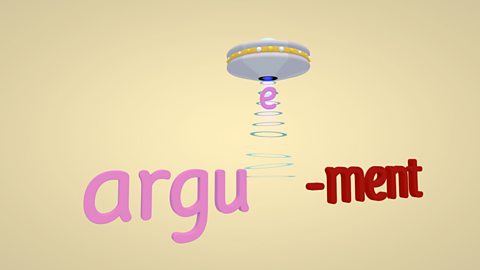
A fun, animated guide to the rules for adding the suffixes 'ment' and 'ly'.
Suffixes - part 3 of 4. video
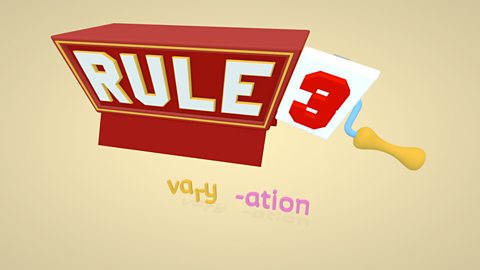
A fun, animated guide to the rules for adding the vowel suffix 'ation'.
Prefixes. video
A fun, animated guide explaining how prefixes can usually be added to the beginning of words.
Homophones. video
A fun, animated guide explaining that homophones are two or more words that sound the same but have different meanings and often different spellings.
Homophone sentence show. video
A fun, animated introduction to homophones, which are similar sounding words that have different meanings and are often spelled differently.
Silent letter b. video
A fun, animated guide explaining that silent letters are found in lots of English words.
Silent letters. video
An animated guide to words containing silent letters.