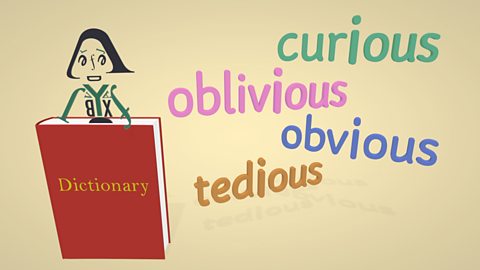
Letter Character:Silent letters are found in lots of English words and because you can’t hear them when you say the word it makes spelling these words really tricky.
To remember the silent n in the words solemn, autumn, column and hymn I remind myself that:
a solemn occasion is full of solemnity;
that an autumn day is full of autumnal colours;
a newspaper column is written by a columnist
and that a hymn is sung from a hymnal
LC:And here’s a crazy sentence to help you remember some tricky silent ts…
After tea listen for the whistle before you fasten up the castle and at bedtime use the bristle of a thistle to wrestle out the gristle and glisten up your teeth.
LC:Which brings me to my final spelling tip for remembering silent letters.
All of these words have tricky silent letters in their spelling so why not try making a big deal about pronouncing the silent letters and see if that helps you to spell them. Here we go …
Is-land; Sal-mon; Feb-ru-ary; Lib-ra-ry; Yach-t; Sciss-ors; Sw-ord.
LC:It’s odd to begin with but after a while you’ll get the hang of it. You can even try pronouncing the silent letters when you’re chatting with each other. It’s like speaking a “fore-i-gn lan-g-u-age” See how you get on, By-e!
A fun, animated guide to a variety of words with silent letters, with inventive strategies for remembering them.
The guide takes a look at; the silent 'n' in solemn, autumn, column and hymn; the silent 't' in listen, whistle, fasten, castle, thistle, wrestle, gristle, glisten; and others including island, salmon, February and sword.
The words in the final set are pronounced as they are written to give children a strategy to help remember how to spell them.
This short film is from the BBC series, Wonderful Words, a series of animated clips to support vocabulary knowledge.
Teacher Notes
This short film could be used in teaching about the silent letters in words to reinforce spellings containing silent letters.
Pupils could could listen to a passage of text read out and asked to spot the words with silent letters.
This could also be used to help develop techniques for remembering words with silent letters.
This short film is relevant to teaching English at KS2 level in England and Northern Ireland and Second Level in Scotland.
Prefixes. video
A fun, animated guide explaining how prefixes can usually be added to the beginning of words.
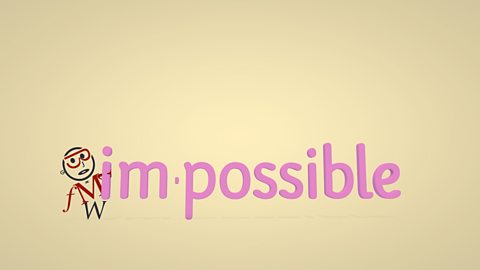
Homophones. video
A fun, animated guide explaining that homophones are two or more words that sound the same but have different meanings and often different spellings.
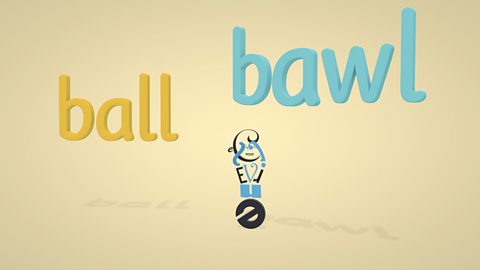
Homophone sentence show. video
A fun, animated introduction to homophones, which are similar sounding words that have different meanings and are often spelled differently.
Silent letter b. video
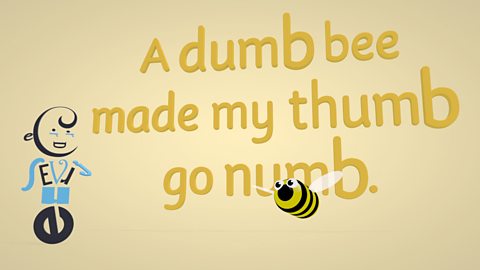
A fun, animated guide explaining that silent letters are found in lots of English words.
Suffixes - part 1 of 4 video
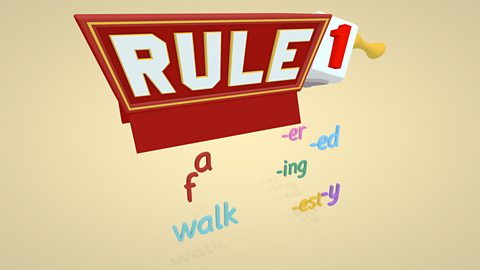
A fun, animated guide to the rules for adding the suffixes 'er', 'ing', 'ed', 'est' and 'y'.
Suffixes - part 2 of 4 video
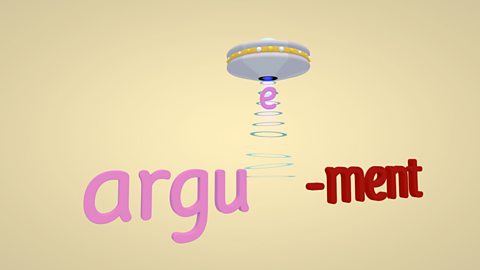
A fun, animated guide to the rules for adding the suffixes 'ment' and 'ly'.
Suffixes - part 3 of 4. video
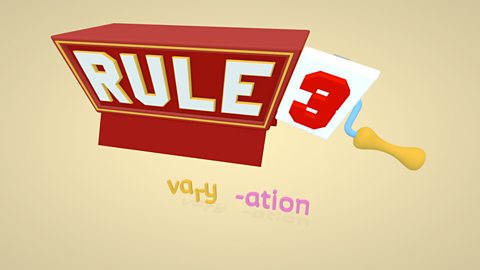
A fun, animated guide to the rules for adding the vowel suffix 'ation'.
Suffixes - part 4 of 4. video
A fun, animated guide to the rules and exceptions for adding the vowel suffix 'ous' to root words.