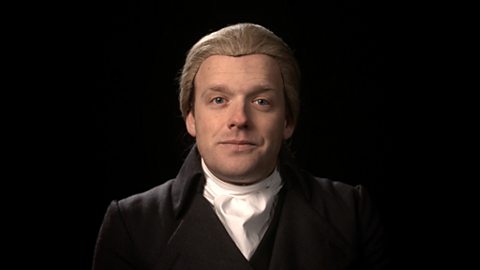
ELIZABETH FRY:I'm going to tell you something about my life.
ELIZABETH FRY:My name is Elizabeth Fry.
ELIZABETH FRY:I was born in 1780, in Norfolk.
ELIZABETH FRY:I will begin the story I will tell you when I was just a child, so you can see where I started from, and what I became.
ELIZABETH FRY:'We were a large family. I had six brothers and sisters, but I always seemed to be the odd one out.
ELIZABETH FRY:'While were siblings all played together, and were loud, and ran around the house, I always felt like I couldn't keep up and I couldn't fit in.
ELIZABETH FRY:'We lived in a big, old house,
ELIZABETH FRY:'and I was afraid of the dark, and sometimes my brothers and sisters would tease me, and make me go into its dark corners, knowing I'd be scared.
ELIZABETH FRY:'My fear of the dark was even worse at night.
ELIZABETH FRY:'We only had candlelight then, and I'd lie awake watching it burn down, dreading the moment it would go out.
ELIZABETH FRY:'Nearly every night, I dreamt the sea was coming to wash me away.
ELIZABETH FRY:'I grew up, but still it was the same. Still I stared at the candle till it went out, and woke from dreams that the sea was coming to wash me away.
ELIZABETH FRY:'I was a timid person, afraid to join in.
ELIZABETH FRY:'I was never quite sure who I was, or what I was supposed to do with my life.
ELIZABETH FRY:'My family were Quakers, a religion that taught us we should do what we could to help the poor.
ELIZABETH FRY:'We had plenty of money, and I felt uneasy about the comfortable life we lived, whilst others around us struggled to get by.
ELIZABETH FRY:'I tried to help. I collected clothes for them, or gave them money or food.
ELIZABETH FRY:'But I knew that handing out apples or pennies wasn't nearly enough.
ELIZABETH FRY:'One Sunday we went to the meeting house like we always did.
ELIZABETH FRY:'At Quaker meetings, there would be no priest or vicar to lead the service, and mostly we would just sit together in silent prayer.
ELIZABETH FRY:'Anyone was free to speak if they felt moved to do so.
ELIZABETH FRY:'A man called William Savery, a Quaker from America, had come to sit with us. When he stood to speak, everyone listened.
ELIZABETH FRY:'Suddenly, something he said made me listen, really listen, like it had woken me up.
WILLIAM:I say again, take the life you have been given and do good with it.
ELIZABETH FRY:'I never knew that one man's words could change your life.'
ELIZABETH FRY:I can't explain what happened.
ELIZABETH FRY:It was like a great weight was lifted from me.
ELIZABETH FRY:I felt light as a feather, light inside.
ELIZABETH FRY:It was like I'd spent all my life up to this point underwater, and finally I'd swum up to the surface and could breathe.
ELIZABETH FRY:And in that moment, what you might call my epiphany, I saw what it was I had to do.
ELIZABETH FRY:I'd always wanted to do good, but I saw for the first time that it should be my sole purpose.
ELIZABETH FRY:And rather than waiting for something to happen, like I had done all these years, I had to act. It was up to me.
ELIZABETH FRY:'I'd heard about Newgate prison.
ELIZABETH FRY:'That it was one of the darkest and most awful places you could imagine.
ELIZABETH FRY:'I felt compelled to visit it and see the terrible conditions for myself.
ELIZABETH FRY:'It was the largest prison in London, and full to the rafters with both the worst kind of criminals, and with people who were put there for the smallest crimes.
ELIZABETH FRY:'It had a reputation for being a terrible place for a person to end up.
ELIZABETH FRY:'Even the building itself had been designed to instil fear in all those who looked upon it.
ELIZABETH FRY:'People tried to put me off, saying it was no place for a lady like me.
ELIZABETH FRY:'But I needed to see it for myself.
ELIZABETH FRY:'To think, I had been afraid to lie down in my own bed at night, and here was I, about to walk down the long, dark corridors of Newgate.
ELIZABETH FRY:'But I was no longer afraid.
ELIZABETH FRY:'I would never fear the dark again. All the fear had gone out of me, and I was focused only on the work that I would do.
ELIZABETH FRY:'What a place it was. All heavy gates and thick walls without windows.
ELIZABETH FRY:'It was a wonder any soul who dwelled in it could breathe at all.
ELIZABETH FRY:'When I saw the conditions the prisoners were kept in, I was appalled.
ELIZABETH FRY:'Treated worse than animals, they were all herded together in one room.
ELIZABETH FRY:'They had no privacy, just a bucket. And nowhere to wash themselves or clean their clothes.
ELIZABETH FRY:'There were women too, amongst the men. Most of them there for petty crimes like stealing clothes or loaves of bread.
ELIZABETH FRY:'But the worst sight of all was the sight of their poor children. Innocent of any crime. Forced to suffer just the same.
ELIZABETH FRY:'I hurried away, knowing that I had found my purpose.
ELIZABETH FRY:'There was so much work to be done.'
ELIZABETH FRY:'The people I had seen at Newgate prison, especially the children,
ELIZABETH FRY:'were like forgotten souls.
ELIZABETH FRY:'Like little ships lost at sea.
ELIZABETH FRY:'I would make it my job to light a way back to shore, to show them all was not lost.
ELIZABETH FRY:'First, I would see to it they got the most basic things.
ELIZABETH FRY:'I gathered friends together and we sewed clothes for the children.
ELIZABETH FRY:'The very next day, I returned to Newgate prison.
ELIZABETH FRY:'I'd brought the clothes we'd made, and fresh bread, which they ate like they'd not seen bread before.
ELIZABETH FRY:'But what I really wanted was to do something for the children.
ELIZABETH FRY:'I picked up a boy who could not have been more than four years old.
ELIZABETH FRY:'I made them listen.
ELIZABETH FRY:'I said, should we not do something for these children who are innocent of any crime.
ELIZABETH FRY:'Should the children have a chance, even if their mothers did not?
ELIZABETH FRY:'I said, we could give them that chance.
ELIZABETH FRY:'A chance of a future beyond Newgate's walls, and to give them that chance, we should give them schooling.
ELIZABETH FRY:'I said I would teach them myself, and they agreed.
ELIZABETH FRY:'I had benches brought in, and books. Soon I had them all lined up and listening as I read aloud.
ELIZABETH FRY:'But the children weren't the only ones listening.
ELIZABETH FRY:'All the better, I thought, if the women too had the desire to learn. I suspect most had never had the chance before.
ELIZABETH FRY:'I decided I would teach them too, that they might find work on leaving prison, and not need to resort to petty crime again.
ELIZABETH FRY:'The schooling was a great success. Word got around, apparently the prisoners had never been so quiet, so orderly, so willing to get on.
ELIZABETH FRY:'When the Mayor of London himself came to see what we were doing I knew then that everyone was listening, and that this was just the beginning.
ELIZABETH FRY:'With his approval, there would be even more we could achieve.'
ELIZABETH FRY:What had started with the words of the preacher William Savery,
ELIZABETH FRY:had become my whole life. My entire purpose.
ELIZABETH FRY:All my fear had gone.
ELIZABETH FRY:I knew at last exactly who I was.
ELIZABETH FRY:I took the life I had been given, and did good with it.
ELIZABETH FRY:The work I did went on to change every prison in the country.
ELIZABETH FRY:And the poor who ended up there would no longer be forgotten.
ELIZABETH FRY:Instead, they would be given the chance of a better life.
ELIZABETH FRY:And next time you've got a £5 note in your hand have a proper look at it. It's my face you'll see looking back at you.
Video summary
This short film is for teachers and review is recommended before use in class.
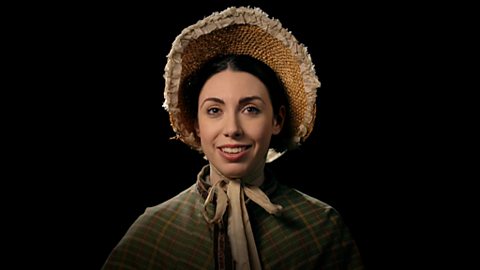
Elizabeth Fry tells the story of her life and how she reformed Newgate prison.
It is told in the first person, and brought to life with a mix of drama, movement, music and animation.
We see the moment she attended a Quaker meeting and heard the words of preacher William Savery, urging the congregation to do good with their lives.
Determined to do good herself, she visited Newgate Prison and, appalled by the conditions there, set out to change things.
She taught the children and sewed their clothes for them.
Elizabeth's actions led to the reform of the prison system across the country.
This clip is from the series True Stories.
Teacher Notes
Questions to consider whilst watching the film
Depending on the focus of your lesson, you may wish to ask the following questions after the video or pause the short film at certain points to check for understanding.
- How would you describe Elizabeth Fry as a child?
- The Fry family were Quakers. How did that influence the actions of Elizabeth?
- Why was hearing William Savery a turning point in Fry’s life?
- Why did Newgate Prison have such as bad reputation at the time?
- Elizabeth Fry was appalled by the conditions the prisoners were kept in. Why was that?
- Why do you think children were in the prison if they were innocent of any crime?
- What did Elizabeth Fry do to help the prisoners?
- Why was Elizabeth Fry’s school in the prison such a success?
Learning activities to explore after the video
History is a subject which can lend itself to a wide range of cross-curricular links. As a teacher, you will have a greater awareness of how this topic may act as stimulus for learning in other subjects. However, the suggestions below relate to ways of developing the children’s historical knowledge and understanding.
Key Question: Why is Elizabeth Fry still remembered today?
SignificanceThere have only ever been three women to feature on the back of Britain’s banknotes since 1975 and Elizabeth Fry is one of them. The Bank of England Museum website has details of her and the other two women. This could be a starting point for considering why Elizabeth Fry is historically significant. The teachers' notes on this Florence Nightingale BBC Teach video provide some guidance for teaching historical significance in the classroom.
This video could be a useful source too, though it focuses on her work at a single prison - Newgate, yet she also influenced prison reform across the country. This BBC Bitesize guide shows how people like Fry and others led to the passing of the 1823 Gaols Act; although this is designed for GCSE students, the text can be understood by KS2 pupils.
When studying Elizabeth Fry, it is possible to explore the importance of her faith, which is a key feature of this film. She is one of the most notable Quakers and this Quaker website has a lesson plan on her, which has clear links to Religious Education. The website makes reference to this famous engraving of Fry reading to the prisoners at Newgate Prison as well as this article on The Angel of Newgate; the latter may be useful for teachers but is not a source for use in the classroom.
The story of Elizabeth Fry could be used as stimulus to explore 19th century crime and punishment more generally. BBC Teach has a series of four videos containing the stories of young 'Victorian villains' and these cover different aspects of the topic. Even if you do not use the films, each one has teacher notes and any one of these could be used as a follow up to this film. Each story of a real child criminal is used as a springboard to explore a key question relating to Victorian crime and punishment and the teacher could choose any one of these enquiry questions:
- Life in a Victorian Industrial School: What were the attitudes of Victorians towards crime?
- Life at a Victorian Reformatory School: What were the differing attitudes to boy and girl criminals?
- How photography changed everything for young Victorian offenders: What can we learn from the records of Victorian child criminals?
- Life in prison for young Victorian offenders: Do you agree with the view that all Victorian punishments were pointless, painful and cruel?
Learning aims or objectives
England
From the history national curriculum
Pupils should:
- understand historical concepts such as …significance.
- understand the methods of historical enquiry, including how evidence is used rigorously to make historical claims.
Northern Ireland
Links can be made with the other learning areas:
- by researching and expressing opinions and ideas about people and places in the world around us, past, present and future.
Scotland
From the Experiences and Outcomes for planning learning, teaching and assessment ofSecond Level Social Studies:
- I can use primary and secondary sources selectively to research events in the past.
- I can discuss why people and events from a particular time in the past were important, placing them within a historical sequence.
Wales
From the new Humanities Area of Learning and Experience
School curriculum design for History should:
- develop rich content across the time periods, through which learners can develop an understanding of chronology through exploring … change and continuity.
Principles of progression
Descriptions of learning for Progression Step 2
Enquiry, exploration and investigation inspire curiosity about the world, its past, present and future:
- I can collect and record information and data from given sources. I can then sort and group my findings using different criteria.
Grace Darling. video
Grace Darling describes the night she and her father rowed out in a boat to save sailors.
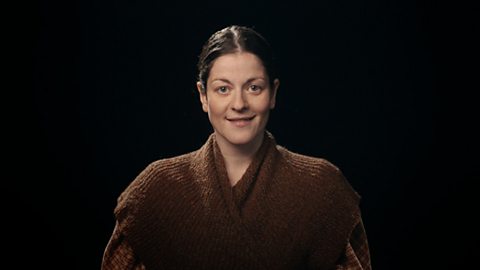
Rosa Parks. video
How Rosa Parks refusing to give up her seat changed the rules of American society.
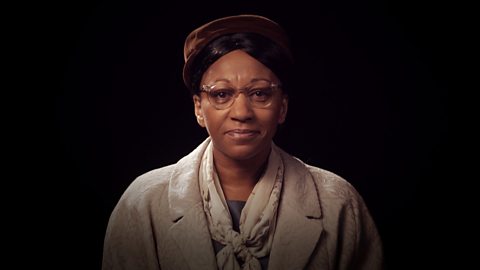
Thomas Barnardo. video
Thomas Barnardo tells the story of setting up his first home for London's street children.
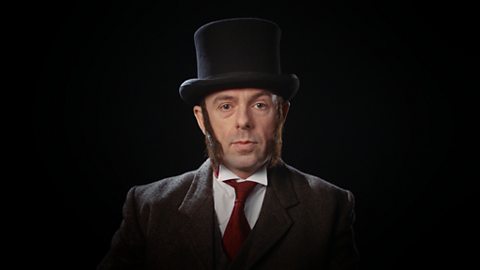
Alexander Graham Bell. video
Alexander Graham Bell tells the story of his life and describes how he invented the telephone.
Florence Nightingale. video
Florence Nightingale tells the story of her life and how she grew up to become a nurse.
Harriet Tubman. video
Harriet Tubman explains how she escaped slavery and then helped others to do so.
Isambard Kingdom Brunel. video
Isambard Kingdom Brunel shares how he became an engineer and tunnelled through Box Hill.
Mary Anning. video
Mary Anning describes how her astonishing fossil finds changed scientific thinking.
Edward Jenner. video
Edward Jenner tells the story of his life and the vaccination against smallpox.