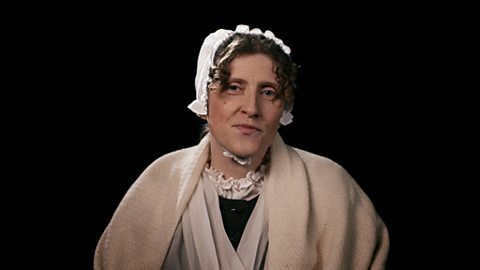
GRACE DARLING:I'm going to tell you something about my life.
GRACE DARLING:My name is Grace Darling.
GRACE DARLING:I was born in the year 1815, in Northumberland.
GRACE DARLING:I would have had a very ordinary life, were it not for something that happened one stormy night.
GRACE DARLING:The story of that night is the story I shall tell.
GRACE DARLING:'The first thing you should know is that my father was a lighthouse keeper. and when I was growing up, the lighthouse was my home.
GRACE DARLING:'It was my father's job to light the lantern at the top of the lighthouse every night so that sailors out to sea would see it, and steer their ships clear of dangerous rocks. Their lives depended on it.
GRACE DARLING:'Lighthouses were built round and tall, so they could stand up against the storms which would whirl around us rather often.
GRACE DARLING:'There was just one room on each floor with a spiral staircase running round the edge from one floor to the next.
GRACE DARLING:'My bedroom had round walls without corners and I loved it.
GRACE DARLING:'When we visited relatives on the mainland, their square rooms never felt quite right.
GRACE DARLING:'I loved the sea. I spent a lot of time looking at it and thinking of the sailors out there somewhere, looking back at the lighthouse.
GRACE DARLING:'And that's how I grew up.
GRACE DARLING:'In our little world of round rooms and routines.
GRACE DARLING:'The sea was a constant companion.
GRACE DARLING:'I learnt to read it like a book.
GRACE DARLING:'I spent so much time looking at it I knew what weather was coming.
GRACE DARLING:'Whether there was a warm breeze on its way and, with it, birds from Africa, or whether a storm was brewing and I needed to lash our rowing boat down extra tight.
GRACE DARLING:'One evening as we sat down to supper, I knew a storm was on its way.
GRACE DARLING:'What I didn't know was quite what a ferocious storm it would turn out to be.
GRACE DARLING:'We sat round the table with the sound of the storm gathering strength all around us.
GRACE DARLING:'We took turns to keep a look out for ships all through the night.
GRACE DARLING:'At five o' clock, my watch was nearly over, and I was about to go and wake Father to take his turn when something told me to take one more look.
GRACE DARLING:'It was then that I saw it.
GRACE DARLING:'It was a ship that must have struck the rocks.
GRACE DARLING:'From what I could see in the flash of light from the lightning, it looked like it had split in two.
GRACE DARLING:'I looked hard for any sign of survivors. The waves were like mountains, and it was hard to see anything at all. But then I saw something.
GRACE DARLING:'I waited for the next wave to pass and then I was sure. There were people in the water.
GRACE DARLING:'I ran to fetch Father.
GRACE DARLING:'He could see them too.
GRACE DARLING:'I knew if we didn't take our tiny boat and try and rescue them, that they wouldn't survive for long in the icy sea.
GRACE DARLING:'I knew we had to try.
GRACE DARLING:'The sea was more vast and more wild than I'd ever seen it. But still, I was not afraid.
GRACE DARLING:'Mother came, and she said there was little hope for them in such a dreadful storm.
GRACE DARLING:'She didn't want us to go, but I couldn't just watch from the window when we had a chance to save their lives.
GRACE DARLING:'It must have been hard for her to watch us leave, and even harder to wait and hope for our safe return.
GRACE DARLING:'Once we were in the boat, I knew we were doing the right thing.
GRACE DARLING:'As I rowed, I tried to think only of the people in the water, and how we were their only hope.
GRACE DARLING:'Not of how cold my hands were, how the rain stung my cheeks, and how every wave seemed bigger than the last.
GRACE DARLING:'We were a tiny boat in an enormous raging sea.
GRACE DARLING:'Father looked out for signs of the survivors.
GRACE DARLING:'At last, we spotted someone a short way from the boat.
GRACE DARLING:'I pulled harder still to reach him.
GRACE DARLING:'Father had the haul the poor soul over the side and into the boat, whilst I tried my best to keep us steady.
GRACE DARLING:'The waves were coming over the sides. At any moment, one big wave could swamp us, and we'd all be drowned for sure.
GRACE DARLING:'But still we kept on. And still I was not afraid.
GRACE DARLING:'There were more people in the water. I rowed harder still to reach them.
GRACE DARLING:'Father pulled as many as he could into the boat, till our tiny boat could carry no more.
GRACE DARLING:'I rowed us back towards the light of the lighthouse, as hard as the strength left in my arms would allow.'
GRACE DARLING:I don't know how many drowned in that terrible storm, but we had saved nine souls who would otherwise have surely perished.
GRACE DARLING:I suppose I had been brave. Only when we returned did I feel the full weight of what we had done.
GRACE DARLING:I had not been afraid. But the sea so vast and wild, could so easily have taken us. I knew then that we were lucky to have made it back to shore.
GRACE DARLING:'I was so glad of the breaking dawn and a lull in the storm as we crossed the rocks.
GRACE DARLING:'The rocks felt so solid beneath my feet, they felt like home itself.
GRACE DARLING:'Mother was waiting for us with blankets.
GRACE DARLING:'She said she knew we would return, but I was so relieved to be back in that little round room.
GRACE DARLING:'Mother had made hot soup to warm us.
GRACE DARLING:'Then, exhausted, they slept where they could.
GRACE DARLING:'I looked at them lying there, and I felt grateful.
GRACE DARLING:'Grateful that I had found the bravery inside me to row out into that storm.
GRACE DARLING:'And grateful that the sea had chosen to deliver us safely back.
GRACE DARLING:'The next morning, the storm had passed. And we could send them on their way.
GRACE DARLING:'Saying goodbye, I felt like my life, in some way, would always be connected to theirs.'
GRACE DARLING:But my story doesn't end there.
GRACE DARLING:What happened next was the strangest thing.
GRACE DARLING:Somehow, news of our rescue spread.
GRACE DARLING:People from newspapers came all the way out to the lighthouse to see me.
GRACE DARLING:Painters came to paint my portrait.
GRACE DARLING:Maybe because it was a girl that rode out in that storm, it made a good story?
GRACE DARLING:Maybe I had been brave.
GRACE DARLING:But I had lived such an ordinary life of round rooms and routines that I didn't know what to make of all the fuss.
GRACE DARLING:People wrote me letters.
GRACE DARLING:Some sent gifts.
GRACE DARLING:But of all the gifts, the one I treasured, the one most precious of all, is this.
GRACE DARLING:This locket.
GRACE DARLING:Inside it are nine hairs, one from each of the people whose lives I helped to save.
Video summary
This short film is for teachers and review is recommended before use in class.
Grace Darling tells the story of her life, and describes the night she and her father rowed out in their tiny boat to save nine sailors.
Told in the first person, and brought to life with a mix of drama, movement, music and animation.
We see Grace growing up in the lighthouse, and the night the storm breaks.
Grace spots people in the waves and, determined to try and save them, rows out into the storm with her father to try to rescue them.
By the time they returned to the lighthouse, they had saved nine souls who would otherwise have perished.
It was an extraordinary act of bravery that made Grace famous.
This clips is from the series True Stories.
Teacher Notes
Before watching the film
The Darlings were the keepers of Longstone lighthouse in the Farne Islands and the rescue took place on 7 September 1838. The nine survivors came from the wrecked ship SS Forfarshire. Tragically, Grace Darling died of consumption (tuberculosis) just four years after this event at the age of 26.
Questions to consider whilst watching the film
Depending on the focus of your lesson, you may wish to ask the following questions after the video or pause the short film at certain points to check for understanding.
- How does Grace Darling describe her childhood growing up in a lighthouse? What would have been the good things about living in a lighthouse, and what not so good?
- What do we learn from this film about the key event for which Grace Darling became famous?
- Why do you think Grace Darling says she was ‘not afraid’
- After rescuing the people from the storm, Grace says that 'perhaps she was brave.' Do the pupils think she was brave?
- There were two Darlings who rescued the nine people. Why do you think it is Grace, and not her father, who became famous?
- Did she deserve all the attention from newspapers and painters?
Learning activities to explore after the video
History is a subject which can lend itself to a wide range of cross-curricular links. As a teacher, you will have a greater awareness of how this topic may act as stimulus for learning in other subjects. However, the suggestions below relate to ways of developing the children’s historical knowledge and understanding.
Key Question: Why do we still remember Grace Darling today?
SignificanceThe remarkable story of Grace Darling is still remembered to the present day as can be seen in this BBC News article and so this provides another opportunity for the children to explore historical significance. These teachers notes on Florence Nightingale provide some guidance for teaching historical significance in the classroom and the criteria for assessing the significance of an individual, which are:
- Relevance: why the achievements of the person are still relevant today.
- Remembered: why the name of the person is still known today.
- Durability: the effects of the life of the person have lasted well beyond the time they were alive.
- Quantity: how many lives have been affected by this person.
However, the story of Grace Darling provides a different challenge. Whereas many of these criteria could be used to assess Florence Nightingale or Elizabeth Fry, some (e.g. durability and quantity) are not so applicable to Grace Darling. She was clearly famous at the time and the pupils will be explaining why that was the case. However, the concept of significance goes beyond contemporary fame and that is why the wording of the key question is crucial: Why do we still remember Grace Darling today?
The story of Grace Darling has inspired a range of classroom resources for primary teachers. As to which you use will depend on the time available for further study and the key learning objective. If it is just one lesson, then this video is at the heart of this lesson, though the activity will develop the pupils’ artistic skills more than their historical skills.
The Historical Association has a three lesson scheme of work on Grace Darling. The lessons do not focus on significance as the main aim is to encourage the pupils to interrogate sources critically. These include the famous painting by Henry Perlee Parker, which is the top image in the BBC News article and sources in the collection of the Grace Darling Museum. The website has a virtual tour of the museum and a factsheet with a range of material which could be used in the classroom.
The RNLI has a six lesson resource pack and this explores in much more detail her early life in the lighthouse and her rescue of the passengers of the Forfarshire. The fifth lesson explores explicitly the question: Why do we remember Grace Darling? Although it states the pack is aimed at Key Stage One, the resources and some of the activities are suitable for KS2 pupils.
Learning aims or objectives
England
From the history national curriculumPupils should:
- understand historical concepts such as …significance.
- understand the methods of historical enquiry, including how evidence is used rigorously to make historical claims.
Northern Ireland
From the statutory requirements for Key Stage 2: The World Around Us
Pupils should be enabled to explore:
- Change over time: The life of a famous person, family or building in the past.
To provide a balance of experiences in History pupils could study:
- effects of historical events.
Scotland
From the Experiences and Outcomes for planning learning, teaching and assessment ofSecond Level Social Studies:
- I can discuss why people and events from a particular time in the past were important, placing them within a historical sequence.
Wales
From the new Humanities Area of Learning and Experience
School curriculum design for History should:
- develop rich content across the time periods, through which learners can develop an understanding of chronology through exploring … historical significance.
Principles of progressionDescriptions of learning for Progression Step 2
Enquiry, exploration and investigation inspire curiosity about the world, its past, present and future:
- Events and human experiences are complex, and are perceived, interpreted and represented in different ways:
- I can recognise and explain that my opinions and the opinions of others have value.
Rosa Parks. video
How Rosa Parks refusing to give up her seat changed the rules of American society.
Thomas Barnardo. video
Thomas Barnardo tells the story of setting up his first home for London's street children.
Alexander Graham Bell. video
Alexander Graham Bell tells the story of his life and describes how he invented the telephone.
Florence Nightingale. video
Florence Nightingale tells the story of her life and how she grew up to become a nurse.
Harriet Tubman. video
Harriet Tubman explains how she escaped slavery and then helped others to do so.
Isambard Kingdom Brunel. video
Isambard Kingdom Brunel shares how he became an engineer and tunnelled through Box Hill.
Mary Anning. video
Mary Anning describes how her astonishing fossil finds changed scientific thinking.
Edward Jenner. video
Edward Jenner tells the story of his life and the vaccination against smallpox.
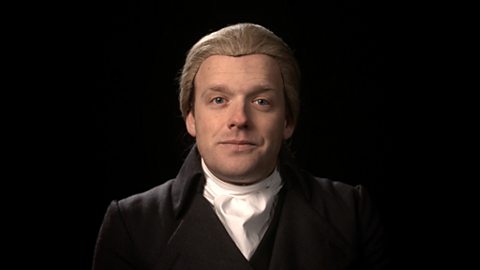
Elizabeth Fry. video
Elizabeth Fry describes how she reformed life for prisoners and their families in prison.