The final video focuses on the Contemporary period and includes a brief summary of previous episodes.
The video
Naomi: Sit tight for a ‘rock and roll-a-coaster’ ride as we explore our current period in music history - the contemporary period.
Ludwig: Vat is all this crazy stuff???!!! Who are deez ‘fab four’?
Naomi: In the contemporary period composers have thrown out the rule book, blending genres and musical traditions from all over the world. There are an endless number of new instruments courtesy of new technology giving a limitless number of new sounds.
Ludwig: Arghhhh! Zee noise!
Naomi: Our first piece of music is by Scottish composer Anna Meredith. It’s called ‘Connect It’ and is innovative in how it uses the body as an instrument, using clapping, stamping and shouting!
CLIP OF 'CONNECT IT'
Ludwig: Using your own body to make music? Hmmm …I prefer zee piano!
Naomi: The Contemporary period is the first period of music to go truly global. Developments in the recording and distribution of sound, like online streaming, mean that we can listen to music anywhere, anytime - all genres of music are available to everyone - like…
Pop
Blues
Jazz
Country
Reggae
World
Rock ‘n’ Roll
Ludwig: (doing an Elvis impression) Uh-huh, thank you very much.
Naomi continues:
Punk
Techno
Electronic
New Wave
Hip-Hop
Rap
Rock
…to name just a few!
Naomi: Another big factor in Contemporary music is the purpose of the music. Traditionally music was written for performance - now it’s also for recording and, importantly, to accompany other media such as video, film and TV. For example the Dr. Who theme tune arranged by Delia Derbyshire in 1963 which uses all sorts of new futuristic sounds.
WE HEAR THE DR. WHO THEME TUNE
Naomi: …and modern composers don’t just create brand new music, they love to borrow from the past! Listen to this clip of Maroon 5’s hit ‘Memories’…
WE HEAR MAROON 5 'MEMORIES'
Ludwig: …hmmm …zis sounds familiar! I feel like I’ve heard zis before!
Naomi: …Now play a little bit of Pachebel's Canon from the late 1600s.
WE HEAR PACHEBEL'S CANON.
Ludwig: Meinen goodness! They are zo zimilar!
Naomi: Do you remember monophonic melodies of very early music, Ludwig?
AN EXCERPT OF PLAINCHANT.
Ludwig: Oh yah… mein old friend zinging ze plainchant!
Naomi: As time went on, music became more expressive. During the Renaissance period, we saw the introduction of harmony - and both polyphony and tonality continued to flourish during the lavish and ornate Baroque period.
WE HEAR AN EXCERPT OF BACH THE TOCCATA AND FUGUE IN D MINOR.
WE HEAR AN EXTRACT OF HAYDN’S STRING QUARTET.
Naomi: Then, throughout the classical period master composers like Mozart, Beethoven and Haydn produced all kinds of works of great elegance and beauty…
WE SEE A CLIP FROM EP04 - TCHAIKOVSKY’S ‘SLEEPING BEAUTY’.
As we reached the Romantic period, the emotion, drama and story-telling through music really took hold.
Ludwig: I really need to work on extending my arms!
A CLIP FROM NIGHT ON THE BARE MOUNTAIN by MODEST MUSSORGSKY
Naomi: …and breaking away from conforming became even more prevalent with Nationalistic music. Composers writing music that truly reflected the history and traditions of their own countries. And then it was onto the 20th Century…
A CLIP OF 'CLAIR DE LUNE’ BY DEBUSSY.
Ludwig: Ah yes - conveying moods and emotions by using subtle music techniques - almost like painting with music!
Naomi: That’s right! Which brings us right up to date… who knows what music of the future will be like? Perhaps YOU will dream up where music will take us next.
Ludwig: Naomi, I zink zat person is me, since I have been experimenting with some new sounds…
LUDWIG'S SMARTPHONE PLAYS SOME MUSIC. HE’S RECORDED HIMSELF SINGING LOTS OF DIFFERENT HARMONIES IN A PARODY OF THE MIKA SONG ‘GRACE KELLY'.
'I could be Bach, I could be Mozart,
I could be Brahms or Chopin,
I could be Schuman, I could be Schubert,
I could be Van Off Beaten'
Ludwig: Ludwig Van Offbeaten…. Often mimicked, never (off) beaten!
Naomi: What are you like!
7. The Contemporary period
Naomi introduces the current period of music history and explains how new instruments and technologies - such as streaming music files - has greatly increased possibilities for composition, on a global scale.
We hear a clip from ‘Connect it’ by Scottish composer Anna Meredith (born 1978) and explore how it is an example of a contemporary composer using the human body as an instrument.
In the Contemporary period, music can be recorded, so that we can listen to it anywhere, anytime. Naomi lists many different popular music styles which sit alongside more traditional genres which are still being written, such as the symphony and string quartet.
Music in the past was written for live performance; today it is also for recording and to accompany other media, such as video, film and TV.
We hear a clip from the 'Doctor Who' theme tune, composed by Ron Grainer and realised by Delia Derbyshire of the BBC Radiophonic Workshop in 1963 (the current arrangement is by Segun Akinola, born 1993).
Naomi and Ludwig listen to a well-known baroque piece, Pachelbel’s ‘Canon’, that has been copied and transformed by modern composers and musicians, including Maroon 5.
Naomi and Ludwig then take a whistle stop tour through the centuries to look back at their music journey through the various periods - Medieval, Renaissance, Baroque, Classical, Romantic, Nationalistic, 20th Century and Contemporary.
Teacher Notes
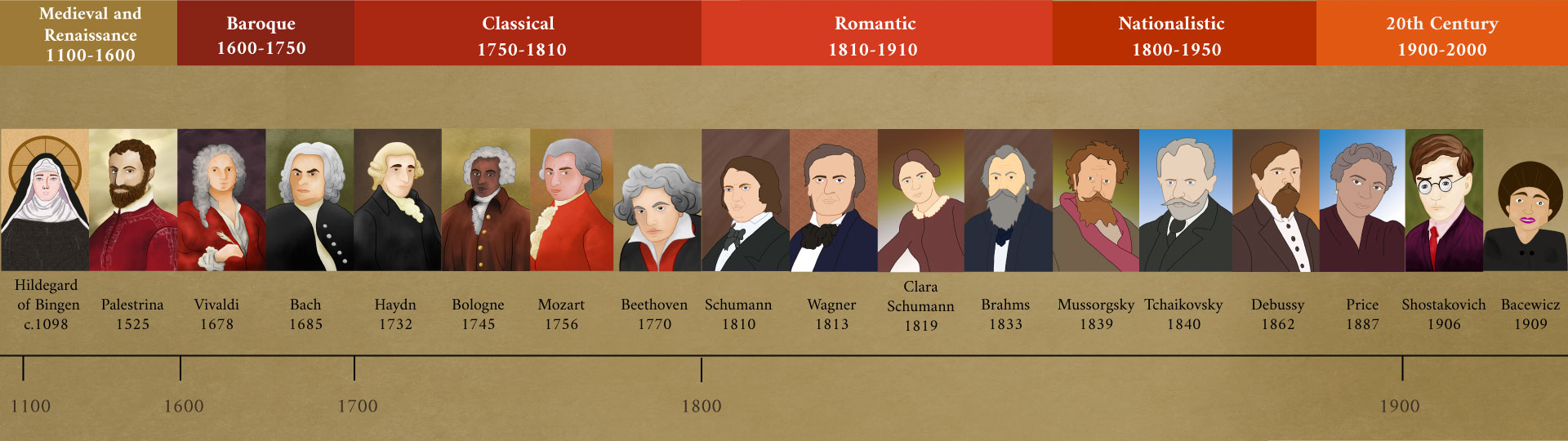
Using a piece of string marked out in centuries from 1100 to the present day, cut out the names or pictures of the composers studied and peg them onto the timeline. This will help children to form a sense of chronology. If you did this for the previous videos you can add to it. Also peg on the names given to the different eras of music studied so far: Medieval (1100-1400), Renaissance (1400-1600), Baroque (1600-1750), Classical (1750-1810), Romantic (1810-1910), Nationalistic (1800-1950), 20th Century (1900-2000), Contemporary.
Explore the resources at Ten Pieces to delve deeper into the music of Anna Meredith.
Explore the resources at Ten Pieces to delve deeper into the theme tune for 'Dr Who'.
Use the musical elements/interrelated dimensions as headings. Can you select one of the pieces of music listened to and describe it using these headings? Or can you select one heading, such as dynamics, and compare the dynamics of each of the music clips in the video. Headings you might choose to consider include:
pitch (how high/low the music is)
dynamics (whether the music is quiet or loud)
tempo (if the music is fast or slow)
timbre (the quality of tone, or sound of the instrument - is it brassy, dull, sparkly, etc)
texture (is there one line, or many parts)
duration (can you feel a driving pulse? can you pick out a repeated rhythm?)
structure might also be relevant - although hard to pick out on such short clips - for example, in a song are there verses?
Can you make your own recorded music? Select a song or compose a piece and record it. How can you share this music - by putting it on a school website or one of the many possible online platforms.
This episode will be relevant for teaching Music at KS2 in England, Wales and Northern Ireland. Also, Second Level P5-P7 level in Scotland. It covers listening and appraising, enabling children to develop a sensitivity to and understanding of music from varied genres, styles and different times. Children are encouraged to build a sense of chronology and begin to understand how musicchanged over time by listening with attention to detail to a variety of music written by the great composers.
Resources
A timeline of the composers
http://teach.files.bbci.co.uk/teach/music/history_of_music/composer_timeline.jpg