The second episode begins with Naomi and Ludwig in an ornate church where they explore the music of the Baroque era, including the composers Bach, Vivaldi and Handel.
The video
Naomi: The style of music called Baroque developed from about the year 1600 onwards. Just like the architecture of the time, it was very ornate and lavish and was dominated by composers like Vivaldi, Handel and Bach.
Ludwig: Meinen Goodness! Look at this place - look at these clotheses! I look amazing!
Naomi: Very dapper Ludwig!
Ludwig: (gasp) What ist this !!!
Naomi: This is an organ, a popular instrument of the Baroque period. It’s a little bit like woodwind or brass instruments, because it uses air to produce sound - the air is blown through the hollow pipes by a set of bellows.
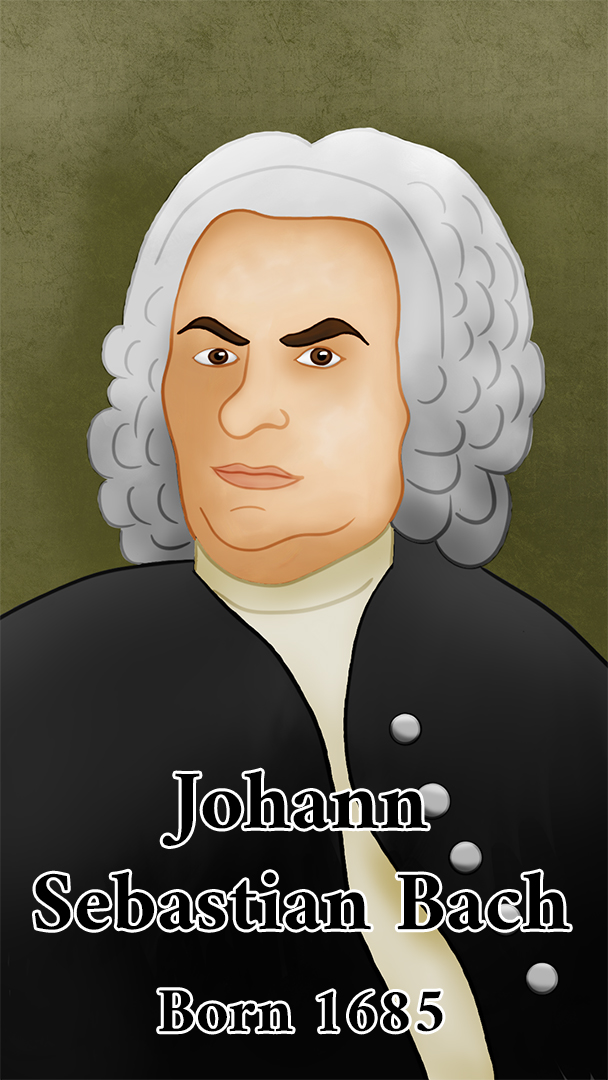
Naomi: This piece is the Toccata and Fugue in D Minor by German composer Johann Sebastian Bach who was born in 1685. Organs are like an orchestra, but played by one person - the different pipes make different sounds, like flutes or trumpets, or strings. Baroque music was full of tiny bits of improvisation and decoration - a bit like this church.
…hmmm - very nice Ludwig.
Ludwig: Another epic performance.
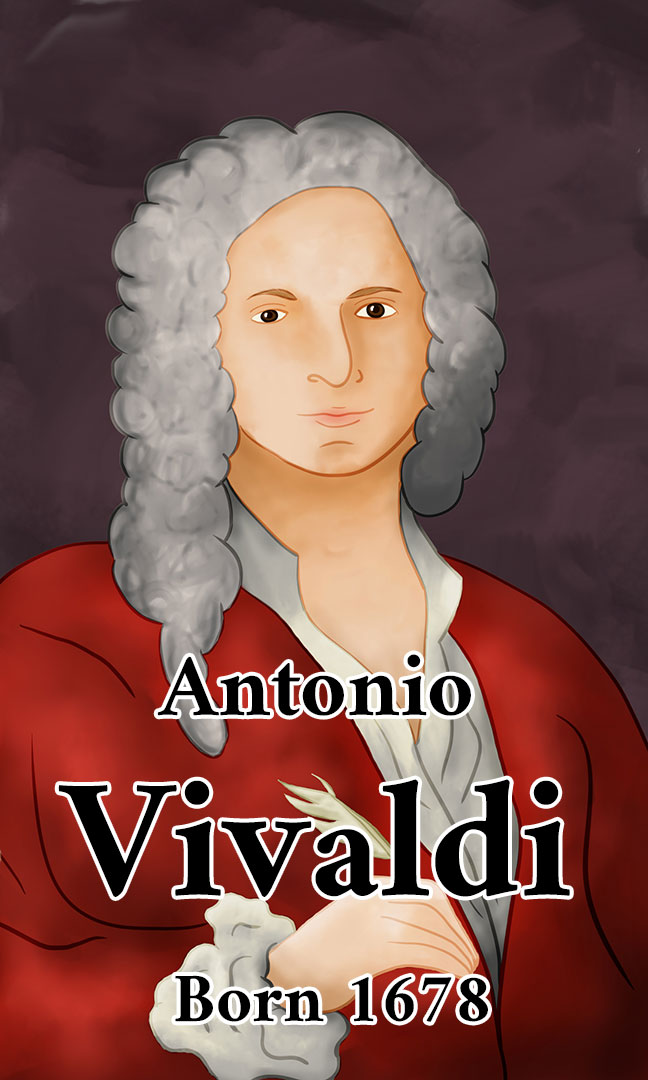
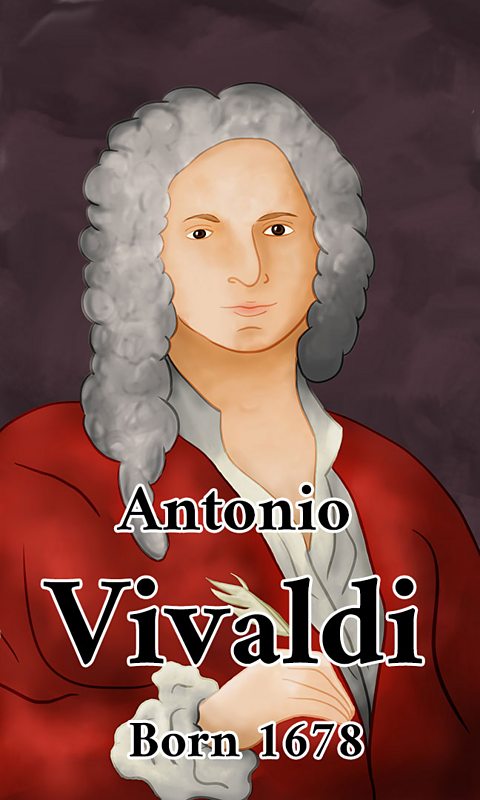
Naomi: Baroque music saw the creation of tonality - composing around a particular note from the musical scale, a ‘key’ and it also saw developments in new instrumental playing techniques. Antonio Vivaldi was an Italian composer born in 1678 and he wrote lots of concertos.
Ludwig: What’s a concerto?
Naomi: A concerto is a composition for one or more solo instruments and an orchestra. Vivaldi was a bit of a whizz at concertos. Each concerto of Vivaldi’s Four Seasons is written about a different season of the year.
Naomi: Listen for the texture of the music representing winter, with the high-pitched strings sounding a bit like cold and icy rain.
Vivaldi’s ‘Winter’ is one of the first examples of programme music - that’s music written to paint images in the listener's mind. It tells a story evoking pictures of being outside with an icy cold biting at our faces.
Ludwig: Brrrrr - I’m freezing!
Naomi: Here Vivaldi writes a sonata - sonata means sounded rather than sung, so it’s for an instrument not a voice - in this case, the oboe.
The tempo or speed is 'adaggio' which means slow.
Ludwig: Beautiful! But so far we have only heard instrumental music. What about voices? Did Baroque music still include singers?
Naomi: Yes, Baroque music expanded the size, range, and complexity of choral music and was often composed for the grandest occasions! Zadok the Priest is an Anthem written in 1727 by George Frederic Handel for the coronation of King George II and it has been sung at every coronation in the UK ever since - including the ceremony for Queen Elizabeth II.
Ludwig: It’s so regal …the energy of the strings …and when the voices come in, it is like an explosion of colour!
Naomi:…and that concludes our History of Music for the Baroque period - it was a HUGE step forward from earlier periods like medieval music. Hey Ludwig, why did Bach have to sell his organ?
Ludwig: I don’t know!
Naomi: Because he was baroque… broke… baroque… get it?
Ludwig: Zat was awful! Worst joke ever!
Naomi: Never mind.
2. The Baroque period
Naomi and Ludwig are in an ornate baroque church. Naomi introduces Ludwig to the organ, an instrument that became very popular in the Baroque era. An organ is a keyboard instrument; sound is produced by using bellows to pump air through thehollow pipes. We learn how music continues to develop from the period covered in the first video.
Polyphony (or 'many sounds'), is now a feature of Baroque music and Ludwig plays us the opening of ‘Toccata and Fugue in D Minor’ by the German composer JS Bach (1685-1750) on the organ. We can hear the decorative nature of the music and Naomi explains that Baroque music is almost always based on a tonality - meaning that a piece of music has a ‘tonic’ and the music is organised around one particular note or key. Bach was a very prolific composer, not only of sacred music (music for the church) but also secular music. Bach was also well-known for being a skilled organist and when we listen to the ‘Toccata’ we can hear how complex the musical lines are that weave together to create a ‘busy’ texture.
We then listen to music by the Italian composer Antonio Vivaldi (1678-1741) who also wrote a vast number of works. Here we focus on a concerto. A concerto is a large-scale composition for an orchestra with a soloist or a group of soloists. In ‘Winter’, from the Four Seasons, we hear the violin alternate playing solo and with the orchestra. The music is programmatic - it attempts to paint a picture in the mind of the listener. The high pitch of the strings sounds a bit like cold, icy rain. Vivaldi was one of the first composers to compose in this way, creating a picture through the sound of the music.
Next we listen to another composition by Vivaldi, this time a sonata written for an oboe. Sonata means ‘sounded’ rather than sung - so a sonata is written for an instrument, not a voice. The piece is entitled ‘Adagio’ which is an Italian musical term meaning ‘slow’.Ludwig reminds us that we haven’t heard any vocal music in this episode and Naomi explains that vocal music was still very popular in the Baroque period. We listen to the opening of ‘Zadok the Priest’ by the German/British composer George Frederic Handel (1685-1759), written for the coronation of King George II.
Teacher Notes
Pupils could collect pictures of different keyboard instruments. Although the actual keyboard on each often looks the same, the sounds produced can be very different. A harpsichord uses a small plectrum to pluck a string; an organ uses pipes and bellows to create sound by blowing; a piano has hammers which hit a string; an electric keyboard uses an oscillator to generate sound waves electronically.
Explore the resources at Ten Pieces to delve deeper into the ‘Toccata and Fugue in D Minor’ by JS Bach.
Explore the resources at Ten Pieces to delve deeper into ‘Winter’ by Antonio Vivaldi.
Create a list of all the monarchs to have been crowned in this country since George II. ‘Zadok the Priest’ is an anthem and has been performed at every coronation in the UK since it was first performed in 1727.
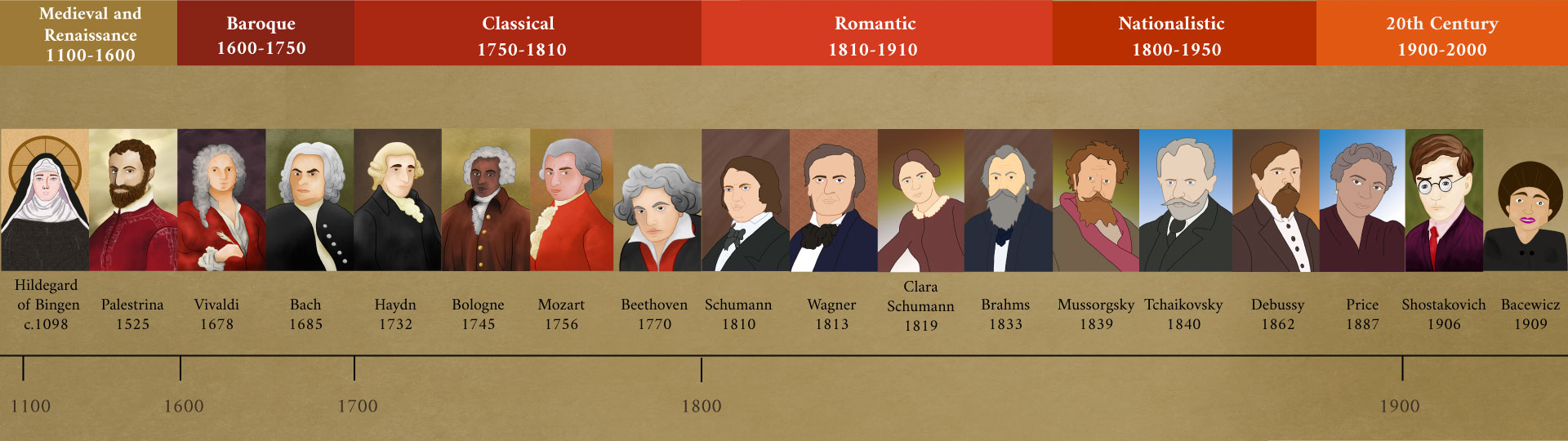
Using a piece of string marked out in centuries from 1100 to the present day, cut out the names or pictures of the composers studied and peg them onto the timeline. This will help children to form a sense of chronology. If you did this for the first video, you can add to it. Also peg on the names given to the different eras of music studied so far: Medieval (1100-1400), Renaissance (1400-1600), Baroque (1600-1750).
Use the musical elements/interrelated dimensions as headings. Can you select one of the pieces of music listened to and describe it using these headings? Or can you select one heading, such as dynamics, and compare the dynamics of each of themusic clips in the video. Headings you might choose to consider might include:
pitch (how high/low the music is)
dynamics (whether the music is quiet or loud)
tempo (if the music is fast or slow)
timbre (the quality of tone, or sound of the instrument - is it brassy, dull,sparkly, etc.)
texture (is there one line, or many parts)
duration (can you feel a driving pulse? can you pick out a repeated rhythm?)
structure might also be relevant - although hard to pick out on such short clips - for example, in a song are there verses?
This video will be relevant for teaching Music at KS2 in England, Wales and Northern Ireland. Also, Second level P5-P7 level in Scotland.
It covers listening and appraising, enabling children to develop a sensitivity to and understanding of music from varied genres, styles and different times. Children are encouraged to build a sense of chronology and begin to understand how music changed over time by listening with attention to detail to a variety of music written by the great composers.
Resources
Image of JS Bach
Click to display the image full size.
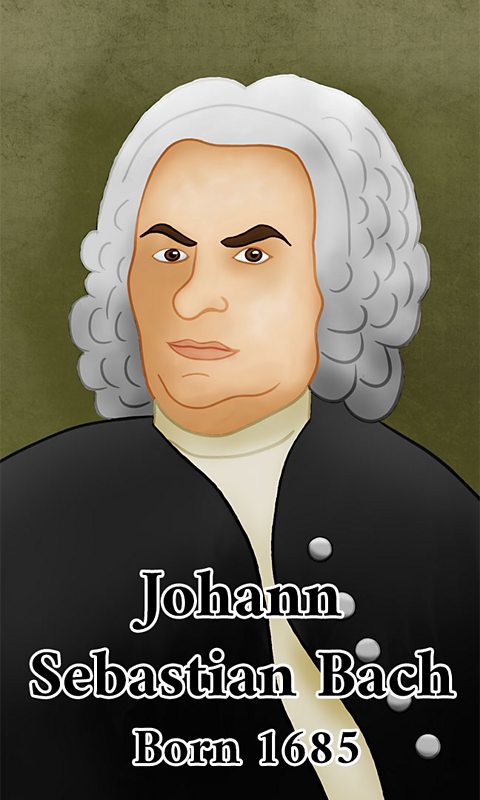
Image of Vivaldi
Click to display the image full size.
A timeline of the composers
http://teach.files.bbci.co.uk/teach/music/history_of_music/composer_timeline.jpg