In the first video we meet Naomi and Ludwig and travel back in time to explore the music of the Medieval and Renaissance eras.
The video
Naomi: Morning Ludwig!
Ludwig: Guten Morgen Naomi. I’m ready to play some marvellous medieval music …I’ve even brought a lute!
Naomi: But Ludwig, medieval church music didn’t use lutes - they didn’t use any instruments at all - just voices, singing beautiful music, 'a cappella' - which means unaccompanied, that means no lute. Sorry Ludwig!
Ludwig: Just my voice? No instrument?
Naomi: Yes – early medieval music was quite simple. There weren’t nearly as many instruments as we have now –instead there was 'plainchant'.
Plainchant was essentially a sung version of the church service - the Mass - that you would have heard in Christianchurches at the time. As Mass was always in Latin, plainchant was always in Latin too.
Choirs were usually made up of monks or priests and the tunes had no harmony or accompaniment, no rhythms even. We call this single line of music monophonic ‘one sound’. Mono - meaning ‘one’ and phonic meaning ‘sound’. ‘Monophonic’ - one sound.
Ludwig: This is remarkable! So simple – but still so emotional! Excellent singing mein Freunden!
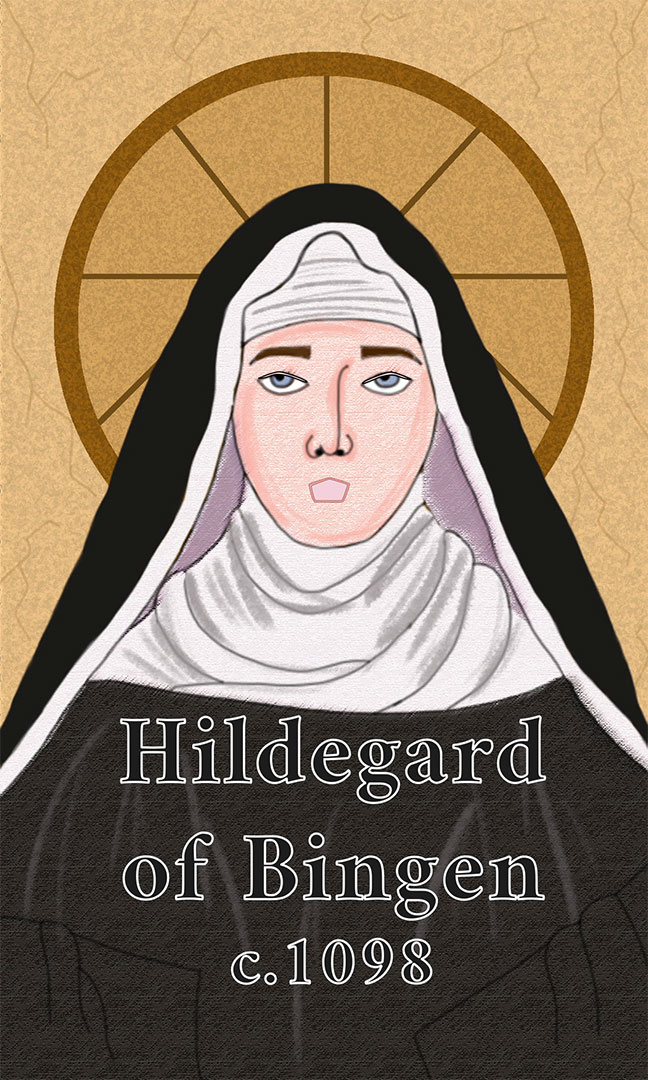
Naomi: As time passed, people began to play with the simple structure of plainchant and made it more expressive. This piece of music is called 'Ave, generosa' and was written by a nun called Hildegard of Bingen who was born around the year 1100. She wrote lots and lots of music, often in prayer to the Virgin Mary, mother of Jesus, or to other saints.
If you listen carefully, you can hear a bigger range in the notes that are sung - that’s the distance from the highest to the lowest pitch – it has a wider, more expressive feel than earlier plainchant. Although it is still monophonic, Hildegard would often use lots of notes for just one syllable of a word - this is called ‘melisma’.
Ludwig: Ah yes – more depth – more range. Very interesting!
Naomi: The music that the monks sang was performed in church and became known as sacred music, but music was enjoyed and performed by people outside of church too - and this was called secular music.
As time went on, travelling musicians called ‘strolling minstrels’ would provide entertainment for people as they travelled around the countryside playing on instruments like lutes.
Ludwig: So they were sort of travelling superstars - like me!!!
Naomi: Well - go on then - if you like.
Naomi: Which brings us right up to the time we call the Renaissance period and the reign of Henry VIII. While nowhere near as complicated as music we hear today, it was light years beyond simple plainchant.
You can hear higher and lower notes at the same time - that’s ‘harmony’. Can you hear the voices singing at the same time but they're singing different notes?
Ludwig: Yah !!!
Naomi: The texture is called ‘homophonic’ which means ‘the same sound’ - so all the parts move together with the same rhythm.
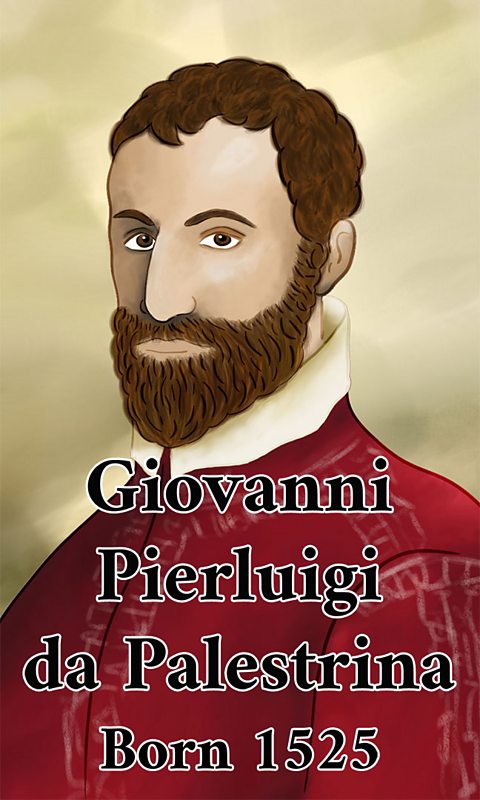
This is Giovanni Pierluigi da Palestrina. Born in 1525, he was considered the king of polyphony. In this piece called ‘Missa Hodie Christus Natus Est’, Today Christ Is Born, we can clearly hear singers singing different notes at the same time - polyphony! Many sounds.
So, in just a handful of compositions, we can see how far music developed from early medieval times all the way up to around 1600!
Ludwig: And to think how much further we still have to go on our musical journey!
Naomi: Too true Ludwig! Hey Ludwig, what is a musical pirate’s favourite instrument?
Ludwig: I don’t know?
Naomi: The lute! (loot) it's like money …never mind.
1. Medieval and Renaissance music
Music in medieval times was sung in churches by monks or nuns. It was sung a cappella meaning unaccompanied. Naomi explains this early music was called plainchant and was sung in Latin as part of a church service. There was no harmony, rhythm and the single line of voices became known as monophonic or one voice.
As church music developed it became more expressive, with a greater range of notes used, such as the music of the nun Hildegard of Bingen, born c 1100. Although still monophonic, the vocal line is more expressive and sometimes has a number of notes all sung on the same syllable, which is called melisma.
Music in medieval times was not only sacred (sung in churches) but also secular (not connected to the church). Ludwig introduces us to the lute, a stringed instrument that would have been played by travelling musicians. We also listen to a piece ofcourt music attributed to Henry VIII, called ‘Pastime with Good Company’. This song is sung in English and there are four vocal parts all singing at the same time. They all sing the same words - but on different notes – which is called homophony.
Moving back to Italy, we hear some church music of Giovanni Pierluigi da Palestrina (1525-1554). He was one of the finest and most ground-breaking composers of the Renaissance period writing an enormous amount of music for the Italian church. He was particularly famous for polyphony - a type of musical texture consisting of two or more simultaneous lines of independent melody - indeed, he became known as the 'King of polyphony'. The meaning of 'polyphony' is ‘many sounds’ and Palestrina’s amazing skill at weaving individual parts together influenced many other composers. We hear 'Missa hodie Christus natus est', sung in Latin.
Teacher Notes
Pupils could use maps to locate the places of the composers in this episode:
Hildegard of Bingen - Germany
Henry VIII - England
Palestrina - Italy
Explore art and architecture from the Renaissance. Look at a picture of St Peter’s church in Rome where Palestrina’s music was performed. The style is highly detailed, rich and decorative. Compare this with the monastery of Rupertsberg, a convent founded byHildegard of Bingen, which is much simpler and less decorated in its architectural style. Does the architecture reflect the music or vice versa?
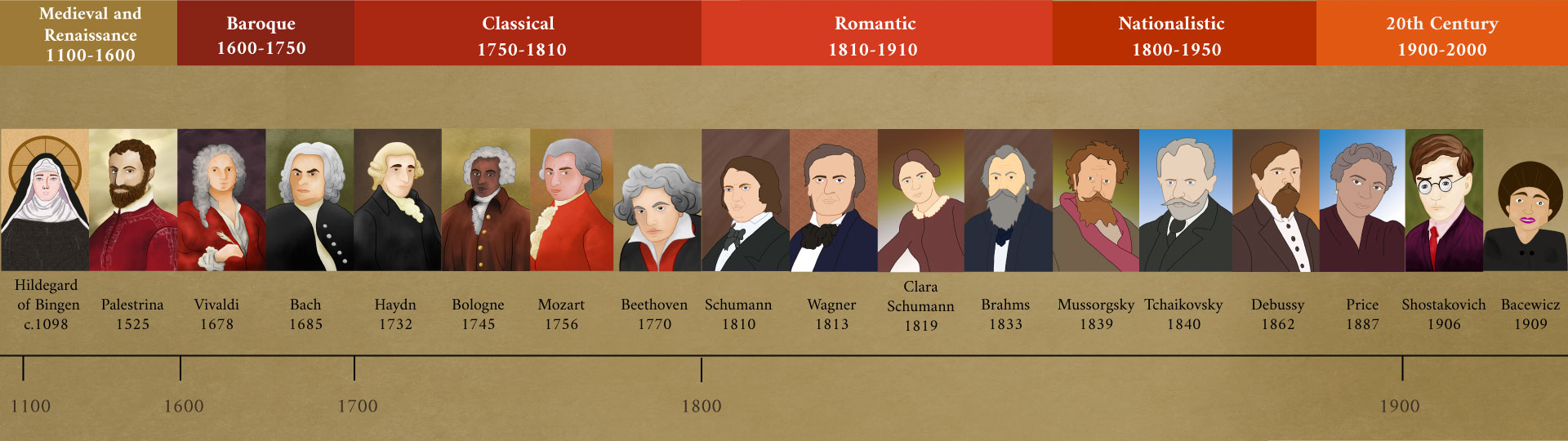
Using a long piece of string divided up into centuries, children could visually ‘travel back’ from the 21st century to discover when this music was being written. This visual image of a timeline will help children gain a sense of chronology. Pictures of the composers could be pegged onto the string at the appropriate dates.
Ask pupils to listen to the musical excerpts in the video again. Can they describe what ‘colour’ they think each piece is? Discuss why pupils have chosen a particular colour. Encourage them to use descriptive and musical language to describe each piece. For example the extract from Hildegard of Bingen might be described as vocal, smooth, moving by step, floaty, gentle, calm, sung, graceful. ‘Pastime with Good Company’ would elicit contrasting words - perhaps rhythmic, chordal, English, dance-like, energetic, loud, cheerful. Palestrina could be described as lilting, beautiful, glorious.
Listen again to the song ‘Pastime with Good Company’. Can pupils tap the ostinato (continually repeated rhythm) that the drum is beating? Can they join in with the song? What do the words tell us about Henry VIII and his court? Can pupils spot any words we do not use so much today (‘pastime’, ‘pastance’). What do the words of the song mean?
The early years of Henry VIII's reign demonstrated an exuberance and extravagance in the English court. Royal banquets and feasts were common and outdoor sports and pastimes, such as hunting, hawking, jousting and archery tournaments were enjoyed by the King and his court. The song reflects how the king enjoyed these ‘pastimes’ with ‘good company’ and argues that it is better tobe busy enjoying yourself than being idle!
Pastime with good company
I love and shall until I die;
Grudge who will, but none deny
So God be pleased thus live will I
For my pastance
Hunt, sing, and dance
My heart is set:
All goodly sport
For my comfort
Who shall me let?
Use the musical elements/interrelated dimensions as headings. Can you select one of the pieces of music listened to and describe it using these headings? Or can you select one heading, such as dynamics, and compare the dynamics of each of the excerpts from the video. Headings you might choose to consider might include:
pitch(how high/low the music is)
dynamics(whether the music is quiet or loud)
tempo(if the music is fast or slow)
timbre(the quality of tone, or sound of the instrument - is it brassy, dull, sparkly, etc.)
texture(is there one line, or many parts?)
duration(can you feel a driving pulse? can you pick out a repeated rhythm?)
structure(might also be relevant - although hard to pick out in such short clips - for example, in a song are there verses?)
This video will be relevant for teaching Music at KS2 in England, Wales and Northern Ireland. Also, Second Level P5-P7 level in Scotland.
It covers listening and appraising, enabling children to develop a sensitivity to and understanding of music from varied genres, styles and different times. Children are encouraged to build a sense of chronology and begin to understand how music changed over time by listening with attention to detail to a variety of music written by the great composers.
Resources
Image of Hildegard of Bingen
Click to display the image full size

Image of Palestrina
Click to display the image full size.
A timeline of the composers
http://teach.files.bbci.co.uk/teach/music/history_of_music/composer_timeline.jpg