Det. Lewis Stinker & Sgt. Janice Fungal Snoring
Narrator: Prime Numbers are numbers which can only be divided by themselves and 1. And Prime factors are the prime numbers which multiply together to make a number. It can take some time to work out which numbers are prime and what factor pairs make up a number, but ~
Narrator: It needn’t be exhausting. Infact, it’s really exciting detective work.
Narrator: Oh. I give up.
V.O: Let’s kick some Maths!!
Det. Lewis Stinker: Good day Maths Rookies… We were working all night looking for Prime Numbers, that’s why we’re a little tired. We’ll tell you about that later, but first let’s look for Prime Factors. Isn’t that RIGHT SERGEANT!?
Sgt. Janice Fungal: Whhaaat!!??? Yeah! That's right! Clean Tractors!
Det. Lewis Stinker: Okay, Prime Factors… Okay
Sgt. Janice Fungal: What? Factors are Prime Now?
Det. Lewis Stinker: Take it easy. ‘Prime Factors’? It’s just a fancy way of saying which prime numbers multiply together to make the number. And an easy way to work this out is using a Factor Tree. Look 28, is 2 multiplied by 14, and then we break 14 into 2 multiplied by 7. And the other 2 drops down to the lowest level, like a banana. And we get 2 x 2 equals 4 x 7 equals 28! So, it works.
Sgt. Janice Fungal: Oh, I see, So I see. That’s neat. Can I have a go?
Det. Lewis Stinker: Be my guest, Sergeant!
Sgt. Janice Fungal: It looks fun. So, let’s do a smaller number. 12! So, let’s start with our 2 and 2 times 6 is 12. And then coz 2 is a prime, we don’t break it down any further …
Det. Lewis Stinker: ONE AIN’T A PRIME, REMEMBER? Why? Go ask your teacher…
Sgt. Janice Fungal: …so we drop 2 down, but we can break 6 down into 2 times 3. And notice each line of the tree multiplies together to get 12. And look! We can do another tree with 12. It’s like a forest! Except we can do 3 times 4, can’t we? Look at how this tree grows! It grows down! And that’s not all! There’s a Factor Tree BIRD! And he’s singing a little song! Oh no! He’s doing a poop!
Det. Lewis Stinker: SERGEANT! That’s enough. Okay. Rookies! Remember Prime Factors of a number are the prime numbers that multiply together to make the number. That’s it. Now, let’s look instead at these Prime Numbers.
Sgt. Janice Fungal: These Prime Numbers are so spooky. It’s like they pop up, where you least expect
Det. Lewis Stinker: Well, the only even Prime Number is 2, the rest are odd. So that narrows it down. But, you’re right. They’re hard to spot. Because not every odd number is a Prime Number and it can take a long time to work out the factors of a large number, which means the bigger the number is, the longer it can take to find out if it’s a prime.
Sgt. Janice Fungal: Yeah, the only times tables these Prime Numbers appear in, is their own. If only there was some kind of pattern to where they crop up. If you could predict where you might find them?
Det. Lewis Stinker: Well, the Clay Mathematics Institute in the United States of America – which is where we are.Off Screen New york street walla
Det. Lewis Stinker: See! The Clay Institute is offering a million dollar prize to anyone who can spot any pattern to the appearance of Prime Numbers. A million dollars! Forget TV Talent Shows, Mathematics is where fame & riches can be found! And because large Prime Numbers are hard to find, they’re used in codes all the time these days.
Det. Lewis Stinker: Every time someone buys something on the internet or spies send each other messages, the data is encrypted using prime numbers…
Sgt. Janice Fungal: Encryption just means to take information and put into a secret code. It’s really hard to crack the code – that is find the key to the code – if the key is a made up of prime numbers!
Det. Lewis Stinker: Yeah, BIG Prime Numbers are like BIG diamonds of the number world, and if we knew where to look to find them without having to look through all the possible factors, well, that sure would help the world of Maths and Computer Science.
Sgt. Janice Fungal: Maths isn’t all worked out yet, Rookies. There’s still so much out there ready to explore. And you could be the next big Maths Genius. There ain’t no reason why not!?
Det. Lewis Det. Lewis Stinker And a Million Dollars!! Just think of the donuts!
Det.Lewis Stinker: Okay Rookies. I hope you now know that there’s more to numbers, than just numbers. Prime Numbers are useful because they’re hard to find, especially BIG prime numbers, and Composite numbers with lots of factors are also useful: ever wondered why there are 60 minutes and a 24 hour long day? It’s because those numbers have lots of factors! Makes time easy to divide into neat little chunks! And talking of time, my time with you guys is over. I hope you learned something. And if you didn’t??
GET OUTA HERE!!!
Det. Lewis Stinker & Sgt. Janice Fungal Eating.
Det. Lewis Stinker: Ok, so here's where the robbers struck.
Sgt. Janice Fungal: Hmm, 2, 4, 6, yesterday was 8. Where will they strike tomorrow?
Det. Lewis Stinker: I've got it, it's obvious!
Sgt. Janice Fungal: Yes, me too, it's -
Det. Lewis Stinker: We just have to find the next house with an orange door!
Sgt. Janice Fungal: No, but that's just our diagram, what I mean is the numbers have a pattern, they go up intwo's. Look, 2, 4, 6, 8, then tomorrow will be … ?
Det. Lewis Stinker: Friday!
Sgt. Janice Fungal: Yes! No, I mean they'll target number 10. Anyway, let's move on to where they hideout eachnight. Look at this street.
Det. Lewis Stinker: Ok, let me think. Hmm, 2, 5, 8, 11. Yes there's a pattern here. Ooh, these robbers arecunning but we've got them figured out.
Sgt. Janice Fungal: Yes, it's going up in threes, so the next hideout will be -
Det. Lewis Stinker A blue house!
Video summary
This clip introduces prime numbers, composite numbers and factors.
We state that the number "1" is neither prime nor composite. The idea of factor pairs is introduced.
We look at how to decide whether a natural number is prime or composite by looking for proper factors.
The importance of being methodical is emphasised.
The clip ends with a square roots sketch illustrating the relationship between square numbers and their square roots.
This clip is from the series Kick Sum Maths.
Teacher Notes
This clip can form an introduction to prime and composite numbers, and lead to discussion of ways to speed up identification of primes/composites, for example, using divisibility tests.
The sketch at the end of the clip can serve as a discussion starter about square numbers and square roots.
These clips could be used for teaching Maths at KS2 or at a beginner level in England, Wales and Northern Ireland and 1st and 2nd Level in Scotland.
Prime Suspects 1. video
Introducing prime numbers, composite numbers and factors in a sketch show featuring puppet Detective L Stinker and his animated friends.
As The Crow Flies. video
A demonstration of how to calculate the perimeter and area of simple and compound shapes with the help of the crow and Detective Stinker.
Decimal Dance Off 1. video
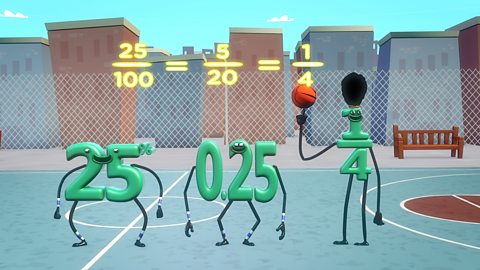
The structure of fractions, decimals and percentages are demonstrated through a 'Decimal Dance Off'.
Decimal Dance Off 2 video
The connection between fractions, x decimals and percentages and how to convert between them are explored through a 'Decimal Dance Off'.
Geometry Rules OK. video
Introducing geometry, angles and shapes through a spoof house building show and an animation game show.
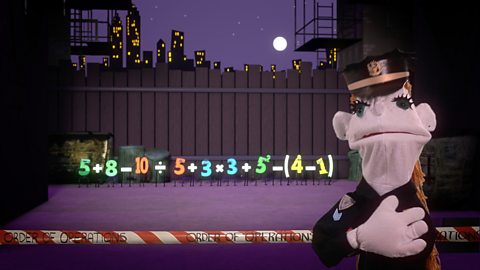
Let's Have Some Order. video
An explanation of why using the correct order in mathematical calculations is important.
Pie And Pie Again. video
An introduction to pie charts and how they show relative proportions.
Scale And Polish. video
A look at the meaning of scale factors and how they allow us to represent large objects in two and three dimensions.
Why Maths Why? video
This clip encourages students to overcome their fear of maths. Learning a few skills will give them the power to tackle the trickiest maths challenges.

X Marks The Thought. video
An introduction to using algebra to solve simple equations by using inverse operations.