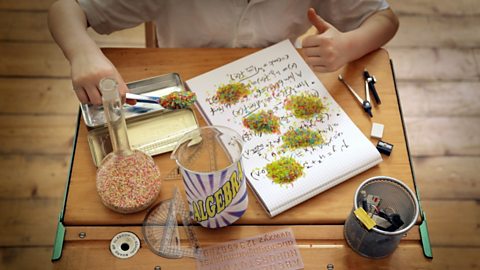
V.O: Take a look. What do you see? What do you see! Numbers, well done… Give yourself a healthy sugar free snack and take the rest of the day off… NO! Think it was going to be this easy? You're about to look at numbers in a whole different way. Like a good detective can see through the obvious, a good mathematician can tell you a lot about a number and in five minutes that's gonna be you! Are you ready to look at numbers in a different way forever? Yeah! Then…
V.O: Let's kick some maths!
Det. Lewis Stinker: As a Maths Rookie
Voice off screen: There’s your coffee ‘Detective’. …Do you not think a puppet is a little young for this audience?
Det. Lewis Stinker: Oh, yeah. Here we go. ‘He’ll never make Lieutenant – he’s a puppet! '. I HAD TO WORK TWICE AS HARD TO GET WHERE I AM. Think it's easy havin' sticks for arms!! Huh…HUH! GET OUTA HERE!
Det. Lewis Stinker: Sorry. Where where we? As a Maths Rookie, you’ll already know how to multiply and divide numbers. But, not all numbers are the same when it comes to multiplying or dividing. Some numbers are useful because they can be divided in lots of ways, and other numbers are useful because they can’t. I’ll show ya. But first let's take it real slow.
Det. Lewis Stinker: There’s a name for numbers that can be divided by other numbers: they’re called Composite Numbers – and the numbers they can be divided by, are called factors. For example, Number 4 can be divided by 2, yeah, 4 divided by 2 is 2, so 2 is a factor of 4. Of course, 4 can also be divided by 4 - itself, and 1, so all numbers have at least two factors –
Det. Lewis Stinker: Except the number 1!
Det. Lewis Stinker: But numbers that can ONLY be divided by the number 1 and themselves are called Prime Numbers!!
Det. Lewis Stinker: Ahhhhh! Let's shake down these numbers into Primes, and factor-packing Composites!
Det. Lewis Stinker: Number 1! She’s special! She ain’t a composite or a Prime! So, let’s leave her alone!
Det. Lewis Stinker: Number 2! It’s a Prime! It can only be divided by itself and 1. Number 3 a Prime! 4 – we already did! It had 2 as a Factor, so it’s a composite number with how many factors? Well, 1, 2 & 4 are the factors of 4. But how many factor pairs? Woah, woah, woah! What’s a Factor Pair? Well, it’s a pair of factors that multiply together! So for 4, you would have 2 factor pairs, because 1 x 4 = 4, and 2 x 2 = 4. Got that? You wanna break? TOUGH!
Det. Lewis Stinker: Number 5? What do YOU think? You got a gut feeling? You want to check it out! Are there any factors in there hiding apart from 1 and 5? So what about 2? Nope! Remainders don’t count! Or 3? Or 4!? So, now we know, 5 is a Prime Number!
Det. Lewis Stinker: So, let’s go onto 6 ~
Sgt Janice Fungal: I think you’re a little too tough on the rookies. It’s a lot to take in.
Det. Lewis Stinker: Oh you think so, Janice?
Sgt Janice Fungal: Sergeant Sgt. Janice Fungal to you, Sir. Let’s do things by the book in an Orderly fashion!
Det. Lewis Stinker: Okay, Sergeant. But you think I’m being too tough? Too much information? (shouting again) WELL, IF THERE’S ONE THING ABOUT FINDING FACTORS IN NUMBERS, SORTING THE COMPOSITES FROM THE PRIMES, YOU GOTTA BE METHODOLOGICAL! YOU GOTTA TAKE IT SLOW AND GET IT RIGHT! Everyone thinks Mathematical work is all kung fu and car chases but it AIN’T! You GOT THAT!? Take it Slow! And Do it Right! And you’ll find factors and factor pairs real easy – like a piece of cake.
Sgt Janice Fungal: You got cake?
Det. Lewis Stinker: Let’s have one last practice!
Det. Lewis Stinker: Okay Rookies! 6. Nice and slow. So, we know 6 can be divided by 1 and 6, but if we can’t find any other factors, then it would be a prime. So, to find out if it’s a composite we start with dividing it by 2, and we can, 2 x 3. And here’s a funny thing, we don’t really need to test out 3, because we’ve already spotted three, here. So we know that 2 and 3 are factors. And we stop there, because we know it ain’t a prime!
Sgt Janice Fungal: Do it in an orderly fashion. Practice. It’ll be fun.
Det. Lewis Stinker: Remember: composite numbers have more than one factor pair, but Prime Numbers will only ever have one factor pair, 1 x themselves! It’s a piece of …
Sgt Janice Fungal: Cake?
Sgt Janice Fungal: CAKE!!!
Person 1: Here are my trees, the fruit is very valuable.
Person 2: Remarkable! Ooh, what's going on at the bottom of these trees?
One 1, two 2's, three 3's, how interesting!
Person 1: Oh they're SQUARE ROOTS
Video summary
*This film clip introduces prime numbers, composite numbers and factors.
We state that the number “1” is neither prime nor composite. The idea of factor pairs is introduced.
We look at how to decide whether a natural number is prime or composite by looking for proper factors.The importance of being methodical is emphasised.
Ends with a square roots sketch illustrating the relationship between square numbers and their square roots.
This clip is from the series Kick Sum Maths.
Teacher Notes
This can form an introduction to prime and composite numbers, and lead to discussion of ways to speed up identification of primes/composites, for example, using divisibility tests.
The sketch at the end of the clip can serve as a discussion starter about square numbers and square roots.
These clips could be used for teaching Maths at KS2 or at a beginner level in England, Wales and Northern Ireland and 1st and 2nd Level in Scotland.
Prime Suspects 2. video
Decompose numbers into prime factors. End sketches look at primes and simple sequences.
As The Crow Flies. video
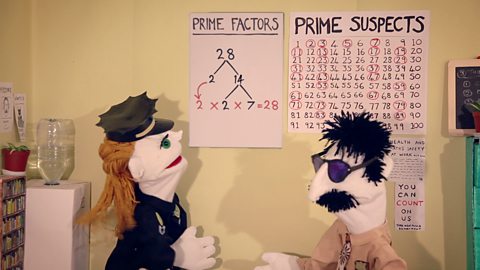
A demonstration of how to calculate the perimeter and area of simple and compound shapes with the help of the crow and Detective Stinker.
Decimal Dance Off 1. video
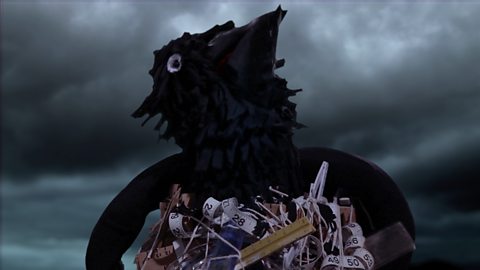
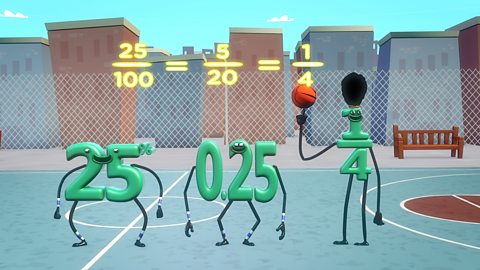
The structure of fractions, decimals and percentages are demonstrated through a 'Decimal Dance Off'.
Decimal Dance Off 2 video
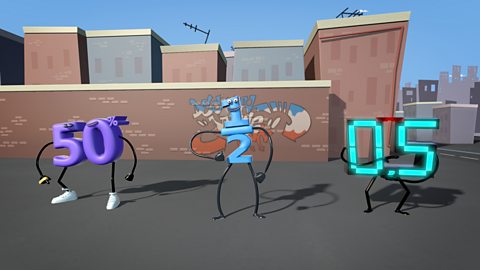
The connection between fractions, x decimals and percentages and how to convert between them are explored through a 'Decimal Dance Off'.
Geometry Rules OK. video
Introducing geometry, angles and shapes through a spoof house building show and an animation game show.
Let's Have Some Order. video
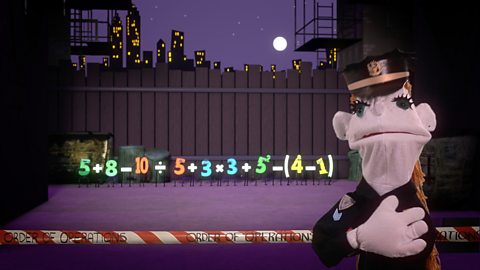
An explanation of why using the correct order in mathematical calculations is important.
Pie And Pie Again. video
An introduction to pie charts and how they show relative proportions.
Scale And Polish. video
A look at the meaning of scale factors and how they allow us to represent large objects in two and three dimensions.
Why Maths Why? video
This clip encourages students to overcome their fear of maths. Learning a few skills will give them the power to tackle the trickiest maths challenges.

X Marks The Thought. video
An introduction to using algebra to solve simple equations by using inverse operations.