1st New york voice: Hey! I’m trying to play my saxophone!
2nd New York Voice: Hey! I’m trying to listen to my cat play the drums here!
Sgt. Janice Fungal: The streets! The craziness multiplies! The city divided! It all adds up! It takes it from me!…. And then one night, it all got too much! EVERYBODY, Freeze! Don’t move! Number 5, stand up straight! Oh, you always slouch DO YA!?
I ain’t never seen anything like it! All numbers and brackets and things, all together in one crazy line up! How to make sense of it all! How to ~
V.O: Kick Sum Maths!
Narrator: You all know how to add, subtract, divide and multiply. So, 5 plus 8 won’t be a problem. Or 3 multiplied by 3. But what happens if your Maths problem looks like this:
Five plus eight minus 10 divided by 5 plus three times three plus five squared minus open brackets, four minus one, close brackets? You might get this wrong if you didn’t know about The Order of Operations.
Sgt. Janice Fungal: WE NEED ORDER HERE PEOPLE! ORDER!!! Let’s work this through nice and slow. Ok, Mr Voice in the Sky, you carry on, I’ll make sure nobody steps out of line.
Narrator: The order of operations, and remember an operation is just a fancy word for multiplying, dividing, subtracting and adding, is just what order we try to work out this problem. So, what is the order? Well, first of all, we work out what’s in brackets and powers such as squared or cubed.
Sgt. Janice Fungal: That’s right! There’s an ORDER! Do it in order. Brackets – so 4 minus 1 is 3. Then the squared. Squared is the little 2. If it was to the power of 3 it would be 5 times 5 times 5. But it ain’t, it’s two, so it’s five times five, which is twenty-five.
Narrator: I was going to do the working out.
Sgt. Janice Fungal: I am the ranking officer. But by all means, have a go, hero. Because next up is multiplication and division. That’s the order. Go to it, Voicey.
Narrator: So, 10 divided by 5 is 2 and 3 multiplied by 3 is 9. And last of all, we ~
Sgt. Janice Fungal: Add and Subtract! Working from left to right! Go to it V Man.
Narrator: That’s five plus eight, which is thirteen minus 2, which is 11, plus nine which is twenty plus twenty five which is forty five minus three, which gives us forty two. Forty Two.
Sgt. Janice Fungal: Wow. 42. Order of operations is the CSI of Maths.
Narrator: You’ve not quite worked out the meaning of life yet, but Order of Operations teaches us to do things in the right order. It’s important to…
Sgt. Janice Fungal: NOT PANIC! And REMEMBER THE ORDER OF OPERATIONS! Go home 42! You’re somebody’s answer! Don’t make any mistakes. Go home.
Now, can Order of Operations get me a coffee? And a doughnut?
Operations: Grumpy walla… I say… Do you mind… How rude!
Multiplication: After you.
Division: After you.
Addition: After you.
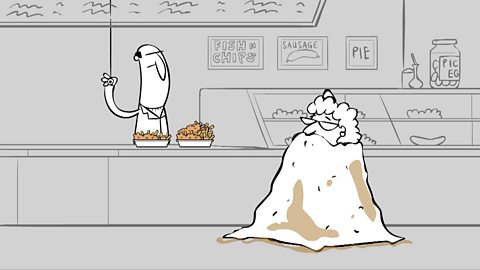
Subtraction: No Sir, You’re to the left of me. Remember? Left to right? So, After you.
Addition: Why thank you.
Video summary
In this clip the order of operations in calculations is introduced.
Correct order of operations ensures that mathematical expressions are unambiguous.
We see a calculation involving all four arithmetic operations, brackets and an exponent. The calculation seems complicated, but by doing one operation at a time and in the right order, we arrive at the correct answer.
The end sketch further demonstrates correct order of operations, utilising the great British traditions of manners and queuing.
This clip is from the series Kick Sum Maths.
Teacher Notes
Students could be encouraged to explore how and when inserting brackets can change the result of a calculation.
The order of operations can serve as an ideal opportunity for revision of basic number facts and skills.
In conjunction with fractions, students could also explore when brackets are absent yet implied, for example the fraction with 5-3 as numerator and 6+4 as denominator.
These clips could be used for teaching Maths at KS2 or at a beginner level in England, Wales and Northern Ireland and 1st and 2nd Level in Scotland.
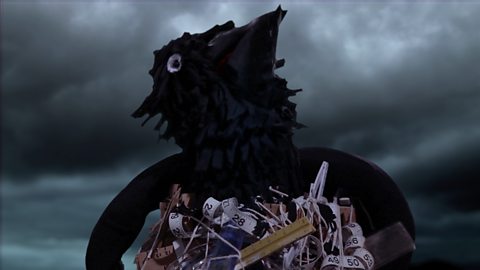
As The Crow Flies. video
A demonstration of how to calculate the perimeter and area of simple and compound shapes with the help of the crow and Detective Stinker.
Decimal Dance Off 1. video
The structure of fractions, decimals and percentages are demonstrated through a 'Decimal Dance Off'.
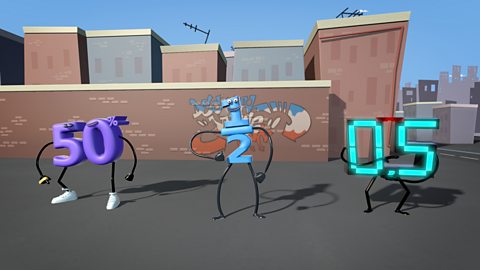
Decimal Dance Off 2 video
The connection between fractions, x decimals and percentages and how to convert between them are explored through a 'Decimal Dance Off'.
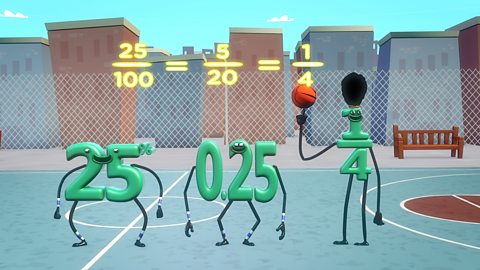
Geometry Rules OK. video
Introducing geometry, angles and shapes through a spoof house building show and an animation game show.
Pie And Pie Again. video
An introduction to pie charts and how they show relative proportions.
Prime Suspects 1. video
Introducing prime numbers, composite numbers and factors in a sketch show featuring puppet Detective L Stinker and his animated friends.
Prime Suspects 2. video
Decompose numbers into prime factors. End sketches look at primes and simple sequences.
Scale And Polish. video
A look at the meaning of scale factors and how they allow us to represent large objects in two and three dimensions.
Why Maths Why? video
This clip encourages students to overcome their fear of maths. Learning a few skills will give them the power to tackle the trickiest maths challenges.

X Marks The Thought. video
An introduction to using algebra to solve simple equations by using inverse operations.