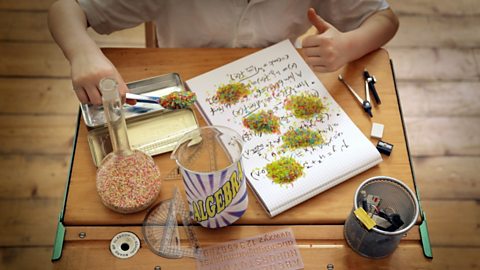
Narrator: Okay. Draw a rectangle.Now, measure the perimeter. It’s the total length around a shape. But what if you couldn’t measure the sides? Then you’d have to use what information you do know to work out what you don’t. You’ll need to work this out, but don’t panic:
V.O: Let’s kick some Maths!!
Narrator: You know a rectangle’s opposite sides are parallel – they’re always the same distance apart. And in a rectangle, these parallel lines are the same length. So straight away, you can do this.Now, using a careful methodology ~
Det.Lewis Stinker: Careful Methodology!
Narrator: Mark one corner and add up all the sides until you get back to the mark. So that’s 6 plus 4 plus 6 plus 4 which equals 20. 20, er, what’s the Unit of Measurement? Oh, I’m sure it doesn’t matter.
Crow: Mwaaaaaaargh!
Narrator: A polygon is a many-sided shape. A regular polygon’s sides are the same length. An irregular polygon’s sides are different lengths. Like this irregular polygon …If you want to find out the missing lengths to work out a perimeter then easy. First fill in the gaps using the sides opposite. We can see the sides are parallel and the corners are right angles, so we can be confident that the 8 plus 4 equals the opposite side, so it’s 12. And If 6 is the total opposite there, then we can work out that 6 minus 4 is 2, so that side’s 2! We’ve got all our missing sides.
Narrator: Now, to find the perimeter of the shape, mark one of the corners. Then add up each side in one big sum. Be careful. Make sure you don’t miss out one side, then stop when you get back to the mark. So, the perimeter of this polygon is 36! 36 thingmys.
Crow: THINGMYS!?!?!?!?!?
Narrator: Now, area. If you want to find out the area of this shape, that is the space within a shape, then don’t panic. It’s about breaking it down into simpler shapes and being methodical!
Narrator: Once you break it down it becomes 2 easy rectangles. And remember area is calculated by multiplying length by breadth. SO, 6 multiplied by 8 equals 48 somethingth squared.
Crow: THINGMEEES SQUARED!?!?!?!?!?
Narrator: 4 multiplied by 2 equals 8. And then you add your smaller shapes together to make up the bigger complicated one: 48 plus 8 equals 5656 Thingmybobs squared.
Crow: Aaaaaaaaaarrrrrh!
Narrator: Oh, I forgot to mention that you must ALWAYS write down what unit of measurement you are using. Always! Never forget. ALWAYS!. Happy now?
Narrator: So, that’s 56 centimeters squared. But you could carve it up differently and get the same answer! Look!
Narrator: Using what you know about Geometry and following the Rules, there are other neat things you can work out. For example, the area of a right angled triangle. Here’s one. As long as it has a right angle, imagine that the lines continue into the shape of a rectangle, with a length of 6 and a breadth of 5 centimeters. Now, multiply those together to get 30. That’s the area of our imaginary rectangle – but because our rectangle has twice the area of our triangle, we can halve that area to get the area of our triangle, and the answer is 15 centimeters squared.
Nefertiti: A top tip! The area of any triangle is height multiplied by width and then halved!
Narrator: And remember always…
Crow: ALWAYS WRITE DOWN UNITS OF MEASUREMENT!
Video summary
We demonstrate how to calculate the perimeter and area of simple and compound shapes.
The importance of using correct units in measurement is emphasised via the increasing annoyance of the Measuring Crow.
We also give the formula for the area of a triangle.
This clip is from the series Kick Sum Maths.
Teacher Notes
This clip can lead to discussion of what may go wrong if we don't write down our units while calculating area and perimeter.
Also, what operations make sense when dealing with units? For example, does metres + metres squared makes sense? What about metres x metres squared? Or pounds (£) per metre? Metres per pound?
These clips could be used for teaching Maths at KS2 or at a beginner level in England, Wales and Northern Ireland and 1st and 2nd Level in Scotland.
Decimal Dance Off 1. video
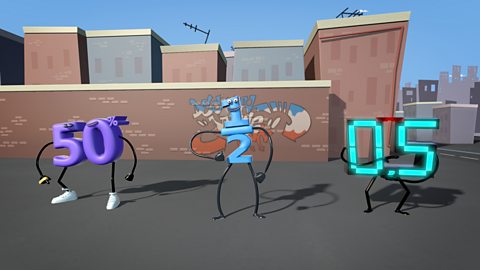
The structure of fractions, decimals and percentages are demonstrated through a 'Decimal Dance Off'.
Decimal Dance Off 2 video
The connection between fractions, x decimals and percentages and how to convert between them are explored through a 'Decimal Dance Off'.
Geometry Rules OK. video
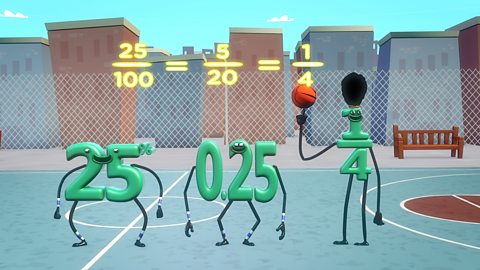
Introducing geometry, angles and shapes through a spoof house building show and an animation game show.
Let's Have Some Order. video
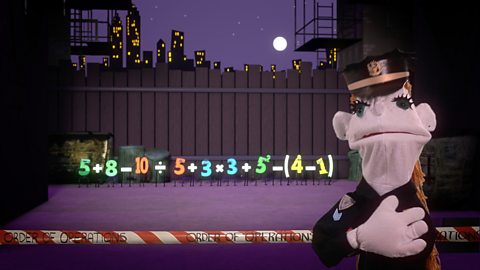
An explanation of why using the correct order in mathematical calculations is important.
Pie And Pie Again. video
An introduction to pie charts and how they show relative proportions.
Prime Suspects 1. video
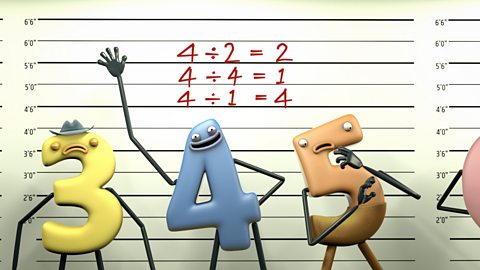
Introducing prime numbers, composite numbers and factors in a sketch show featuring puppet Detective L Stinker and his animated friends.
Prime Suspects 2. video
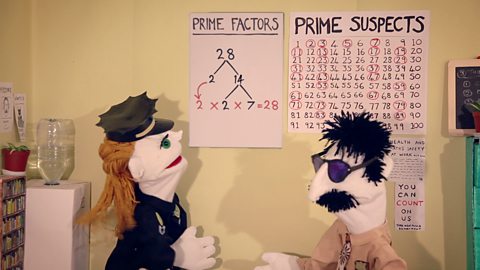
Decompose numbers into prime factors. End sketches look at primes and simple sequences.
Scale And Polish. video
A look at the meaning of scale factors and how they allow us to represent large objects in two and three dimensions.
Why Maths Why? video
This clip encourages students to overcome their fear of maths. Learning a few skills will give them the power to tackle the trickiest maths challenges.
X Marks The Thought. video
An introduction to using algebra to solve simple equations by using inverse operations.