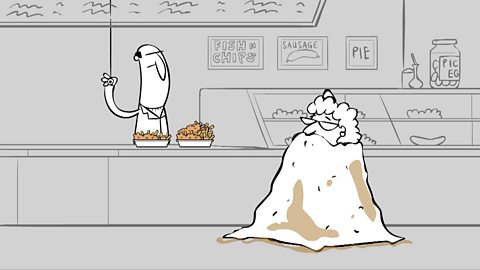
Cheesy V.O: Mum sent you to tidy your room?Want to get all this mess sorted out?You need ALGEBRA!
ALGEBRA tidies up any mess!
ALGEBRA helps you find what you need! It also helps solve the World’s Problems and unravel the mysteries of existence!
ALGEBRA: one of the main ingredients of SCIENCE!
ALGEBRA! From now on, Maths will never taste the same! Delicious!
V.O: Let’s kick some Maths!!
Narrator: Algebra isn’t really an edible powder that can tidy your room. But it is a kind of Maths that really does tidy up complicated problems and helps you find answers that are difficult to find. Algebra comes from Arabic language meaning ‘a reunion of broken parts’, and you’ll find out shortly how good it is at joining things together…
Ooh. A lamp. I wonder what’s in there?
Oh. This is very strange. Seeing something that’s not a number, surrounded by numbers. But don’t panic. This isn’t a mistake. It’s a whole new kind of Maths called Algebra! Let’s ~
Algebeard: Dance the Maths Shanty with Algebeard, the Maths Pirate! And we’ll all know Maths in the Mornin’!
Narrator: We can work out what’s in the lamp probably just by looking. After all, six, plus something, equals 10. What you’re looking at is an equation, which just means that something equals something else!
Algebeard: Like eating crisps in bed equals CRUMBS on your BUM! HAR HAR HAR HAR
Narrator: Well, I suppose that’s an equation of sorts. Back to this equation. What do we need to add to six to make ten? 4! But here’s a way to do it, that it’ll be useful when the problem is a bit more complicated. Think of the equals as the middle of a see-saw.
What’s on either side of the equal sign is in balance. So, we can write out the same problem in a different way but it’ll mean the same thing. See? Something equals 10 minus 6. And also note what happens to the plus when it travels from one side of the equals to the other: it becomes the opposite operation, or as we say in Maths, the inverse operation: addition to subtraction. And then 10 minus 6 is 4.
Algebeard: What’s it for?!?
Narrator: No. Four. Not For.
Algebeard: OH! The Number 4! You see being ALGEBEARD the Algebra Pirate, I don’t always do Numbers! I be doing all sorts of things! I’m very flexible see!
Narrator: Okay. Fine. It’s the number 4. Just, try not to interrupt again.
Algebeard: Got you matey!
Narrator: In Algebra, instead of drawing a lamp to signify an unknown, we use a letter, so let’s use X. But notice it’s a squidgy kind of X, so we don’t mistake it for a multiplication sign. Get into the habit of drawing your algebraic X’s not like other X’s. Anyway, look at this: 6 multiplied by X equals 24. Is there another way we can write out this problem? Remembering the whole equals-sign-balance inverse thing? Yes! If X times 6 equals 24, then 24 divided by 6 must equal X. And the answer to that? X is 4!
I’m very impressed that you’re now working with letters as well as numbers doing equations. So, let’s see how good you are working with two different letters in the same maths problem!
Algebeard: I always be working with these two letters! AAAAAARRRRRRRR !
Narrator: sigh Okay. Let’s simplify this expression. Here is 8x plus 3y minus 5x plus 2y. Confused? Well, 8x just means 8 times x and 3y just means 3 times y. And so on. And when working through this problem remember that we combine like terms – or work with the same things. So, what looks alike? Well, we’ve got two Xs: 8X and minus 5X, so we put them together and two Ys – plus 3Y and plus 2Y. And once the similar terms are together, we work through them, so we get 3X plus 5Y. But we can’t add x and y together, because they’re not the same! So, 3X plus 5y is our answer.
Narrator: That’s the beauty of Algebra.
Algebeard: Why Thankee Sir, I do my best!
Narrator: Even though problems can look quite odd, with numbers and letters all mixed together, try to remember; that an equation is a kind of maths seesaw, with operations becoming their inverse on the opposite side; and when working with more than one letter, combine like terms. If you remember those rules, you’ll do well! And once you learn the basics, who knows where Algebra will take you?
Algebeard: Oh I knew a lass with a squidgy X and I must confess that I made a mess of failin' in identifying what I thought was multiplyin' and I've never been fined for a lack of tryin'. The squidgy X that I loves the best!!! Har har har har har
Algebeard: We be pirates !!!
Video summary
In this clip the basic principles of algebra are explained and explored.
We see an equation of the kind that students will be expected to solve, where an icon stands for an unknown.
We replace the icon with “x” and demonstrate solving simple equations by using inverse operations.
We also see examples of simplifying an expression by collecting like terms.
This clip is from the series Kick Sum Maths.
Teacher Notes
Aside from introducing Algebra, this clip contains literacy elements such as the etymology of the word “algebra”, “like terms”, “inverse”, and “drawing a squidgy x”.
Students could explore the etymology of other mathematical words and phrases and also compare and contrast the mathematical meanings of some words to their everyday usage.
These clips could be used for teaching Maths at KS2 or at a beginner level in England, Wales and Northern Ireland and 1st and 2nd Level in Scotland.
As The Crow Flies. video
A demonstration of how to calculate the perimeter and area of simple and compound shapes with the help of the crow and Detective Stinker.
Decimal Dance Off 1. video
The structure of fractions, decimals and percentages are demonstrated through a 'Decimal Dance Off'.
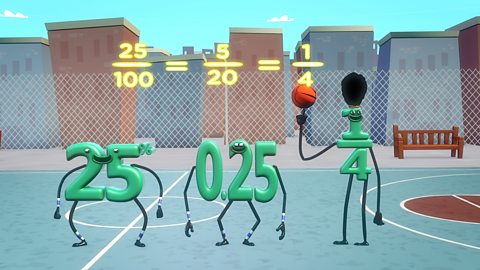
Decimal Dance Off 2 video
The connection between fractions, x decimals and percentages and how to convert between them are explored through a 'Decimal Dance Off'.
Geometry Rules OK. video
Introducing geometry, angles and shapes through a spoof house building show and an animation game show.
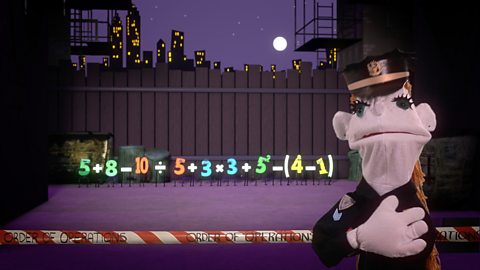
Let's Have Some Order. video
An explanation of why using the correct order in mathematical calculations is important.
Pie And Pie Again. video
An introduction to pie charts and how they show relative proportions.
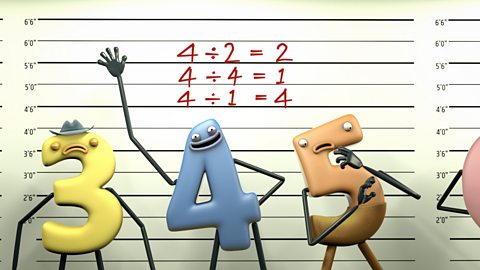
Prime Suspects 1. video
Introducing prime numbers, composite numbers and factors in a sketch show featuring puppet Detective L Stinker and his animated friends.
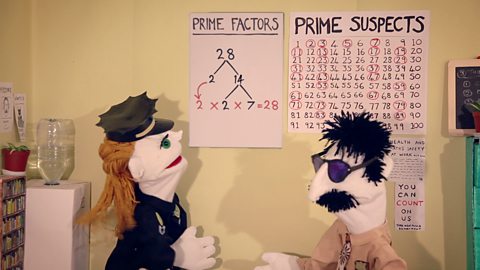
Prime Suspects 2. video
Decompose numbers into prime factors. End sketches look at primes and simple sequences.
Scale And Polish. video
A look at the meaning of scale factors and how they allow us to represent large objects in two and three dimensions.
Why Maths Why? video
This clip encourages students to overcome their fear of maths. Learning a few skills will give them the power to tackle the trickiest maths challenges.