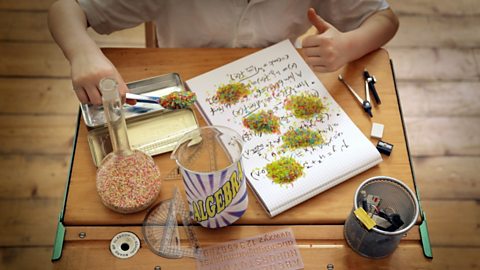
Narrator: Fractions, Decimals and Percentages. Can you change one into another? Out of this crowd, can you find the ones that are the same value? It might look confusing, but ~
Det. Lewis Stinker: If you take it nice and slow and stay real calm. You can ~
V.O: Kick Sum Maths!
Narrator: Do you remember equivalent fractions? That a quarter is equivalent to 4/16ths or 5/20ths?Well, knowing how to work out what fractions are equivalent, is great training for working out what fractions, decimals and percentages are equivalent. Just always remember what decimals and percentages are.
Rapper: Decimals are columns after zero point. Percentages are hundredths – You got that boy!and girl
Narrator: Respect. They look familiar.
Once you know how fractions, decimals and percentages are related, it’s straight forward to recognise that a half is the same as 0.5 and 50%.
Well, with a bit of practice you’ll be able to spot similar fractions, decimals and percentages on sight, but until you do, you need to know how to convert one into the other. So, let’s start with a fraction. What about 1/10? How do we change a fraction into a percentage? A percentage is a fraction of 100, so let’s scale up that denominator to 100! Multiply the denominator by 10 to get 100, and to keep the numerator and denominator in proportion, also multiply the numerator by 10! So, we’re looking for 10%. There she is.
What about 0.25? Well, it's got two decimal places, which means that we're talking about hundredths. Hundredths are parts of a hundred, which is exactly what percentages are! So 0.25 is 25/100, which is 25%! Numbers with two decimal places are easy to convert to percentages, look 0.43 becomes 43%, 0.97 becomes 97% and so on.
But what about our fraction answer of 25 over a hundred? We should simplify this! And we can by dividing by 5! We get 5/20ths because 25 divided by 5 is 5, and 100 divided by 5 is 20. But we could simplify this even more by dividing by 5 again! And then our answer is 1 over 4: one quarter!
Narrator: Okay! Just one more practice! What about turning this percentage, 75% into a fraction and decimal? Now percentages are easy, because you already know that a percentage is a something of a hundred, so 75% can be immediately written down as a fraction as 75 over 100. Then we simplify! We get ¾! To convert percentages into decimals, what do we do? Divide by 100! We get 0.75.
That’s a lot to remember in one go, but if you keep practicing, or watch this film again and again, you’ll get it. Eventually, you’ll also be able to put fractions, decimals and percentages in order just by looking. You’ll be able to see past the differences in how they’re written out and realise that they’re all really saying the same thing!
Now, it’s time to get busy with the language of dance! And we have a late entry! A third expressed as a decimal.Some numbers go on and on….
Video summary
In this clip we show that percentages are amounts out of 100, which may simplify to an equivalent fraction.
Division by 100 is used to convert percentages to decimals. Equivalent fractions and place value denominators are used to convert between decimals and fractions.
The concept of a recurring decimal is also introduced.
This clip is from the series Kick Sum Maths.
Teacher Notes
This clip could be used to demonstrate how being able to convert between fractions, decimals and percentages enables us to compare quantities presented in different ways.
Simple examples of comparison are questions such as “who's result is better: 12/20 or 55%?”
These clips could be used for teaching Maths at KS2 or at a beginner level in England, Wales and Northern Ireland and 1st and 2nd Level in Scotland.
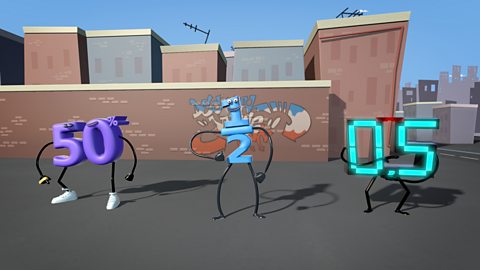
Decimal Dance Off 1. video
The structure of fractions, decimals and percentages are demonstrated through a 'Decimal Dance Off'.
As The Crow Flies. video
A demonstration of how to calculate the perimeter and area of simple and compound shapes with the help of the crow and Detective Stinker.
Geometry Rules OK. video
Introducing geometry, angles and shapes through a spoof house building show and an animation game show.
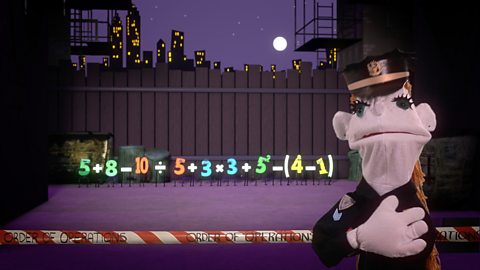
Let's Have Some Order. video
An explanation of why using the correct order in mathematical calculations is important.
Pie And Pie Again. video
An introduction to pie charts and how they show relative proportions.
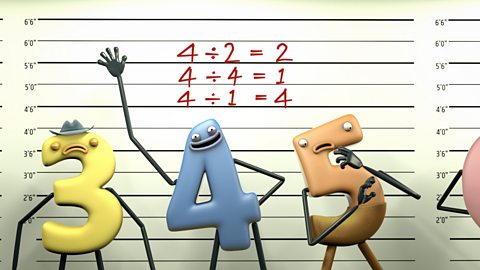
Prime Suspects 1. video
Introducing prime numbers, composite numbers and factors in a sketch show featuring puppet Detective L Stinker and his animated friends.
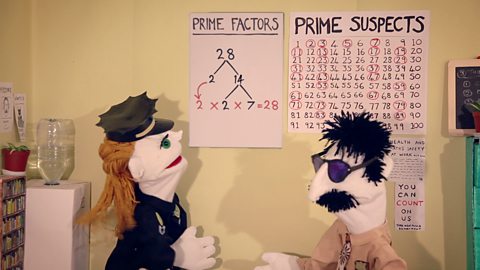
Prime Suspects 2. video
Decompose numbers into prime factors. End sketches look at primes and simple sequences.
Scale And Polish. video
A look at the meaning of scale factors and how they allow us to represent large objects in two and three dimensions.
Why Maths Why? video
This clip encourages students to overcome their fear of maths. Learning a few skills will give them the power to tackle the trickiest maths challenges.

X Marks The Thought. video
An introduction to using algebra to solve simple equations by using inverse operations.