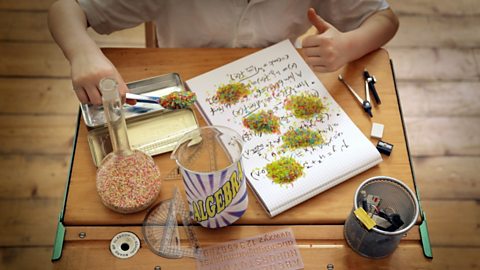
Keiran McLean: Building your own home is an exciting adventure for any family, but for one couple, Hugh and Daisy Watson, they’re really embracing the unknown.
Hugh Watson: Hi
Keiran McLean: Hello!
Keiran McLean:So, tell me about the architect who’s designing your new home?
Daisy Watson: Yes, he’s Cosmo Wunderlich. Ignores all the boring rules. Can’t wait to see his design.
Keiran McLean: So tell me about your exciting new design!
Cosmo Wunderlich: I can’t.
Keiran McLean: Is it a secret?
Cosmo Wunderlich No. It’s just that I don’t use the language of geometry.
Keiran McLean: Is your building square? Rectangular? Triangular roof? Any parallel lines? Right angles? Any parallelograms?
Cosmo Wunderlich: Ha! You just made that word up. Parallel o gram… There’s no such thing!
Keiran McLean: Yes there is. A parallelogram is a ~
Cosmo Wunderlich:Listen you boring man, it’s the 21st Century! I don’t need to know this building blocks stuff. I am not a child. I will build a house for Hugh & Daisy and it will be beautiful. Geometry! HA! Who needs it!?!?
Keiran McLean: It’s a year later, let’s see what he’s built.
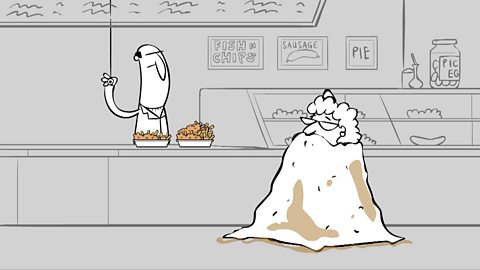
Narrator: Don’t worry. I’m sure they’re absolutely fine underneath there. clears throat. You see, Geometry is serious stuff. There’s a bit to learn, but don’t panic. You can do it! Now ~
V.O: Let’s kick some Maths!!
Narrator: Geometry is how Math’s measures and describes the world around us, and can describe simple shapes like squares or triangles Right up to the most complicated shapes. But you don’t have to worry about the complicated stuff now. Or 3D shapes just yet.
Narrator: What’s important to understand is that geometry has rules, has facts you need to know. Here’s a rule you probably know: that a shape with 4 right angles and 4 equal sides is a square! What’s an angle again? It’s a measure of the amount of turn between two lines! A box in the corner means that it’s a right angle!
Narrator: These two lines are perpendicular, which just means they are on either side of a right angle. The lines facing each other are parallel. This means they’re always the same distance apart. They’d never meet, even if they stretched on forever! We use matching arrows to show parallel lines.
No matter the length of the sides, as long as they’re equal and there are 4 right angles of 90 degrees – it’s a square! It’s always a square!
Narrator: But what if I squeeze this square? Two angles get wider and two get narrower. Now, it’s still got four equal sides, but it’s not a square, it’s a rhombus! All its angles add up to 360 degrees, just the same as any four sided shape. But a rhombus has matching pairs of opposite angles. Two are acute angles, smaller than 90 degrees. And two are obtuse angles, bigger than 90 degrees. That angle is 65 degrees. Can you work out the others?
Narrator: Don’t panic. You have all the information you need to beat this problem. And this is pretty much what geometry and a lot of Maths is about. Using what you know to find out what you don’t. The answer is staring you in the face. So stare back. And Kick Sum Maths!
Narrator: So, we know the angles add up to 360 degrees, and that the angles that face each other match, so right away you can fill in that as 65 degrees too. Now, the other 2 angles must match too – but what are they? Well, if ALL the angles add up to 360 degrees, then how about this? Take the sum of those angles, 65 + 65 = 130 from the total of 360 and you get 230. The other two must add up to 230, so divide 230 by 2 and you get 115! Easy!
Narrator: You’ll be asked a lot of questions about triangles.
NEFERTITI: Tell me about it.
Narrator: So, it’s important to know that there are 4 different types of triangles. An equilateral triangle has equal sides and equal angles.
Narrator: An Isosceles triangle, has 2 equal sides and 2 angles that are equal.
Narrator: A right angled triangle has a right angle in it, but not necessarily any equal sides.
Narrator: And a scalene triangle has different sides and different angles. But remember, all the angles in a triangle add up to 180 degrees
Narrator: So, if I were to ask you what the missing angle is ~ here?
You’d be able to use what you know to find out what you don’t. That is a right angle, and that is 40 degrees so, 180 minus 90 minus 40 equals 50! And that’s the magic of geometry! Whatever the problem is, use the information you are shown, plus the information you already know, with a careful step by step method to find the answer. And that’s Maths explaining itself right there!
Narrator: Isn't that right maths lamb?
Maths Lamb: Maaaaaaaath
HOST: Ladies and gentlemen, boys and girls, it’s time for another exciting addition of the geometry based gameshow, that you can play along at home. Name That Shape!
So without further ado, contestant Number 1…
Can you… Name That Shape?!
Number1: Errr…Emmm…
HOST: I can tell you it's got 4 sides…
Number 1: A quadrilateral, hmm, rectangle, kite, rhombus, trapezium…
HOST: And all the sides are equal.
Number 1: It could be a rhombus, or maybe a square…
HOST: What if I told you that all the corners are right angled?
Number 1: Are you telling me that?
HOST: Yes
Number 1: It’s a square.
HOST: It is a square! Well done contestant number 1. You’ve won an all expenses paid luxury holiday to the planet Mars!
Number 1: Yeah!!!
HOST: Contestant Number 2…
Can you… Name That Shape?!
Number 2: A triangle!
HOST: I’m going to have you to be more specific. What type of triangle?
Number 2: Uh… A big one?
HOST: All the interior angles are equal…
Number 2: Oh an equilateral triangle!
HOST: It is an equilateral triangle. You really know your geometry contestant Number 2… and you’ve one… a lifetimes worth of chocolate ice cream!
Number 2: Hmmm Yeah!! I like icecream
HOST : Okay contestant Number 3 I’ve got a very simple shape for you…For your chance to win your very own magical wish granting unicorn, can you Name That Shape?!
Number 3: Err…Err…
HOST: I’m going to have to hurry you!
Number 3: A sausage?
HOST: No I’m sorry- a sausage??
Number 3: A squid?.. A squirrel?.. A squid riding a squirrel?
HOST: You’re really going to kick yourself when I tell you… It was a GOMBOC! I’m sorry contestant Number 3 but for getting that wrong you lose a million points and have to spend a week in the horrible dungeon of nasty smellyness!
Number 3: No please, anything but the horrible dungeon of nasty smellyness!
HOST: Well that’s all for this weeks show, but make sure you tune in next time when we’ll be playing… Name That Squirrel!.. I mean shape! Name That Shape!!
Johnny James: What is it you want boss?
Editor: You’re the best young reporter at this newspaper Johnny.
Johnny James: Thanks boss.
Editor: And I’m sure you’ve heard the news. There’s a giant parallelogram that’s escaped from a geometry research laboratory. Those crazy geometrists always thinking they can play god. When will they ever learn!!! It’s the “teaching a triangle to sing” debacle all over again.
Johnny James: What do you want me to do about it boss?
Editor: It’s a beserk giant parallelogram. I want you to go out and get the “angle” on this story.
Johnny James: Right away boss!
Johnny James: I think I’ve got the right angle for the story boss!
Editor: It’s a right angle sure. But it’s a parallelogram so a right angle is the WRONG angle! Now go out again and get me the angle on this story.
Editor: That’s a straight line! The only angle you’ll get from that is 180 degrees and that’ll turn everything upside down.
Editor: Now THAT’S the angle I’m looking for. Well done Johnny. You’ve knocked this story into shape.
Scientist: Behold Igor, my latest and most fantastical creation. The like of which the world has never seen!
Scientist: I call it a “Frankencube!”. It’s like a square, with pairs of sides that are equal in length and parrallel, but look closely my mutant chum and you will see that there are NO RIGHT ANGLES!! AH-HA-HA-HA-HA!!!
Igor: It’s a rhombus
Scientist: What?
Igor: A rhombus. It’s what you’s get if you stitch two triangles together.
Scientist: So it’s not a new shape?
Igor: No master. In fact it’s quite common.
Scientist: Oh dear. Back to the drawing board.
Igor: What do you want me to do with your creation?
Scientist: Dispose of it Igor. I have new shapes to create!
Rhombus: Rhombus want to live!
Igor: Oh look master, he’s left a hole. It’s in the shape of a Frankencube!
Video summary
A demonstration of the importance of using correct mathematical language.
Descriptions of acute, right and obtuse angles as well as parallel and perpendicular lines.
We compare and contrast the geometric properties of different triangles and quadrilaterals.
A sketch explores naming shapes through their properties, while another looks at different types of angles and how they relate to shapes.
One final sketch explores the properties of a rhombus.
This clip is from the series Kick Sum Maths.
Teacher Notes
Pupils could work in pairs. One has a 2D shape and describes it to their partner using mathematical language. The other student attempts to draw the shape. Compare the shape drawn to the shape described.
These clips could be used for teaching Maths at KS2 or at a beginner level in England, Wales and Northern Ireland and 1st and 2nd Level in Scotland.
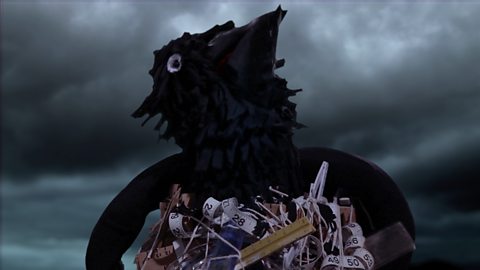
As The Crow Flies. video
A demonstration of how to calculate the perimeter and area of simple and compound shapes with the help of the crow and Detective Stinker.
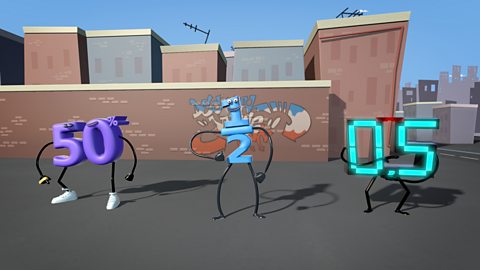
Decimal Dance Off 1. video
The structure of fractions, decimals and percentages are demonstrated through a 'Decimal Dance Off'.
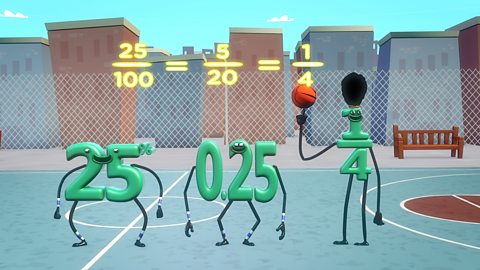
Decimal Dance Off 2 video
The connection between fractions, x decimals and percentages and how to convert between them are explored through a 'Decimal Dance Off'.
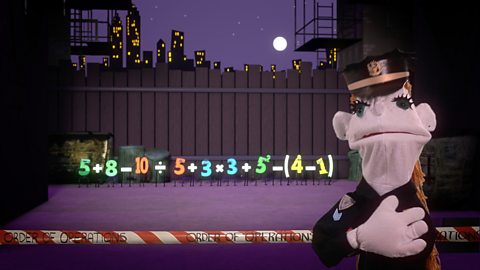
Let's Have Some Order. video
An explanation of why using the correct order in mathematical calculations is important.
Pie And Pie Again. video
An introduction to pie charts and how they show relative proportions.
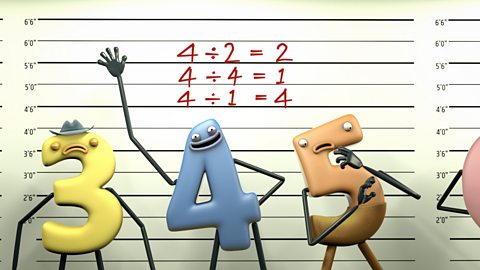
Prime Suspects 1. video
Introducing prime numbers, composite numbers and factors in a sketch show featuring puppet Detective L Stinker and his animated friends.
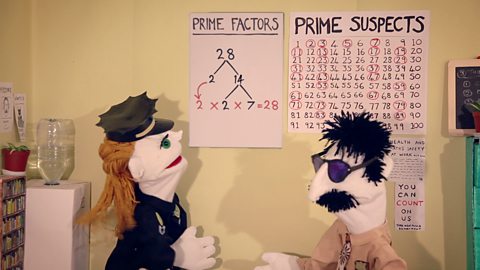
Prime Suspects 2. video
Decompose numbers into prime factors. End sketches look at primes and simple sequences.
Scale And Polish. video
A look at the meaning of scale factors and how they allow us to represent large objects in two and three dimensions.
X Marks The Thought. video
An introduction to using algebra to solve simple equations by using inverse operations.