CHARLES DARWIN: Hi fans, followers and friends, Charles Darwin here, the man who's going to give you the theory of evolution and natural selection. My theory is plants and animals do not stay the same, they change over time. Natural selection is the adaptation of organisms to their environment and the conditions in which they live.The better they adapt, the more likely they are to survive and reproduce passing on those good genes and characteristics to their offspring.
ALFRED WALLACE: Excuse me Charles, unbelievable, you seem to have started without me. Always trying to take all the credit for our joint theory of evolution aren't you?
CHARLES DARWIN: Keep your hair on, Wallace, I was just trying to make a start.
ALFRED WALLACE: Clearly.
ALFRED WALLACE: Natural selection is the survival of the fittest. We have evolved over time from simple specimens that first lived over three billion years ago.
CHARLES DARWIN: So, how did we come up with our theory on evolution and natural selection?
ALFRED WALLACE: Well, for some time now myself and Charles Darwin have both been independently and unknowingly investigating the connection between animals and humans, asking the scientific question what the origin of plants and animal species is, where we came from, and how we all came to be.
CHARLES DARWIN: Yes, and would you believe, humans shared a common ancestor with chimpanzees millions of years ago. [imitates monkey]
CHARLES DARWIN: To prove this hypothesis was correct I set off on my voyage on the HMS Beagle to Australia and the Galapagos Islands. While I was there I started to put into practice my scientific method, this was through-ALFRED WALLACE: -experimentation in the form of observation.
CHARLES DARWIN: Yes, observation and documentation was key to this discovery. For example, I observed adaptations of finches' bodies, beaks, and claws on the Galapagos Islands. I carefully recorded that, depending on the food source, the finches had different features in order to survive.
ALFRED WALLACE: Likewise, whilst I was in Brazil in 1848, in the Amazon, collecting specimens of butterflies, insects and birds, I observed the different species and recorded my findings accurately. I also found variations in different species depending on their living conditions and the environments they inhabited.Sadly, all the specimens I collected never made it home as the ship caught fire destroying them all.
CHARLES DARWIN: Dreadful ordeal for you, Wallace, but it didn't stop you did it?
ALFRED WALLACE: No, it didn't, I set sail in 1854 on an eight-year trip around Singapore, Malaysia and Indonesia where I carried out observations on species. I observed how they'd adapted to their environment and I categorised them based on their characteristics.When I returned, I started to write up my findings, summarising the reasons as to why I thought some animals became extinct and that's when I contacted Darwin and we realised we'd discovered and determined the same theory of evolution and natural selection.
CHARLES DARWIN: Yes, I was over 250,000 words into writing my natural selection book when I received your letter backing up my theories.
ALFRED WALLACE: Our theories you mean!
CHARLES DARWIN: Well, that's it for today's vlog.
ALFRED WALLACE: Hey, maybe next time you guys are outdoors, you could observe a bird, an insect or a mammal and document how it's adapted to survive to its environment. Look at their beaks, claws and other features.
CHARLES DARWIN: And remember there's hundreds of thousands more species waiting to be discovered, and who knows, if your records are really good, one day, you could find one. They might even name one after you. Oh and don't forget to subscribe to my channel, it's Charles Darwin Da Man.
ALFRED WALLACE: Really?!
Video summary
This vlog style film explores how Charles Darwin and Alfred Wallace came up with the theory of evolution and process of natural selection.
It is set in 1858 and explains the adaptation of plants and animals to their environment.
The film covers covers how they both explored the connection between animals and humans, and asked scientific questions: what the origin of plant and animal is; where we all came from and how we all came to be.
They found that humans shared a common ancestor with chimpanzees.
To prove their hypothesis, Darwin travelled on the HMS Beagle to Australia and the Galapagos islands.
While there, he used scientific method of observation, documentation, adaption of finches to food sources.
Wallace was in Brazil in 1848 collecting butterflies, insects and birds, when he noticed variations in species depending on their living conditions.
His specimens were destroyed by fire on the return journey, but he carried on.
The vlog covers how, in 1854, he started an eight year trip to Singapore, Malaysia and Indonesia; observing species and categorising them based on their characteristics.
The process shows an example of thinking skills.
This clip is from the series Scientists and their discoveries.
Teacher Notes
As a starter to introduce a practical science activity, you could write a simple quiz to encourage pupils to capture the keywords shown in the video.
Pupils can write their own definitions from these words using the internet or science dictionaries to improve their scientific vocabularies.
To consolidate their knowledge, you could get pupils to make booklets that include key information about Darwin and Wallace.
They could define the keywords featured in the film, and find five or more pieces of additional pieces of information about the work of the scientist using books, encyclopedias or the internet.
Suitable for teaching Science at Key Stage 2 in England, Wales and Northern Ireland and at 2nd Level in Scotland. They also have cross-curricular links with History and Literacy.
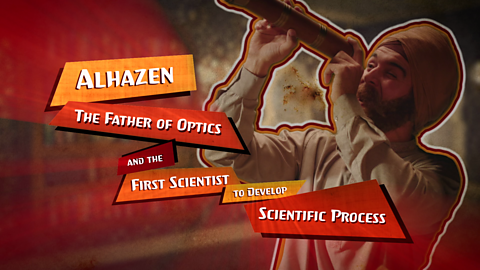
The work of the ‘father of optics’ Alhazen. video
This vlog style film introduces the work of Alhazen, and the scientific discoveries that he made about optics and the eye.
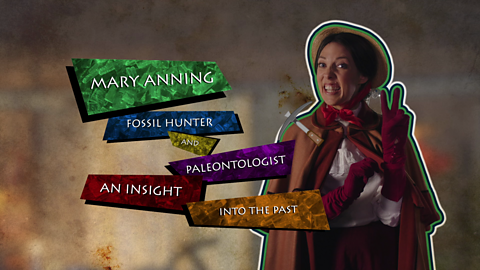
The work of Mary Anning. video
This vlog style film explores the work of Mary Anning; the famous paleontologist and fossil hunter.
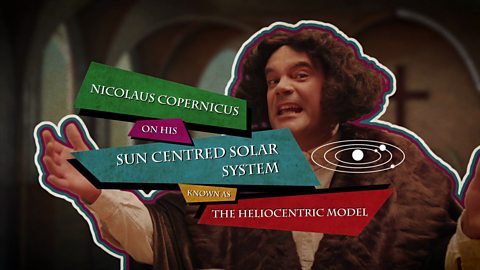
The work of Nicolaus Copernicus. video
This vlog style film introduces the work of Nicolaus Copernicus, and the scientific discoveries he made about the solar system.
The work of Galileo Galilei. video
This vlog style film explores the work of Galileo Galilei around forces, and how they work.
The work of Caroline and William Herschel. video
This vlog style film introduces the work of Caroline Herschel and and her brother William Herschel.
The work of Andre Geim and Konstantin Novoselov. video
This vlog style film explores how two Russian scientists, Geim and Novoselov, accidentally discovered a 'wonder material' called graphene.
The work of Carl Linnaeus. video
This vlog style film introduces the work of Swedish scientist, Carl Linnaeus. He talks about his scientific method - taxonomy - used for classifying plants, animals and stones.
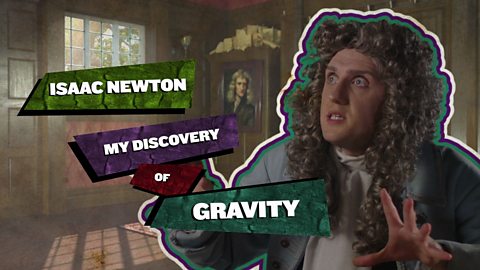
The work of Sir Isaac Newton. video
This vlog style film explores the work of Sir Isaac Newton as a physicist and astronomer, and how he made one of his biggest discoveries - gravity.