SAM: I'm hungry, Granddad. We have been walking for ages and we didn't find anything to eat.
GRANDDAD: It hasn't rained for a long, long time, Sam. Without water, plants can't grow.
SAM: But my tummy's rumbling.
GRANDDAD: Lots of animals had to walk a lot further than us to find food. I'm sure their tummies were rumbling too.
SAM: Like who?
GRANDDAD: Like the brown bears. A long, long, long, long time ago, there were lots of brown bears who lived in a forest but they had a problem - there wasn't enough food for them all.
BEAR: I'm sorry, everyone. These are really hard times for us all. We'll have to split up to find food. Some of us can stay here in the forest but some of us must go to the hot South to find food and some of us will have to go to the cold, cold North.
SAM: I wouldn't want to go where it was very, very cold - I'd be so shivery.
GRANDDAD: That's how the brown bears felt when, after a long, long journey, they reached the edge of the forest.
YOUNG BEAR 1: Ooh, I don't like it here - it's very cold. And the only food I can see are the seals way out there on the ice.
YOUNG BEAR 2: Well, I'm hungry. Let's go hunting.
SAM: Did they catch the seals?
GRANDDAD: They tried… but their small paws weren't used to walking on snow and ice. They slipped and slithered all over the place and the seals were able to get away.
YOUNG BEAR 2: Oh, no!
SAM: So what did they eat?
GRANDDAD: In the summer, they could eat fish but in the winter, when the water had frozen, they had to try and get the seals.
SAM: Did they ever catch any seals?
GRANDDAD: Sometimes. But then, after a long, long time, a brown bear was born with bigger paws, with thicker pads.
BIG-PAWED BEAR: I can run and not fall over!
THEY LAUGH
GRANDDAD: The young brown bear's paws were perfect for walking on the snow and ice.
SAM: What happened to the other bears?
GRANDDAD: They found it harder to survive. The bears with the bigger paws did better.
SAM: Hooray for the brown bears. But weren't they still very cold?
GRANDDAD: Not all of them. Some were born with thick fur and they were better at coping with the freezing weather.
SAM: So could they catch lots of seals?
GRANDDAD: Not many - their fur was still brown and that meant the seals could still see them coming.
BEAR: Oh, no! Fish again!
GRANDDAD: One day, a brown bear was born that had lighter fur, almost white - so when he crept up on a seal…
SAM: The seal didn't see him coming.
LIGHT-FURRED BEAR: Rarr!
GRANDDAD: And after a long, long, long time, more and more bears were born that were white and they could all catch seals more easily.
POLAR BEAR 1: Hic! Delicious!
POLAR BEAR 2: Yummier than fish any day.
GRANDDAD: And now they're called polar bears.
SAM: And do polar bears like living in the snow and ice?
GRANDDAD: They do.
SAM: And brown bears like living in the forest?
GRANDDAD: And we like living on our island.
SAM: Especially when it rains and there are lots of green plants to eat. Granddad, are there such things as green bears?
Video summary
An animation describing how brown bears adapted to life in the Arctic.
Sam, a young tortoise, is hungry. Granddad Charlie tells him a story about how brown bears had to travel a long distance to find food.
A group of brown bears went to a region which was cold and inhabited by seals living on ice. The bears were hungry but their paws weren't good for walking on snow and ice, their fur wasn't thick enough for the cold conditions and the seals could easily see them coming with their brown fur.
After a long, long time, some bears were born with bigger, thicker paws and with warmer, lighter-coloured fur. These were the bears who flourished. They are now called polar bears.
Teacher Notes
- When looking at variation, pupils could be challenged to identify the similarities and differences between the brown bear and the polar bear.
- The pupils could use the clip to write simple stories on the journey of the brown bear.
- This clip could also initiate a discussion by asking pupils what might happen if the brown bears went on holiday to the polar regions and the polar bears went on holiday to the forests.
This clip is relevant for teaching Science at KS1 in England and Wales, Foundation and KS1 in Northern Ireland, and early level and first level in Scotland.
The difference between nocturnal and diurnal animals. video
Discover how animals that hunt and forage at night are quiet, while those active in the daytime make lots of noise.
How have different animals adapted to their habitats? video
Explore how four separate climates lead to very different animal adaptations in lizards, camels, bats and penguins.
How squirrels collect nuts. video
Find out how hungry grey squirrels beat the coming winter by stocking up on autumn nuts and acorns.
The problems facing seabirds. video
Birds flying south for winter find their journey fraught with human-made dangers.
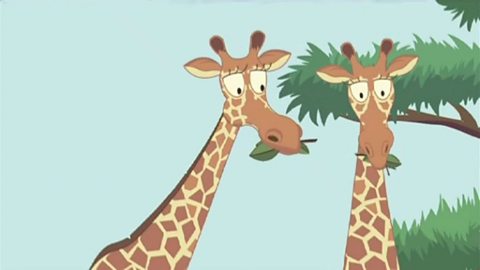
Why does the giraffe have a long neck? video
Giraffes compete for food with other animals of the African plains and adapt over time.
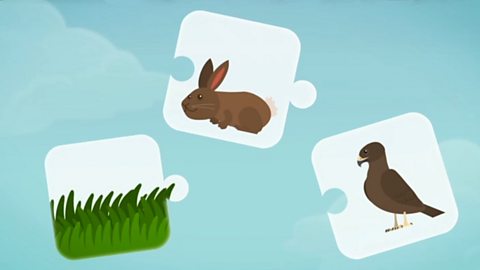
What is a food chain? video
Explore simple food chains, in which plants are eaten by prey animals, which are eaten by predators.
Rock pools. video
Discover how plants and animals in a beach tide pool have found ways to survive the constantly changing sea levels.
Where do owls live? video
Find out how owls survive in the snow, in forests, and even in deserts thanks to their wise adaptations.
Animals. collection
A collection of KS1 science clips about animal classification. Watch simple introductions to fish, amphibians, marine life, egg-laying animals, spiders, animals with patterns and nocturnal wildlife.