Two owls sitting in the dark looking all around them and looking at you. What huge eyes they've got. They've got very good eyesight and very good hearing. Most owls are awake at night and go out to look for their food when it's dark.
Here's a Scops owl, balancing carefully on top of a tree while he eats a big juicy insect.
Different kinds of owl can be found living in most parts of the world.
Snowy owls are able to survive in the freezing cold in the Arctic. They're nearly all white, with a few dark spots, and this helps them to blend into the background when it snows. They are among the largest owls in the world and can be seen flying during the day.
There aren't any trees in the Arctic for the owls to live in - it's too cold for trees to grow - so the owls nest on the ground. Snowy owls often have lots of chicks. Some owls only have one or two. They huddle together against the freezing Arctic wind, waiting for their mother to return with food for them. The oldest chick is already learning to wander off. And you can see his first white feathers coming through on his back and feet.
Like snowy owls, great grey owls are also able to cope with very cold weather. They live in chilly pine forests. They have very thick feathers to cope with the cold, and they hunt in the daytime. The great grey owl chick waits patiently in a tree, hardly moving and staring straight ahead. He may look worried, but his parents are close by.
One of the smallest owls in the world lives in a hot place, the desert. There aren't any trees here, so the elf-owl lives in tall cactus plants. He hunts at night and catches insects.
This owl does need trees to nest in. It's called a flammulated owl, and he lives in mountain forests. He's able to hide completely in his tree home because his feathers look just like the bark of a tree. If he stands very still - and owls are very good at that - you can hardly see him.
No wonder owls are known for being wise. They're very clever at coping with different weather and different places to live.
Video summary
A look at different types of owls around the world and how they have adapted to the different places they live in.
The species shown include snowy owls in the Arctic, great grey owls in the pine forest, elf owls in the desert, flammulated owls in mountain forests, and British barn owls.
This clip comes from the BBC series, Our Planet, Skin Patterns and Owls.
Teacher Notes
- This clip can be used to highlight the similarities and differences within a species. It could be used to look for patterns when grouping and classifying things.
- The clip could be used without sound to encourage the pupils to suggest features that are common to all owls.
- Through watching, pupils can observe a variety of owls and develop their understanding of how they have adapted to suit their environments.
This clip is relevant for teaching Science at KS1 in England and Wales, Foundation and KS1 in Northern Ireland, and early level and first level in Scotland.
The difference between nocturnal and diurnal animals. video
Discover how animals that hunt and forage at night are quiet, while those active in the daytime make lots of noise.
How have different animals adapted to their habitats? video
Explore how four separate climates lead to very different animal adaptations in lizards, camels, bats and penguins.
How squirrels collect nuts. video
Find out how hungry grey squirrels beat the coming winter by stocking up on autumn nuts and acorns.
The problems facing seabirds. video
Birds flying south for winter find their journey fraught with human-made dangers.

Why did the brown bear evolve into the polar bear? video
Bears migrate to the frozen Arctic and find it difficult to hunt seals until they gradually evolve to suit their habitat.
Why does the giraffe have a long neck? video
Giraffes compete for food with other animals of the African plains and adapt over time.
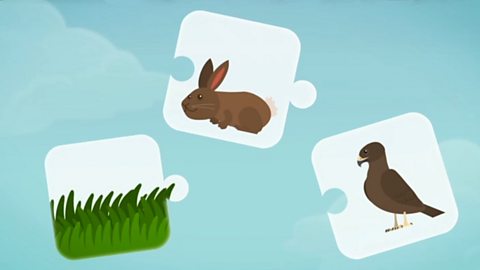
What is a food chain? video
Explore simple food chains, in which plants are eaten by prey animals, which are eaten by predators.
Rock pools. video
Discover how plants and animals in a beach tide pool have found ways to survive the constantly changing sea levels.
Animals. collection
A collection of KS1 science clips about animal classification. Watch simple introductions to fish, amphibians, marine life, egg-laying animals, spiders, animals with patterns and nocturnal wildlife.