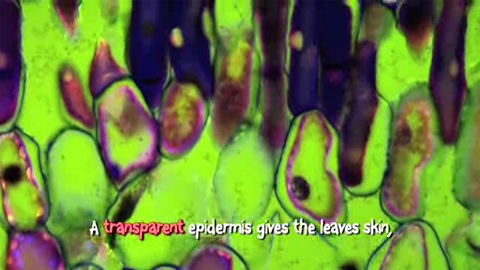
JON CHASE:'Water moves in and out of living cells across their cell membranes. 'These membranes are partially or selectively permeable.
JON CHASE:'Check which term you need to use.'
JON CHASE:Osmosis is a special type of diffusion which happens across a membrane, and it's always in regards to water.
JON CHASE:'The hockey net represents the membrane.' You have some water molecules there.
JON CHASE:'The blue balls represent water molecules, 'and the other colours are different sized solute molecules 'which are dissolved in the water.'
JON CHASE:I want you to send different sized molecules at this membrane, and see what happens.
JON CHASE:'The net only lets the smaller blue balls through, 'and this is what happens in osmosis.
JON CHASE:'When water molecules move from a high water concentration 'to a low water concentration across a membrane, 'the process is called osmosis 'Water molecules actually move back and forth across the membrane 'all the time.
CAPTION:H2O
JON CHASE:'But overall, there is a movement of water 'from an area of higher water concentration, 'to an area of lower water concentration.
JON CHASE:'The overall movement is called the net flow. 'Haha, get it? I feel a rap coming on!'
CAPTION:Every cell requires the ability to separate the stuff that is inside of it from the stuff in which is operates.But water penetrates and is permitted through the membrane cos it's partially permeable.
CAPTION:With very small holes permitting molecules of water any bigger molecules just simply get caught up.Across the barrier molecules make a migration from a region of a higher to a lower concentration.
CAPTION:That's a concentration gradient between two solutions, in osmosis that's water with various inclusions.We use the word solute for whatever has infused in, and the term solvent for what it's dissolved in.
CAPTION:If concentrations are the same there will be no water movement, equal concentrations are isotonic solutions if the solute levels higher then we call it hypertonic, if it's relatively low then it is known as hypotonic.
JON CHASE:'Plants use osmosis to take in water through their roots.
JON CHASE:'The net flow of water into the plant causes the plant cells to expand, 'so that they become turgid, or stiff.
JON CHASE:'This means that they are able to hold the plant upright.
JON CHASE:'However for animal cells, osmosis can cause problems, 'as animal cells have no cell wall and there is a danger 'that they may take in so much water that they explode.
JON CHASE:'This is called lysis. 'There's also a danger that so much water moves out, 'that they become irreparably damaged like this blood cell. 'When this happens, this is known as crenation.
JON CHASE:'Our bodies stop this from happening 'by carefully regulating the concentration of our tissue fluid. 'It's complicated stuff, so how about another rap to help clear things up?'
CAPTION:Using a microscope we're able to tell, that there's not a cell wall around an animal cell. Only on plants but they've got a membrane as well, and it's osmosis that makes it either shrivel or swell.
CAPTION:So take a red blood cell and stick pure water on it, which is lower in solutes so we call it hypotonic. But with no cell wall, the cell swells until the sides splits, the membrane has burst and the word for this lysis.
CAPTION:If surrounding water has a lower concentration, we call this crenation. But for a plant cell we must look at things differently, the added cell wall gives it strength and rigidity.
CAPTION:Water flows in but extra pressure won't burst It, the cell becomes rigid and is said to be turgid. In reverse then the membrane shrinks from the sides, making the cell go flaccid cos it plasmolysed.
JON CHASE:'So bottom line, osmosis is the net movement of water 'from an area of high water concentration 'to one of lower water concentration, 'across a selectively or partially permeable membrane.'
Video summary
Science presenter Jon Chase describes the difference between a ‘selectively permeable’ and ‘partially permeable’ membrane, as well as the terms ‘crenation’ and ‘lysis’.
In doing so, he performs a rap about the basics of osmosis.
Teacher Notes
Ask students to list the similarities and differences between diffusion and osmosis.
Students could then complete a practical exercise to measure the change in mass of small sections of raw potato when placed into distilled water and different concentrations of sugar.
These short films will be relevant for teaching biology and science in general at KS3 and KS4 in England, Wales and Northern Ireland and National 4/5 in Scotland.
Aerobic respiration. video
Science presenter Jon Chase explains aerobic respiration.
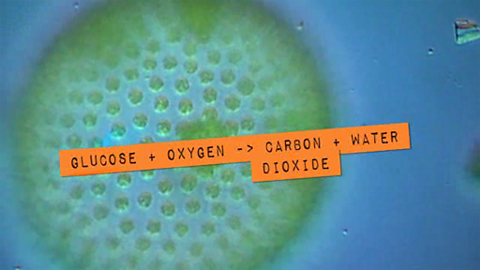
An explanation of photosynthesis. video
Jon Chase explains photosynthesis.
Enzymes and active sites. video
Jon Chase demonstrates the action of the enzyme catalase.
Factors that affect germination. video
Jon Chase investigates the effect of temperature, water and oxygen on seed germination.
Food as fuel. video
A screaming jelly baby is demonstrated to show the energy content of food.
Microorganisms and bacteria. video
Personal possessions are swabbed for bacteria which are then cultured on agar plates.
Microscopy. video
Jon Chase describes three different types of microscope.
Mitosis Rap. video
Jon Chase raps about the stages of mitosis.

Photosynthesis Rap. video
Science presenter Jon Chase raps about photosynthesis.