| | | | | PROGRAMME INFO | | | |
| | | Check Up is your chance to talk to doctors about the health issues that most concern you and your family. Each week Barbara Myers is joined by a medical expert to take your calls and emails on a particular topic and give you the most up to date advice. No appointment necessary.
Call 03700 100 444
| | | | | | Contact Check Up | | | | | LISTEN AGAIN 30 min 30 min | | | |
|
|
|  | PRESENTER | | | |
|  | | | | "There is no substitute for one-to-one advice from a top medical expert and that's what we offer our callers and emailers. But for each person who calls to ask for help, someone else phones in to pass on a tip or a suggestion - it's a great programme to present."
Barbara Myers | | | | |
| | | | | | PROGRAMME DETAILS | | | |
|  | | | (picture credit: Benjamin Dudoit) |
 Full programme transcript >> Full programme transcript >>
Feet
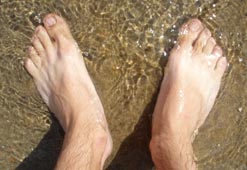
If you’ve bought your summer sandals but are ashamed of the state of your feet, get some advice about foot health on this week’s Check Up.
Barbara Myers' guest in the studio is Emma Supple, Podiatric Surgeon at the Chase Farm Hospital in Enfield.
Heel pain
A common complaint which people take to podiatrists is heel pain.
If this occurs in the morning when you’re getting out of bed and is excruciating, it could be plantar fascititis, where the tight band of fibre that forms the sole of the foot becomes inflamed.
It's not clear what causes the problem, although it could be an imbalance in the muscles around the foot.
This type of heel pain is usually relieved by streching exercises, rest or an insole in the shoe. However, a small minority of sufferers may need an injection or surgery.
Bunions
When the big toe is angled towards the second toe, a bunion often forms. These run in families and are more common in women than in men, but can be made worse by ill-fitting shoes.
A podiatrist might recommend splints or insoles to relieve the symptoms but there is no evidence that they can correct the underlying deformity.
To change the shape of the foot, surgery is needed – a bunionectomy, where more or less bone is removed, depending on the severity of the bunion.
Deeper, wider shoes can help reduce the risk of getting a bunion.
Flat feet
Having flat feet, where almost the whole of the foot comes into contact with the ground, without an arch between the heel and toes, may not cause any problems.
It's when there is pain in the feet or lower legs caused by walking abnormally that treatment is needed.
Stretching exercises, wearing wide-fitting shoes and using insoles or heel cups can help to relived pain.
Athlete's foot
Athlete's foot is easily picked up in communal changing rooms and swimming baths, and thrives in wet, damp shoes.
The symptoms are itching between last toes, red raw-looking, itchy and flaking skin. There can also be a sore, pus-filled, weeping rash.
The best way to prevent developing athlete's foot is to wash the feet at least once a day with soap and tepid water, drying thoroughly and gently in between the toes. Using an antifungal powder or spray sparingly (twice a day at most), and wearing natural fibres and well-fitting shoes also helps.
Fungal toenails
Toenail infections are more difficult to clear totally than skin infections.
This is because the nail thickens with fungal infection, so it is best for a podiatrist to thin the nail down as far as possible before using a paint or cream.
This enables the treatment to reach the affected area in the most effective way.
The infection can take up to a year to clear up with regular treatments.
Cracked heels
Now that many styles of shoe show off the back of the foot, cracked heels have become a concern for some.
Washing the feet every day in warm, soapy water (but not soaking them), and using pumice stone and moisturising cream should improve the appearance of the heel.
Contact the programme:
Please contact the programme with your questions or comments on 03700 100 444 on the day of broadcast or e-mail using the Contact Check Up link.
Next week: Back pain. | | |
RELATED LINKS
Feet for Life
Supplefeet (Emma Supple)
NHS: Foot Health
BBC Science: Skeleton - Hands and Feet
BBC Health: Foot Problems
BBC News Health
Dr Foster
BestTreatments
The BBC is not responsible for the content of external websites
| |
| | |