|

| |
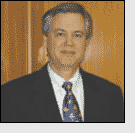
Dr Kim Holmes
 There were some people at that stage who felt it would be unwise for the President to go through the Security Council and the United Nations. What was your view? There were some people at that stage who felt it would be unwise for the President to go through the Security Council and the United Nations. What was your view?
In the end it was a wise thing to do, it was the right thing to do and I think that frankly there was no other choice.
I think you took up your post just after resolution 1441 had gone through. Did you feel that the UN had passed the first test in the terms of the challenge that the President had set it?
Yes I think it had and one of the reasons why we were confident to move on the second resolution is because of the fact that 1441 had passed and because we believed at the time that the expectation was that if we wanted to carry it though - even though we believed that resolution 1441 provided the legal authority - we thought it was politically wise to take the extra step because in fact that is what France and other countries had set they wanted us to do and so we tried to follow through with that in order to accommodate our friends and allies. Even though we did not think it was legally required. It turned out that some of the countries either had a different view or changed their minds or weren't quite sure and so the resolution was not approved.
Can I just ask you one question about the nature of your job and the bureau that you are head of. I see that one of its stated objectives is effective or promoting effective multi-lateralism. What does that mean?
It means that the United Nations in its programmes and in its actions and its decisions truly support international peace and security, truly support economic development for all people and truly support human rights, freedom and democracy. This is the principles on which the UN was founded. As you know the United States was instrumental in founding the United Nations and so we think we should always go back to our root principles. And so we believe that if the United Nations is doing its job effectively it is living up to those principles. And we just think that we and our allies and like minded democratic countries should be insisting that the United Nations live up to these principles. That's what I mean by effective.
Well in that context, can I just take you back to a briefing that you gave - along with your colleague from the Defense Department, Paul Wolfowitz - in February just as the critical moment in all this was approaching. You said there is a question here of whether or not Security Council resolutions are going to be enforced or not and this does of course raise the larger question about the credibility and the integrity of the United Nations now the logic of that is surely that you feel the question was answered in the negative, that the United Nations did not live up to those standards.
Well the United Nations does not always live up to its standards. Sometimes it does, sometimes it doesn't. In that case we were disappointed. We were disappointed that that second resolution was not passed. There is no secret about that. But as a point I made earlier is that we have put much of that disagreement and discord behind us. The Council came together with the unanimous consent on 1483 and even though every little single detail of issues that divided us before have not been agreed upon we came together on the basic premise that it was time to move on, it was time to lift sanctions on Iraq [and as I said the Security Council recognises the legal authority of the British and US forces and the provisional authority in Iraq and we think that is a step forward. Mr De Mello is working very well with the provisional authority and trying to bring a democratic political process and humanitarian relief to the Iraq people. We are very pleased with that and I think that most countries just wanted to look forward, to move on.
In terms of the larger question that you posed. What was it that failed? Was it the Security Council, was it the United Nations, the institution of the United Nations or was it the member states?
Well it is a little bit of both. But it is true that the Security Council is only a mirror of international politics. I mean historically anytime the Security Council has faced huge divisions among the Permanent 5 members as it did during the Cold War then it doesn't function with consensus by definition and therefore it doesn't operate very well. And that was pretty much the record of the Council throughout the Cold War. And then the Cold War ended and the Soviet Union and the United States came together in the first Gulf War and supported a resolution that engaged the Security Council constructively in Iraq that continued for many years up until around 1996, 97, 98 when the Gulf War coalitions that was formed in the early 1990s started falling apart and Russia and France in particular were trying to raise, lift sanctions on Iraq and then eventually the disagreements that existed in the Council at that time resulted in the inspectors being kicked out of Iraq in 1998 and that's where we were until 9/11 happened and there was a renewed sense of urgency on the part of this administration to start enforcing the resolutions that had not been enforced in the past on Iraq and that is where 1441 came through and then we had I think consensus, we thought we had consensus on Iraq in 1441 but it turned out not to be operable, or actually did not exist in the second resolution debate. But as I said we came together again in 1483.
I know you have written in the past in your academic life before you came into government about what you have described as diverging trends between Europe and America. Did you see those reflected in that debate over a second resolution?
Well there is no doubt that there were divisions among the Permanent 5, not just with Russia but also Germany and France had a different opinion on the debate on the second resolution. I think it's natural with the Cold War being over for a decade that the kind of closeness that existed on almost all the security issues during the Cold War is not quite as close as it was then. But then we don't want to make too much of that. I keep on coming back to the point that the Council came back together and I am doing that because I don't want to lose sight of that point in my point here. But I don't want to make too much of it because I believe that still the NATO alliance is very valuable to the United States. It's valuable to Europeans and we should not lose sight of that fact.
You were very much involved in the negotiations for 1483 weren't you?
Yes we were the lead bureau.
And is it fair to say that the United Nations as an institution paid a price then for what had happened in the immediate run up to the war, that perhaps America, the Coalition would have been willing to see a greater United Nations role if it hadn't gone into the war in such a messy way?
Well you know it is hard to say because you have to speculate about what might have been. I have been somewhat surprised at the backlash that people have talked about in the United States against the UN has not been larger than it was, than it has been. In fact we are returning to UNESCO and so far the House of Representatives so far - you know we haven't gone through the entire budget process - has been supportive of that effort, at least in terms of the budget. So it could have been quite different, I think the best way I would put it is that if there was a disappointment among the American people over that, over the failure of that second resolution it would have be in such a way that we could have perhaps done so much more if it had not happened.
But it is pretty clear isn't it in 1483 that the real power will rest with the coalition forces. And indeed that's what's happening and the UN, although 1483 talks about it having a vital role, that is something of a misnomer isn't it?
Well 1483 recognises under the Geneva convention the authority of the occupying powers and the vital role of the United Nations is to find in humanitarian and political terms in a supportive role - whatever way you want to describe it. I mean 'vital' was intended to describe that we consider the United Nations to be important in the process but that is a separate issue of the Quentin of sovereignty and the legal rights of the occupying power under the Geneva Convention.
Do you think that if the UN had had a more, or been given a more prominent role in resolution 1483 and in the reality that followed it, it might have been easier to accommodate Iraqi concerns about the way the country was run in the immediate aftermath of the war?
No I don't think so. I think the problems that have occurred about security and trying to get the infrastructure up and running and the like are fundamental problems that just simply need to be dealt with by the authority in Iraq and I don't know, and I have not seen any evidence or indication that the lack of a larger UN role has caused any serious problems politically for the authority in Iraq.
There is an argument though isn't there that says that people would find it easier to accept authority which had the legitimacy of the UN than comes from a nation or coalition which are conquerors essentially.
Well this is what a number of people expected to happen. I am just sayingwhen I see the impatience that some people have about getting their life back together in Iraq they're not out there clamouring for the United Nations to have a more powerful role as a way of satisfying their immediate concerns about electricity, security, you know better food distribution. I mean those are day to day problems that they want solved and I don't think, and I haven't seen any evidence that they think the United Nations if it had a greater role than it already has would be any more effective at delivering that than we, than the authority is.
Do you think that the scale of that task - both in terms of maintaining security but also in terms of reconstruction might draw United States back more close, closer to the United Nations?
Well we think that the resolution 1483 which called on countries to contribute to the security and stability of Iraq, we think that enough authority is there and a number of countries have already volunteered to help including troops if they would just simply take advantage of what is already in 1483. Some countries for domestic political purposes were saying they may need another resolution or need more - we don't think they need it but that is a political question in our eyes. So I just repeat what I said before, we have worked very closely with the Secretary General's special representative Sergio de Mello. We think he is doing a good job. I have spoken with administrator Jerry (sic) Bremmer about that. He is very pleased with his working with the UN and he thinks there are a number of areas where we need to work more on and so I think we have got a good balance right now and I think that is where we need to keep it.
Do you feel optimistic about the UN's future?
Well I am realistic about the UN's future in the sense that there are some areas where it does very good work - particularly in humanitarian relief area - and there are some areas where it doesn't do such good work. The human rights commission is I think does not function as it should. . I think it could function better. There are issues about how decisions are made and how budget decisions are made that could probably be improved but you know if the United Nations didn't exist we would have to invent it all over again because it is a forum where all the countries can come together - absolutely necessary for that reason - and also as we have seen in this crisis in Liberia, the Secretary General has been a key player in bringing together what may turn out to be a peacekeeping force in Liberia. So it performs a function that no other institution performs. For that reason alone it should exist.
| | | |
| |
| | |








 Listen