|

| |
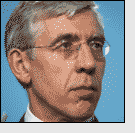
The Rt Hon Jack Straw MP
 If we could go back to that period last September, this time last year you were making the case to the United States for using the UN mechanisms for pursuing their policy in Iraq. What was the nature of the case you put to them? If we could go back to that period last September, this time last year you were making the case to the United States for using the UN mechanisms for pursuing their policy in Iraq. What was the nature of the case you put to them?
The case was a very straight forward one which was that the charge against Iraq - the fundamental charge - was that they had broken international law and that, therefore, the Security Council had to be given an opportunity to decide what should happen as a result of those breaches over the previous 11 years. It didn't in fact take a huge amount of effort with the UN system for them to agree and, particularly, the President to agree that he should put his case to the UN and he did it in very straight forward and for some people, rather surprisingly, open terms on September 12th last year.
Did you share the American analysis which was reflected in that speech that to an extent the United Nations and the Security Council had already shown a degree of weakness - and shown flaws because those resolutions about Iraq hadn't actually been carried through?
Yes, I think there's no doubt. And I … in a sense what you had within that speech was that this really rather serious tension in the world system between the so called hard diplomacy of the Americans and the soft diplomacy of the continental Europeans. I mean, that's a generalisation and no doubt that that tension is there and that was reflected by a degree of frustration in President Bush's speech because the truth is that if the international community had taken firmer, tougher decisions about Iraq five, six years ago then there would not have been an Iraq crisis whatever side of the argument people have been on over military action.
Were you at all concerned at that stage about finessing the objectives because the United States had made it very clear - the President made it very clear in the months before that speech - that his objective was regime change. There was no secret about it. Once the policy was within the UN process, weapons of mass destruction became the focus. Were you concerned that there was going to be a tension between those two objectives?
Well, there was a tension there and it was principally a tension about means and ends. I mean, what was the objective? Was it regime change or was it, in my judgement, compliance with UN Security Council resolutions including compliance with those relating to weapons of mass destruction? Everybody appreciated, in the UN system, that one of the consequences of a failure by Iraq to comply with any future diktats from the Security Council could be a change of regime. But the question was was that the objective? In practice, what happened in late September and October is that the debate about, so called regime change got subsumed into the debate about what should be in the resolution that became 1441.
That whole period when you worked - all of you, Colin Powell, the French - extremely hard to create what became 1441. At the time it looked like a triumph of diplomacy and what you could achieve by using the system as it was meant to be used. In retrospect, you could argue that actually it was an illustration of the fact that when there is a real division within the Security Council no amount of playing with words, no amount of hard work is actually going to resolve it.
In fact, I think it was a triumph of diplomacy and I don't say that in a self serving way but here you had a US President - Republican President - from a background of a lot of scepticism about the UN saying I commit this issue to the UN but there's got to be corresponding degree of responsibility back and the reason that the resolution took such a time to hue out and there were so many arguments and debates about individual words was because people were taking the text very seriously indeed. It was in no sense a charade. And I think that everybody was very serious about it. I think in 10 / 20 years time when the historians can really step back and view what happened, I think, however, what they may say is that after the resolution was passed, key heads of government inside the, amongst the Permanent 5 adopted different strategies and I think that would be said to be particularly true of President Chirac and President Putin that they then I think decided that, in a way, whatever happened they weren't going to be involved in military action. They may say, 'Well the Americans have decided whatever happened they wer' but that's for them not for me and I don't agree with that. But, anyway, I think that was the parting of the ways after the resolution not at the time of the resolution.
You would have said wouldn't you that the day that Jeremy Greenstock stood there, Britain's Ambassador, and said the attempt to get a second resolution has collapsed and the game is over and this is not going to happen with the legitimacy conferred by the United Nations. That must be one of the blackest days in the UN's history mustn't it?
I wouldn't say it was the blackest day in the UN's history. It was a very sad day. I know there were many, many blacker days in the UN's history. Basically the whole of the Cold War when the UN was irrelevant to conflict, never discussed Vietnam, I mean we were just out of it. So, there there was a very black period for the UN. And the importance of this period is that the whole focus was on the UN and the test for the world's only superpower as well as everybody else was, could we get that extra legitimacy by a second resolution. So it was a sad day but I have to say, it wasn't for the want of trying.
But it … they failed the test by your criteria, didn't they?
Who failed the test?
The United Nations.
Yes. I mean, I … by my criteria the case was overwhelming and that I'd argued five times in the Security Council between the end of January and the beginning of March. And I was surprised and saddened that my colleagues were not willing to face up to the consequences of decisions of which they had been explicit party in 1441 and, had they been - obviously the history of the last 3 months would have been very different - but we could have still have produced a benign result in Iraq because what Saddam was doing was playing each side of the P5 against the other, rather successfully in the short term.
How seriously do you think the institution was damaged by that?
Well, I think it is a very resilient institution and there remains a strong commitment by the US, thank God, to the UN as well as by other countries. What I think happened was everybody was really very shocked about the potential damage that happened to the whole UN system and the system of international law as a result of that failure to agree a second resolution. So what we've seen since the end of the formal conflict in mid - April is an understanding and appreciation that we've had to come together. Now, that led in towards the end of May to 1483. It led to resolution 1500 in mid-August and, as I speak now, right at the beginning of September we're involved in what I think will turn out to be satisfactory discussions about a new and strengthened mandate for the UN, again, arising from a shared sense of outrage and concern following the bombing of the UN building on the 19th August.
But talking to people in the United Nations during that period after the end of the conflict is that they're wondering what the lessons were. One thing that came through very clearly was that all of them were wrestling with the problems of how you deal with a United Nation's system which was designed for one set of power dispensations -that of after the 2nd World War and was now dealing with the reality of having one country which was so much more powerful than the others? I mean, that is really the lesson of the last six months, isn't it?
Yeah, I mean it's an obvious point that the world has changed in the 58 years since the UN got going immediately after the end of the war. And it has to accommodate the fact that there is this huge power which has larger military forces than the next 27 countries put together including the forces of France and the United Kingdom. I think it is showing, however, itself to be reasonably adaptable. There's another point that I observe about the relationship between the US and the UN which is that the fact the UN operations headquarters is in New York makes it too familiar to the US system. For us, it is different time zones, there is a kind of mystique about the UN - I think that's true about the rest of the world. For people in America it's just another organisation in the same time zone in New York which is anyway regarded as slightly suspect by middle and the southern America. So, you've got to factor that into the account as well as the fact, of course, that the US pays so much money towards the UN. But when I talk to people in the administration these days, I get a stronger sense of recognition of the importance of the UN than I did, say, two years ago.
But do you think that it's just a fact that we have to accept or do you think you can adjust the way the Security Council works to reflect the new reality?
There are plans that we've sometimes talked about for reform of the Security Council and if you were designing the system from scratch, for sure, you'd have a different make-up of the Security Council and we've put forward ideas about that. That said, an expanded Security Council with a greater number of permanent members would not be an easier Security Council in which to gain a consensus and it's also the case that because there is such disagreement about who should be the additional permanent members, it is likely that reform of the Security Council will be the last item to be successfully reformed rather than the first. So we've just got to work round that.
You mentioned the bomb in Baghdad directed at the UN Headquarters there. Obviously a great tragedy but what do you think are the long term implications of that?
The … well the immediate implications of that bomb was to get everybody in the international system to understand that everyone was a target. I mean, before those countries which had taken a different view about military action, I think, were saying, well the targets are the US and the UK and one can see why they were saying that. Now they've realised that these international terrorists and Ba'athists are targeting all the institutions and all the individuals in Iraq who have, within their power and their skills, a better future for Iraq. So, the immediate consequences have been to bring the international community together. Long term consequences - hard to say. In my judgement the fact of the bombing makes it all the more important that the international community comes together and fights such terrorism. It may lead to a better understanding between the US which is accused of power without legitimacy and the continental Europeans which are accused of seeking legitimacy without power - and there needs to be a synthesis of these two views.
Do you think there is a danger it'll make the UN more reluctant to take on a more prominent role in Iraq which we seem to be moving towards or had been seen to be moving towards?
I don't think it will make the UN more reluctant to take on a more prominent role on paper. Of course, as long as the security situation is uncertain and potentially unsafe, it makes it more difficult to get good people to go to work there - whether they're from the UN or from individual countries.
But it also means does it politically that terrorists in a way have succeeded in identifying the United Nations with the coalition in an odd sort of way which the UN may be reluctant to see?
They have but, you know, that's the identity the terrorists have put on it. Certainly not the identity which the UN has put on it. And, one of the reasons why they stayed in the Canal Hotel away from the secure area of the US military and the coalition provisional authority in Baghdad, was precisely because they wanted to maintain a separate identity. They'd been in Iraq years before, decades before, US / UK military forces and so they thought, I think, quite reasonably, that the Iraqi people including potential terrorists would view them differently and very sadly that changed. But, what we're dealing with and people have to understand this, is that there is a very powerful political virus which has infected groups of extremists who happen to say that they are fundamentalist Muslims but who's creed is as far away from Islam as it is from any other religion. And it's as powerful a virus as that which infected parts of Europe with fascism and Nazism in the 1930's and it does require very firm and concerted action - military but also political as well.
This time last year at the General Assembly everyone was talking about the Americans objectives, whether the President would announce, as he in the end did, that America would go down the UN route. What do you expect your colleagues to be talking about in New York when you go this year?
Well, they're bound to be talking about the aftermath. But I think that it'll be a discussion which will be relatively moderate with people accepting that there is a reality on the ground in Iraq whatever view people took of the rightness or wrongness of the military action. And the truth is that around the Arab world no-one had a good word to say for Saddam. All of them wanted to see him go. Of course there is concern about the terrorism and the lack of security in Iraq but I very rarely come across an Arab foreign minister these days who says, well you shouldn't have done that, because they knew that Saddam was such a source of instability inside Iraq and in the Arab world as a whole and was preventing the potential of beneficial change across the whole of the region.
And as far as the UN goes after the events of the last year?
Well, for the UN, my view as an individual and a government are very committed to the UN, it's a time to re-state our commitment to the UN but also to say that if the UN is going to stay relevant it has to deal with these new issues, particularly of international terrorism, yes, of weapons of mass destruction and of rogue and failing states. And this is a different agenda from the agenda which faced the UN 58 years ago.
| | | |
| |
| | |








 Listen