Ogbonge UN report wey chook eye for Nigeria, South Africa and oda countries, reveal why fertility rates dey go down

Wia dis foto come from, Getty Images
- Author, Stephanie Hegarty
- Role, Population correspondent
- Published
- Read am in 5 mins
One new report by di United Nations Population Fund (UNFPA), don warn of a global norm wia fertility rates dey go down.
Di agency don take dia strongest line yet on fertility decline, warning say hundreds of millions of pipo no dey able to get di number of children dem want, citing di very high cost of parenthood and di lack of a suitable partner as some of di reasons.
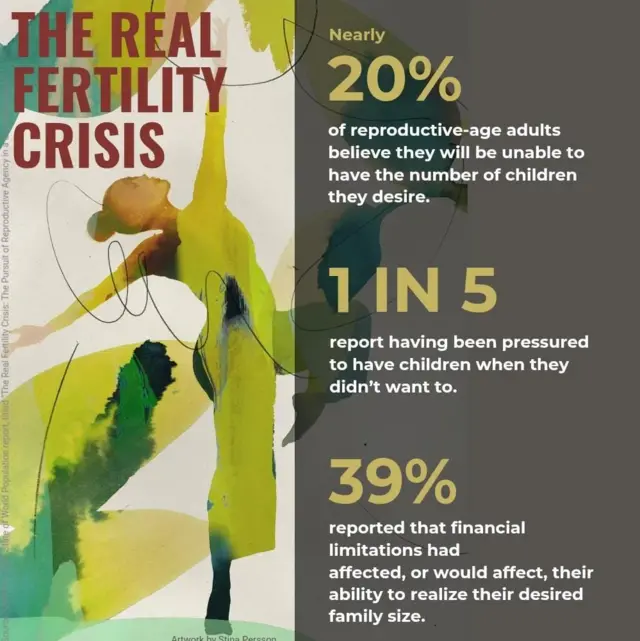
UNFPA survey 14,000 pipo in 14 countries about dia fertility intentions. One in five say dem never get or expect say dem go get dia desired number of children.
Di countries dem survey na - South Korea, Thailand, Italy, Hungary, Germany, Sweden, Brazil, Mexico, US, India, Indonesia, Morocco, South Africa, and Nigeria - wey account for a third of di global population.
Dem include a mix of low, middle and high-income countries and those with low and high fertility. UNFPA also survey young adults and those wey don pass dia reproductive years.
"Di world don begin see an unprecedented decline in fertility rates," na so Dr Natalia Kanem, head of UNFPA tok.
"Most of di pipo we survey want two or more children. Fertility rates dey fall in large part becos many feel say dem dey unable to create di families dem want. And dat na di real crisis," she tok.
Social and economic barriers, not choice, na im dey drive global fertility crisis: UNFPA
Di UN Population Fund (UNFPA) wen dem unveil dia flagship State of World Population report on Tuesday, warn say a rising number of pipo dey denied di freedom to start families due to skyrocketing living costs, persistent gender inequality, and deepening uncertainty about di future.
Di report argue say wetin really dey threat na pipo ability to choose freely wen – and weda – dem go get children.
Di report rely on a recent UNFPA/YouGov survey wey cover14 countries wey togeda represent 37 per cent of di global population. So of di reasons dem identify include:
Money worries
Economic barriers na di top factor, with 39 per cent of respondents wey cite financial limitations as di main reason for having fewer children dan dem go like.
Fear for di future – from climate change to war – and job insecurity follow, cited by 19 per cent and 21 per cent of respondents, respectively.
Thirteen per cent of women and eight per cent of men point to di unequal division of domestic labour as a factor wey make dem get fewer children dan desired.
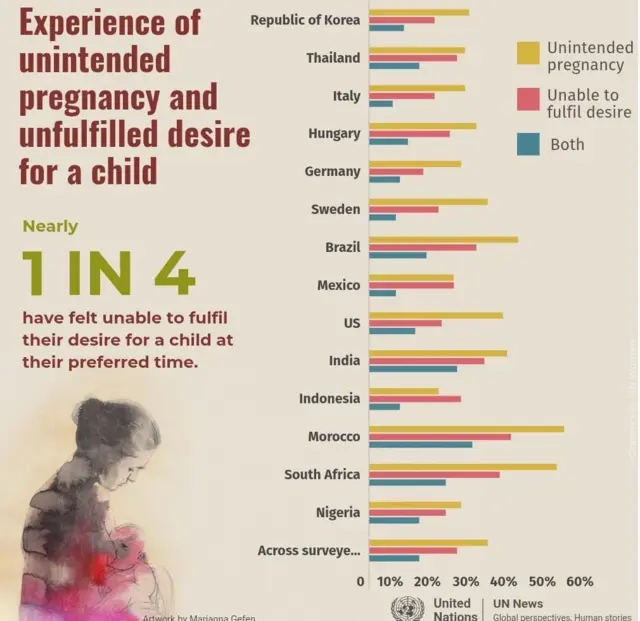
Di survey also reveal say one in three adults don experience an unintended pregnancy, one in four feel unable to have a child at dia preferred time and one in five report say dem dey under pressure to have children wey dem no want.
Wia dis foto come from, UN
Fertility crisis
Di report warn against simplistic and oda responses to falling birth rates, such as baby bonuses or fertility targets, wey no dey work most times and e dey risk violating human rights.
Instead, UNFPA dey ask goments to expand choices by removing barriers to parenthood wey dia populations don identify.
Recommended actions include to make parenthood more affordable through beta investments in housing, decent work, paid parental leave and access to comprehensive reproductive health services.
Immigration factor
Di agency also dey encourage goments to view immigration as a key strategy to address labour shortages and maintain economic productivity inside dis declining fertility.
Regarding gender inequality, di report dey call for addressing stigma against involved fathers, workplace norms wey dey push mothers out of di workforce, restrictions on reproductive rights, and di widening gender gaps in attitudes among younger generations wey also dey contribute to rising singlehood.
Wia dis foto come from, UN
Di survey, wey be pilot for research in 50 countries later dis year, dey limited in dia scope. Wen e comes to age groups within countries for example, di sample sizes dey too small to make conclusions.
But some findings dey clear.
In all countries, 39% of pipo say financial limitations don prevent dem from having a child.
Di highest response na for Korea (58%), di lowest na for Sweden (19%).
In total, only 12% of pipo cite infertility - or difficulty in conceiving - as a reason for not having di number of children dem want. But dat figure dey higher in countries including Thailand (19%), di US (16%), South Africa (15%), Nigeria (14%) and India (13%).
"Dis na di first time wey [di UN] don really go all-out on low fertility issues," na so Prof Stuart Gietel-Basten, demographer for Hong Kong University of Science and Technology tok.
Until recently, di agency bin dey focus heavily on women wey get more children than dem want and di "unmet need" for contraception.
Still, di UNFPA dey ask for caution in response to low fertility.
"Right now, wetin we dey see na a lot of rhetoric of catastrophe, either overpopulation or shrinking population, wey dey lead to dia kind of exaggerated response, and sometimes a manipulative response," Dr Kanem tok.
"In terms of trying to get women to have more children, or fewer."
She point out say 40 years ago China, Korea, Japan, Thailand and Turkey all bin dey worried say dia populations dey too high. But by 2015, dem want to boost fertility.
"We want try as far as possible to avoid those countries starting any kind of panicky policies," Prof Gietel-Basten tok.
"We dey see how dem dey use low fertility, population ageing, population stagnation as an excuse to implement nationalist, anti-migrant policies and gender conservative policies," e tok.
UNFPA find say one even bigger barrier to children dan finances na lack of time. For many women wey dey hustle for busy cities and dey do different kind of jobs, dat na true.