Hidden sugar: How much sugar you dey really chop?
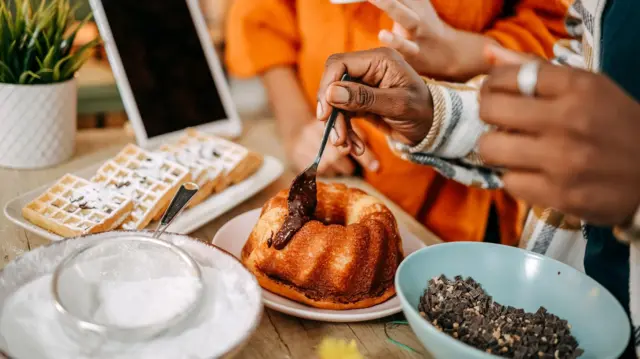
Wia dis foto come from, StefaNikolic/Getty Images
- Author, Global Journalism team, World Service
- Author, Near East Visual Journalism team, World Service
- Published
- Read am in 6 mins
E good make evribody dey check how much sugar dem dey chop. You fit dey eat pass wetin you tink and wen pesin dey consume too much sugar, e fit raise im risk well-well to get Type 2 diabetes, heart disease and cancer.
Di way pipo dey chop for evri wia don change strong-strong for di last few decades, and as e change, obesity and diabetes don dey increase anyhow.
According to data wey dem publish for The Lancet medical journal, more dan half of adults and one-third of children, teenagers and young adults for di world go overweight or obese by 2050.
One big wahala wey dey make weight hard to manage be say plenty hidden sugar don enta evriday food from yoghurt to bread, salad dressing to ketchup, and even smoothies.
As World Diabetes Day wey happun on 14 November, we dey look how pesin fit avoid to dey chop too much sugar eviri day.
We still get one small game to help you check how much sugar you dey take: how sabi you be to calculate di hidden sugar wey dey your food and drink?
Wetin be free sugar?
Yogurt, granola and fruit juice fit sound like healthy breakfast.
But depending on di product wey you choose, dis kain food fit mean say before mid-morning you don already chop more sugar pass wetin World Health Organization (WHO) recommend for one whole day. According to UK National Health Service, adults no suppose chop more dan 30g of "free sugars" per day.
"Free sugars" na any extra sugar wey dem add to sweeten food or drink, plus di ones wey dey naturally for honey, syrup and agave nectar. Dem still dey inside juice.
How your bodi take process sugar dey different based on how e dey inside di food. Wen you chop whole fruit or vegetable, di fibre wey dey inside dey slow digestion so e no go allow dangerous blood sugar spike.
But wen you consume added or free sugars, dem enter your bloodstream quick-quick and many times in large quantity making your blood sugar rise sharp-sharp.
Di same tin fit happun wen you drink fruit or vegetable juice, bicos once dem process fruit into juice, e don lose di fibre wey dey protect you.
Wen dis kain big blood sugar spikes dey happun over time, anoda wahala fit start your cells fit begin reduce how dem respond to di hormone insulin.
Di increase of processed foods too dey cause sugar to dey take bigger space for our diet compared to before.
Processed foods even dos wey you no go expect like preserved meat and fish don change from dia natural state so dem go last longer or taste better. Dem dey use sugar join salt inside.
Ultra-processed foods worse pass. Dis type of food don pass through some industrial processing and get many complex ingredients wey you no go ever see for your kitchen cupboard.
If one product get more dan five ingredients, e fit be ultra-processed.
Make you still dey check ingredient names well high-fructose corn syrup, fruit juice concentrate, honey and agave nectar na different names for sugar. So one milkshake wey you buy for shop or jar of pasta sauce fit end up contain your entire daily sugar allowance.
Di world get sweet tooth

Wia dis foto come from, Getty Images
Globally, we dey chop more sugar evri day pass before, even be say pipo don sabi say e no good for our health.
Health organizations for world tok say na US still dey lead for sugar wey dem dey consume per persin, but India, China, Pakistan and Indonesia own dey rise fast too.
If obesity trend no stop, by 2050, about 57.4% of men and 60.3% of women go overweight or obese, na wetin The Lancet publish for March afta dem check over 200 kontris.
For 25 years time, China, India and US go get di biggest number of overweight or obese pipo – 627 million, 450 million and 214 million respectively – and dis one go put heavy pressure for dia health system.
For sub-Saharan Africa, pipo wey overweight or obese go increase by more dan 250%, reach 522 million. Nigeria own stand out well-well – dem predict say di number go more dan triple.
But we fit do tins now to stop this wahala and control our health for future.
For US, for example, 63% of adults dey drink sugary drinks every day, na wetin Centers for Disease Control and Prevention tok. If pipo fit avoid dis kain drinks, plus sweets, confectionery and processed food, e go make big improvement for health.
WHO recommend say make you limit sugar wey dem add to less dan 10% of your daily calories, and if you wan get better health, aim for less dan 5%. Dat one na about six teaspoons per day, and e include sugar wey dem bake inside food plus di one you add by yoursef.
Dem also suggest make you dey check your Body Mass Index (BMI) to sabi if you don overweight.
BMI fit predict obesity well?
Your BMI na wetin doctors for everywhere dey use because e easy to calculate, na just your height and weight dem take do am.
But e no perfect and e get some wahala.
E dey show if persin heavy pass normal for im height, but e no fit tell if na fat cause am. BMI no dey consider different type of fat like wen fat gada for belle or around organs.
E no dey look age, how you dey active or weda you be man or woman.
For UK, dem find say some black, Asian and other minority ethnic pipo dey get higher risk of sickness like heart wahala or type 2 diabetes even when dia BMI low. So for January dis year, UK National Institute for Health and Care Excellence (NICE) release new guideline.
For this group, dem reduce BMI level wey dem dey use check if persin overweight or obese, so dem fit catch di risk early.
NICE new guideline also talk about bodi composition how fat and muscle dey different for ethnic groups.
Methodology
To make di quiz, we pick list of food and calculate how much sugar dey inside each product per 100g. Example, if food get 25g sugar for 100g and di portion size na 50g, e go get 12.5g sugar.
From di calculation, we come work out how many teaspoon of sugar dey inside each product, using 4g sugar per one level teaspoon – na benchmark wey UK Public Health England dey use.
To get average sugar for common product like biscuit, we check di mean amount across five products of dat type (if we fit find am).
Abeg note, na rough estimate we dey give. To build dis method, we consult UK National Health Service.
To calculate how many steps you go need to burn di sugar, we work wit Nicholas Sculthorpe, professor of clinical exercise physiology for University of di West of Scotland, and apply Atwater system wey define energy (kilocalories) per gram of each macronutrient. For carbohydrate, na 4 kcal per gram. We use estimate between 0.04 and 0.05 to calculate how many calories you burn per step; but na for level ground and e depend on body size.