Key points about exact trigonometric values

A branch of mathematics which explores the relationships between sides and angles in a triangle. can be performed without a scientific calculator for a select number of angles.
The exact trigonometric values that need to be learned are:
| 0° | 30° | 45° | 60° | 90° | |
|---|---|---|---|---|---|
| sinθ | 0 | \( \frac{1}{2}\) | \( \frac{1}{√2}\) or \( \frac{√2}{2}\) | \( \frac{√3}{2}\) | 1 |
| cosθ | 1 | \( \frac{√3}{2}\) | \( \frac{1}{√2}\) or \( \frac{√2}{2}\) | \( \frac{1}{2}\) | 0 |
| tanθ | 0 | \( \frac{1}{√3}\) or \( \frac{√3}{3}\) | 1 | \(√3\) | Undefined |
- Some exact trigonometric values are equivalent. For example, \( \frac{1}{√2}\) = \( \frac{√2}{2}\). The denominator has been rationalised.
To be successful with exact trigonometric values, especially at Higher tier, it is essential to be confident with working with surds.
Video – Exact trigonometric values
Watch this video to explore how to work out the exact trigonometric values for 0°, 30°, 45°, 60° and 90°.
Tom: What are exact trigonometric values?
Let's start with a recap.
Remember, sine theta equals opposite over hypotenuse, cos theta equals adjacent over hypotenuse, and tan theta equals opposite over adjacent.
A good way to remember this is Soh Cah Toa.
To find exact trigonometric values for 30 and 60 degrees, first sketch an equilateral triangle with sides of 2 units and angles of 60 degrees.
Then, slice it in half to create two identical right-angled triangles, each with angles of 30 degrees and 60 degrees.
The hypotenuse of each triangle has a length of 2 units, the base is 1 unit, and Pythagoras’ theorem can be used to find the length of the third side, root 3
Pause the video here to look at the working out.
Use this triangle to work out exact values of the sine, cosine, and tangent of 30 and 60 degrees.
Starting with 30 degrees, the opposite side is 1 and the adjacent side is root 3
Sine of an angle equals the opposite over the hypotenuse, so sine 30 equals 1 over 2, or one half.
Cosine of an angle equals the adjacent over the hypotenuse, so cos 30 equals root 3 over 2
And tangent of an angle equals the opposite over the adjacent, so tan 30 equals 1 over root 3
Now, looking at 60 degrees, why not pause the video and have a go at finding the exact values?
The opposite side becomes root 3 and the adjacent side becomes 1
This means sine 60 equals root 3 over 2, cos 60 equals one half, and tan 60 equals root 3 over 1, which is just root 3
Let's look at the trigonometric values for 45 degrees.
Starting with a square with side lengths of 1 unit, slice this into two identical right-angled triangles each with two 45 degree angles.
This time, the opposite and adjacent sides both have length 1 and the hypotenuse has a length of root 2, which can be found using Pythagoras’ theorem.
Sine 45 equals 1 over root 2, cos 45 equals 1 over root 2, and tan 45 equals 1 over 1, or just 1
It's impossible to create a triangle with an angle of 0 degrees, so it's best to memorise the trigonometric values for 0 and 90 degrees.
This topic is mostly non-calculator, but if you entered sine or cos 45 degrees into a calculator, you would see equivalent fractions of root 2 over 2
Similarly, for tan 30, you would see root 3 over 3 as an equivalent fraction.
Both forms are fine to use and to memorise.
And remember, you can always work out exact trigonometric values by using a sketch of one of the triangles.
Geometry with exact trigonometric values
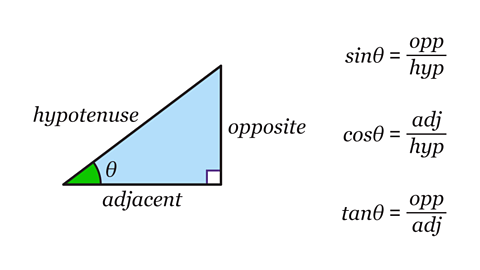
To solve right-angle trigonometry problems without a calculator, the exact trigonometric values must be recalled.
Use the three trigonometric A part-to-part comparison. (or formulae) and the exact trigonometric values to find unknown sides and angles in a right-angled triangle.
The formula used will depend on what information is given in the question.

- The formulae for trigonometry can be remembered using the mnemonic SOHCAHTOA. Try making up your own!
Follow the worked example below
Check your understanding
GCSE exam-style questions
- Work out the value of angle θ using trigonometry.
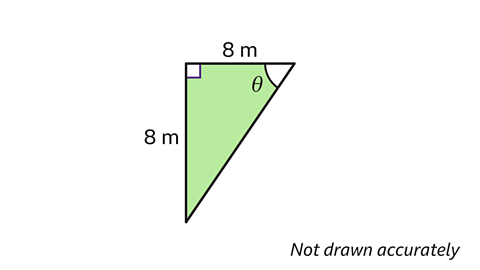
θ = 45°
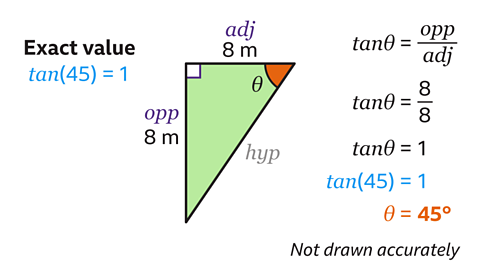
Label the sides of the triangle. The hypotenuse (hyp) is the longest side and is opposite the right angle. The opposite side (opp) is the side opposite the given angle, θ. The adjacent side (adj) is the final side next to the given angle.
In this triangle the opposite (opp) and the adjacent (adj) sides are known.
The trigonometric ratio needed must contain the opposite and the adjacent.
The correct formula to use is the tangent ratio, tanθ = opp ÷ adj.
- Substitute the values of opp, adj and θ into the formula to form an equation.
Here the opposite is 8, the adjacent is 8 and the angle should be substituted with θ.
This gives tanθ = 8 ÷ 8.
8 ÷ 8 = 1, so tanθ = 1
- Recall the exact trigonometric value for tanθ = 1.
tan(45) = 1
Hence angle θ = 45°.
- Find the size of length AB using trigonometry.
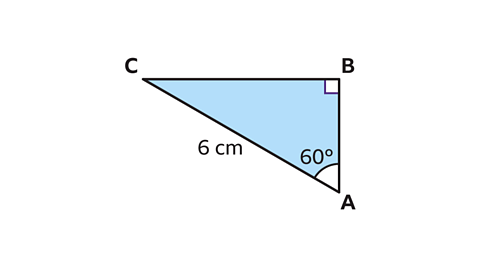
AB = 3 cm
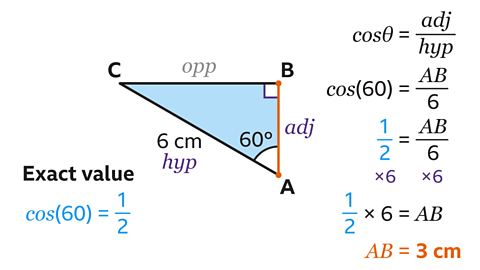
Label the sides of the triangle. The hypotenuse (hyp) is the longest side and is opposite the right angle. The opposite side (opp) is the side opposite the given angle. The adjacent side (adj) is the final side next to the given angle.
In this triangle the hypotenuse (hyp) is known and the adjacent (adj) is the side to be calculated, AB. The trigonometric ratio needed must contain the adjacent and the hypotenuse. The correct formula to use is the cosine ratio, cosθ = adj ÷ hyp.
Write down the formula cosθ = adj ÷ hyp.
Substitute the values of θ, adj and hyp into the formula to form an equation. Here θ = 60°, the adjacent should be substituted with AB and the hypotenuse is 6.
This gives cos(60) = AB ÷ 6.
- Recall the exact trigonometric value for cos(60) equals ½.
Substitute this into the left-hand side of the equation, to give ½ = AB ÷ 6.
Rearrange the equation to make AB the subject.
Find the value of AB by multiplying both sides of the equation by 6.
This gives ½ × 6 = AB.
This simplifies to AB = 3 cm.
Quiz – Exact trigonometric values
Practise what you've learned about exact trigonometric values with this quiz.
Higher – How to use exact trigonometric values
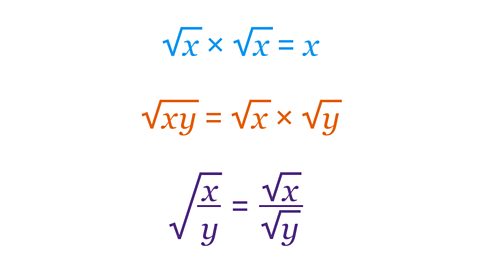
Exact trigonometric values can be used in calculations.
Many of the exact trigonometric values are written as A number expressed as a square root..
Use the rules for calculating with surds to write answers in their simplest form.
Follow the worked example below
GCSE exam-style questions
- Without using a calculator, work out the value of ⁷⁄₃ × sin(60) × cos(60) × tan(60).
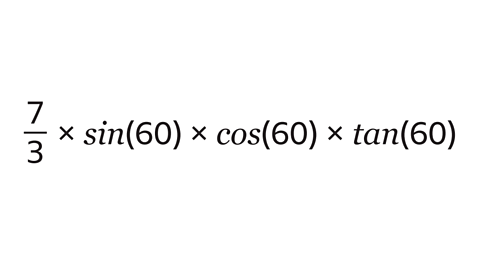
⁷⁄₄ or 1¾.
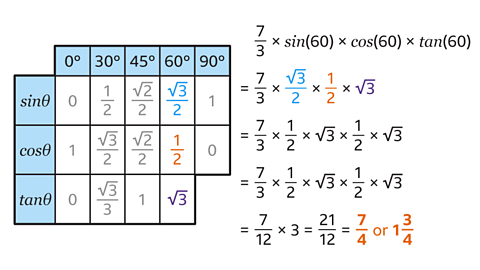
Recall the values for sin(60), cos(60) and tan(60). sin(60) = √3/2, cos(60) = ½ and tan(60) = √3.
Substitute the values into the expression.
This gives ⁷⁄₃ × √3/2 × ½ × √3.
√3/2 can be written as ½ × √3, so the expression can be rewritten as ⁷⁄₃ × ½ × √3 × ½ × √3.
Multiply the fractions and multiply the surds.
⁷⁄₃ × ½ × ½ = ⁷⁄₁₂ and √3 × √3 = 3.
Therefore the expression becomes ⁷⁄₁₂ × 3.
So ⁷⁄₁₂ × 3 = ²¹⁄₁₂.
This fraction can be simplified by dividing the numerator and denominator by 3, to get the improper fraction ⁷⁄₄, or as a mixed number 1¾.
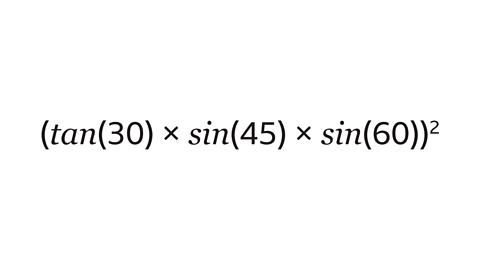
- Without using a calculator, work out the value of (tan(30) × sin(45) × sin(60))².
⅛
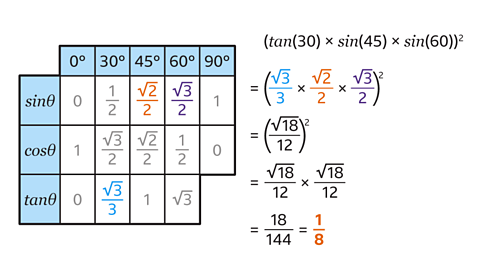
Recall the values for tan(30), sin(45) and sin(60). tan(30) = √3/3, sin(45) = √2/2 and sin(60) = √3/2.
Substitute the values into the expression.
This gives (√3/3 × √2/2 × √3/2)².
- Simplify the bracket by multiplying the numerators and denominators.
√3 × √2 × √3 = √18, and 3 × 2 × 2 = 12.
The bracket is equivalent to √18/12.
- Square the bracket by multiplying √18/12 by itself.
√18/12 × √18/12 = ¹⁸⁄₁₄₄
- Simplify the fraction by dividing the numerator and denominator by 18, to give ⅛.
Higher – Using exact trigonometric values with geometry problems
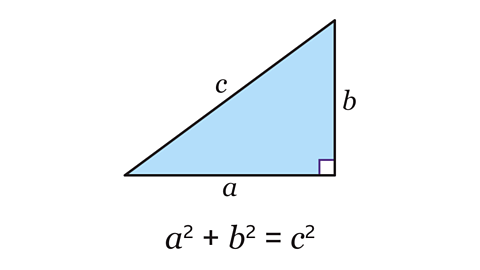
A multi-step problem may combine Pythagoras’ theorem states the relationship between sides in a right-angled triangle. It states that 𝒂² + 𝒃² = 𝒄², where 𝒄 is the hypotenuse (longest side), and 𝒂 and 𝒃 are the other two sides. with trigonometry.
If the sides of the right-angled triangle are labelled 𝑎, 𝑏 and 𝑐, then Pythagoras' theorem can be written as the A fact, rule, or principle that is expressed in terms of mathematical symbols. The plural of formula is formulae.:
𝑎² + 𝑏² = 𝑐²
Many of the exact trigonometric values are written as surds, so it is common for final answers also to be expressed as a surd.
Follow the worked example below
GCSE exam-style questions
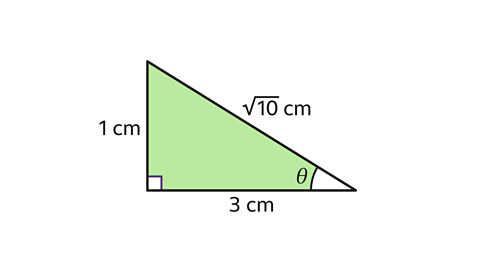
- In the given triangle, what is the exact value of cosθ?
3/√10
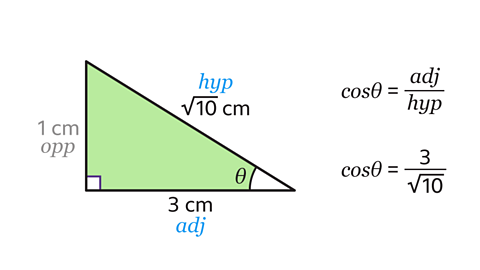
Label the sides of the triangle. The hypotenuse (hyp) is the longest side and is opposite the right angle. The opposite side (opp) is the side opposite the given angle. The adjacent side (adj) is the final side next to the given angle.
Write down the formula cosθ = adj/hyp.
Substitute the values of θ, adj and hyp into the formula to form an equation.
Here the adjacent is 3 and the hypotenuse is √10.
This gives cosθ = 3/√10.
In the triangle sinθ = 1/√10 and tanθ = 1/3.
- The length of 𝑄𝑅 equals 𝑥/√3 cm, where 𝑥 is an integer.
Work out the length of 𝑄𝑅.
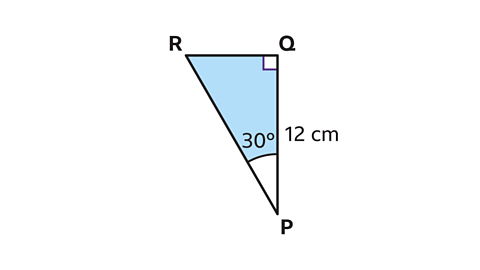
𝑄𝑅 = 4√3 cm
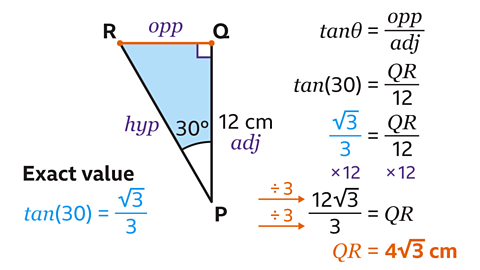
- Label the sides of the triangle. The hypotenuse (hyp) is the longest side and is opposite the right angle. The opposite side (opp) is the side opposite the given angle. The adjacent side (adj) is the final side next to the given angle.
In this triangle the adjacent (adj) is known and the opposite (opp) is the side to be calculated, QR. The trigonometric ratio needed must contain the opposite and the adjacent. The correct formula to use is the tangent ratio, tanθ = opp/adj.
- Write down the formula tanθ = opp/adj and substitute the values of θ, opp and adj into the formula to form an equation.
Here θ = 30°, the opposite should be substituted with QR and the adjacent is 12.
This gives tan(30) = QR/12.
Recall the exact trigonometric value for tan(30). tan(60) = √3/3 and substitute this into the left-hand side of the equation to give
√3/3 = QR/12.Rearrange the equation to make QR the subject.
Find the value of QR by multiplying both sides of the equation by 12.
This gives 12√3/3 = QR.
- Simplify the surd further by dividing the numerator and denominator by three.
This gives QR = 4√3 cm.
Higher – Quiz – Exact trigonometric values
Practise what you've learned about exact trigonometric values with this quiz for Higher tier.
Now you've revised exact trigonometric values, why not look at solving 2D and 3D problems using Pythagoras' theorem?
More on Geometry and measure
Find out more by working through a topic
- count31 of 35
- count32 of 35

- count33 of 35
- count34 of 35