Previous subjects
To tell people which subjects you've studied in the past, you need to use the perfect tense.
So instead of saying, eg 'I'm learning...' – ich lerne... you need to say 'I learned...' – ich habe…gelernt.
All you need to do is insert the school subjects or what you did into the gap between the A 'helping' verb that is used to form the perfect tense. It goes with the past participle and is the verb which stays in the second position in the sentence. The auxiliary verbs in German are haben and sein. (habe) and the A form of the verb which indicates a completed action in the past. It corresponds to the '-ed' or '-t' ending in English, eg I played, I cycled, I slept. It is used with an auxiliary verb to form the perfect tense in German.gelernt so:
- Ich habe Kochen gelernt. – I studied cookery.
- Ich habe einen deutschen Film gesehen. – I watched a German film.
- Ich habe einen Aufsatz geschrieben. – I wrote an essay.
Question
Change these present tense sentences into perfect tense sentences. Remember that some past participles use haben and others use sein.
- Ich gehe schwimmen.
- Ich spiele Klavier.
- Ich fahre ski.
- Ich zelte.
- Ich backe einen Kuchen.
- Ich bin schwimmen gegangen. – I went swimming.
- Ich habe Klavier gespielt. – I played piano.
- Ich bin skigefahren. – I went skiing.
- Ich habe gezeltet. – I camped.
- Ich habe einen Kuchen gebacken. – I baked a cake.
Did you know?
At one time, Latin was taught in most UK schools, but very few schools still teach the language today.
However, Latin – Latein – is still taught in a large number of schools in Germany. More German students study Latin than Spanish. In fact, after English and French, Latin is the third most popular language learnt in German schools.
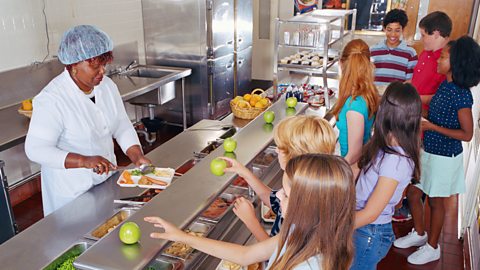
Latin borrowings can be heard in German to this day. A school assembly hall is called die Aula, from the Latin meaning 'the inner court of a house or palace'. German pupils and students eat their lunch in the school canteen or university cafeteria, known as die Mensa. This is the Latin word for 'a table'.