Agricultural disorder during the Industrial Revolution
While life in the new industrial towns and cities in the 19th century was difficult, life in the countryside had its own problems. When work is done by machines rather than by hand. threatened the jobs of farm labourers. Additionally, new developments like the Turnpike roads levied a toll charge to help the cost of building and maintenance. This new system vastly improved travel and thus aided the economy and people's quality of life. with their Gates on turnpike roads. Farmers and other road users had to pay tolls to use the roads. disrupted traditional routes that farmers used to get their produce to market.
Rebecca Riots
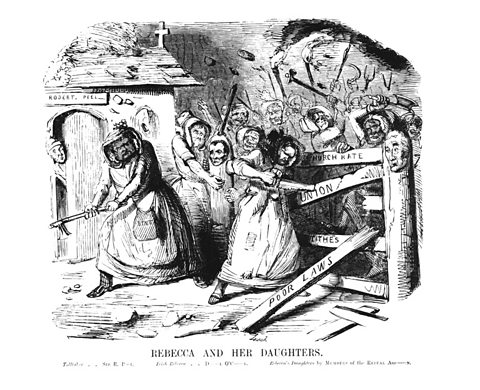
Between 1839 and 1843, groups of farmers disguised themselves as women and attacked toll gates in west Wales. They were protesting about the high tolls, but also increasing rents, To pay a sum of money to support a religious cause; usually one tenth of an individual's earnings. and poverty. They had suffered some poor harvests, and then the price of livestock fell. Many began to struggle to pay rents, tithes, rates and the tolls.
The farmers rode horses and were armed with sticks and axes. They attacked numerous toll gates in west Wales. The name ‘Rebecca’ was most likely a Biblical reference.
On 13 May 1839, the Rebecca rioters attacked a toll gate at Efailwen. The toll house was burned down on 6 June and the toll gate destroyed. One toll keeper, Sarah Williams, was killed in an attack on 7 September 1843 in Hendy.
The attacks continued until 1843 but decreased after the government sent more troops to the area. The protesters began to hold peaceful meetings instead of conducting violent attacks.
Swing Riots
In 1830 and 1831, agricultural labourers attacked houses and barns belonging to rich farmers and landowners in south-east England. They burned hayricks and smashed farm machinery. The attacks spread across the Midlands, East Anglia and southern England. Threatening letters were sent to landowners, signed by ‘Captain Swing’.
The labourers were protesting about poverty and the introduction of new machinery. The government arrested around 2,000 people. Of these, 19 were hanged, 644 were jailed and 481 were A form of punishment during the 18th and 19th centuries, in which convicted criminals or other people considered undesirable were sent, or 'transported', to work in colonies in Australia, America or the Caribbean islands. to Australia.
