Common crimes in the medieval era
The A person from Normandy in northern France. The Normans invaded and conquered England in the 11th century. kings defined a criminal as someone who disturbed the ‘king’s peace’. Norman laws focused on crimes against authority. For the monarchy this meant treason and rebellion, while for the Church this meant blasphemy and heresy.
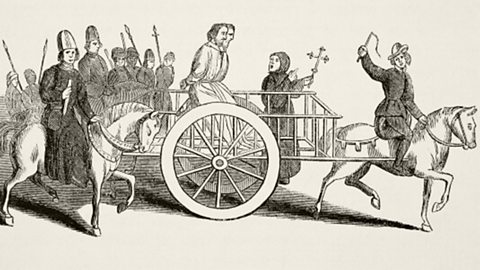
In the medieval era, treason did not just mean defying the authority of the king - it meant defying any authority. According to the 1351 Treason Act, this included a wife killing her husband, whom the law recognised as the source of authority within a family.
Heresy was defined as spreading religious beliefs that were not those supported by the Church. The most prominent group of heretics in England in the medieval era were the Lollards of the 15th century. They wanted to read the Bible in English rather than the official Church version, which was in Latin.
There were a number of very serious revolts against royal authority in the medieval era. For example:
- the 1381 Peasants’ Revolt against Richard II’s A tax paid by all adults. The amount was the same for everyone, regardless of their income or occupation.
- Jack Cade’s Rebellion in 1450, against the poor way the country was being governed by Henry VI
- the 1497 Cornish Rebellion, which was an attempt to overthrow Henry VII
The most common crime in the medieval period was theft. As a result, Edward I passed a law in 1275 that said that thieves would be executed. This did not deter people from stealing as theft still made up 75 per cent of crimes in the first half of the 14th century. There was also criminal activity that was particular to the medieval era:
| Criminal activity | Description |
| Scolding | This was abusive or offensive speech that was heard in public. It tended to relate to domestic arguments, but the authorities were worried that it could lead to disorder. It was usually punished with a fine. |
| Vagrancy | This became much more common in the 14th century after the Black Death, as survivors wandered the countryside looking for food and work. |
| Breaking Forest Laws | The Norman kings claimed ownership of all forests and everything in them. As a result, cutting down trees for firewood or for building, or hunting without permission, were serious crimes. |
| Being part of an outlaw gang | Groups of criminals robbed travellers and burgled people’s houses. They were often already on the run from crimes they had committed elsewhere. They could hide in houses that had been left deserted after the Black Death. One of the most famous groups was the Folville Gang of Leicestershire, who committed their first crime in 1326. |
| Criminal activity | Scolding |
|---|---|
| Description | This was abusive or offensive speech that was heard in public. It tended to relate to domestic arguments, but the authorities were worried that it could lead to disorder. It was usually punished with a fine. |
| Criminal activity | Vagrancy |
|---|---|
| Description | This became much more common in the 14th century after the Black Death, as survivors wandered the countryside looking for food and work. |
| Criminal activity | Breaking Forest Laws |
|---|---|
| Description | The Norman kings claimed ownership of all forests and everything in them. As a result, cutting down trees for firewood or for building, or hunting without permission, were serious crimes. |
| Criminal activity | Being part of an outlaw gang |
|---|---|
| Description | Groups of criminals robbed travellers and burgled people’s houses. They were often already on the run from crimes they had committed elsewhere. They could hide in houses that had been left deserted after the Black Death. One of the most famous groups was the Folville Gang of Leicestershire, who committed their first crime in 1326. |
