Vagrancy, heresy and treason in the 16th century
There were two big changes that occurred in the 16th century that led to an increase in crime. The first was the The 16th century religious revolution that led to the establishment of the Protestant churches. which led to an increase in people being accused of heresy and treason. The other was economic problems, which led to an increase in people without jobs who became vagrants.
Vagrancy
Homeless, unemployed person who wandered the streets. was a big concern for the monarchy and government in the 16th century. Homeless and unemployed people would roam around the country and were often called vagabonds.
Vagrants were a mix of ex-soldiers, unemployed farm workers, women, children, old people and sick people. The 1388 Statute of Winchester set out the law surrounding the poor and poverty. It made a distinction between vagrants who were incapable of work and those who were capable but chose not to work. People who were capable but chose not to work, and to beg instead, were often known as Fit and healthy beggars.
Some sturdy beggars engaged in cons or tricks to steal from people, or to get people to feel sorry for them. Thomas Hardman's pamphlet A Caveat for Common Cursetors was first published in 1566. It was one of the earliest in a series of pamphlets that sought to expose criminals, and warn the public about criminals.
Writers from the time, including Hardman, described several common types of sturdy beggar. Examples included:
| Type of sturdy beggar | Con or trick |
| Tom O’Bedlam | These people pretended to be mentally disabled and followed people around until they gave money. |
| The Counterfeit Crank | These people pretended to have violent fits and sucked on soap to make themselves froth at the mouth. |
| The Baretop Trickster | Female beggars would flash men in the street and trick them into going into a house. There would be a gang of men waiting in the house to rob them. |
| The Clapper Dudgeon | These people cut their skin to make it bleed and then covered it with dirty rags. Some children were deliberately mutilated by their parents to get more money from passers-by. |
| Angler/Hooker | These people carried a long wooden stick and would knock on people’s doors during the day to see what they could steal. They would then return after dark with a hook attached to the end of the stick. They would use the stick to steal items through windows. These items could then be sold. |
| Type of sturdy beggar | Tom O’Bedlam |
|---|---|
| Con or trick | These people pretended to be mentally disabled and followed people around until they gave money. |
| Type of sturdy beggar | The Counterfeit Crank |
|---|---|
| Con or trick | These people pretended to have violent fits and sucked on soap to make themselves froth at the mouth. |
| Type of sturdy beggar | The Baretop Trickster |
|---|---|
| Con or trick | Female beggars would flash men in the street and trick them into going into a house. There would be a gang of men waiting in the house to rob them. |
| Type of sturdy beggar | The Clapper Dudgeon |
|---|---|
| Con or trick | These people cut their skin to make it bleed and then covered it with dirty rags. Some children were deliberately mutilated by their parents to get more money from passers-by. |
| Type of sturdy beggar | Angler/Hooker |
|---|---|
| Con or trick | These people carried a long wooden stick and would knock on people’s doors during the day to see what they could steal. They would then return after dark with a hook attached to the end of the stick. They would use the stick to steal items through windows. These items could then be sold. |
Just being a vagrant was enough to be considered a crime in Tudor times. The authorities believed that people who did not work should be punished for their idleness.
1547 Vagrancy Act
The 1547 Vagrancy Act stated that any able-bodied person who had been out of work for more than three days should be Marking a person’s skin with a hot iron. Vagrants were branded with a letter V for example. with a V and sold into slavery for two years.
Child vagrants were forced into service. Other laws said that vagrants should be whipped and sent back to their place of birth.
Over time the authorities began to distinguish between able-bodied vagrants, who continued to be treated as criminals, and the ‘impotent’ or ‘deserving’ poor, who were given work or sent to a House of correction – a type of prison.
Heresy and treason
To disagree with, or refuse to follow the religious views of the monarch or the state. is no longer a crime in Britain, but it was a serious crime in Tudor times. Often heresy was linked with The crime of betraying one's country, sovereign or government. as refusing to follow the state religion was an offence against the authorities as well as a religious offence.
What constituted the crime of heresy was different in each reign, depending on the laws passed concerning religion. During the reign of Mary I, a Catholic, around 280 Protestants were burned at the stake for committing the crime of heresy. Under Elizabeth I, a Protestant, continuing Catholic traditions became heresy. However, Elizabeth preferred to have people convicted of treason rather than heresy.
The punishment for heresy was being burned at the stake for men, or beheading for women and nobility. The punishment for treason was being hanged, drawn and quartered. This was also known as a To die through being hanged (until near death), drawn (have their intestines pulled out) and quartered (body chopped into four pieces).
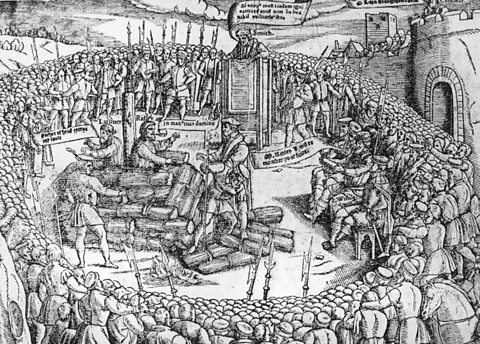
Archbishop Thomas Cranmer agreed to To give something up or to change one’s views. his Protestant beliefs, but Mary still decided to have him executed. When he was burned at the stake, he put the hand that he had used to sign his recantation into the fire first.
Bishops Latimer and Ridley were bishops who helped Edward VI to make the country Protestant. Both were executed by Mary I for heresy on 16 October 1555.
Edmund Campion
Edmund Campion was born in London and grew up to become a deacon in Elizabeth I’s Church of England. He had always held some Catholic beliefs so he went to Ireland and then Douai in the Netherlands to train as a Catholic priest. Campion came back to England in 1580 to preach Catholicism in secret in London. He was arrested by priest hunters and convicted of treason in 1581. He was hanged, drawn and quartered at Tyburn, London.
John Penry
A Strict Protestants who wanted to get rid of ritual in church services and lead a plain and simple life. preacher, John Penry, used a secret printing press to publish material that was denounced, publicly declared to be wrong or evil, by the Anglican bishops. He was executed for treason in 1593.
Mary Queen of Scots
Various Catholic plots against Elizabeth I focused on the claims of Elizabeth’s cousin, Mary Queen of Scots, to the throne. How much Mary herself knew of some of the plots is unclear. However, she was executed by Elizabeth I in 1587 after 19 years of imprisonment.
