Advanced mechanical systems
Bevel gears
A Two gears placed at an angle to each other, this rotates the direction of the turning motion - one gear will drive the other. is a special gear that can transfer rotary motion through 90 degrees. The diagram below shows two gears of the same size - the name given to this arrangement is a mitre-gear.
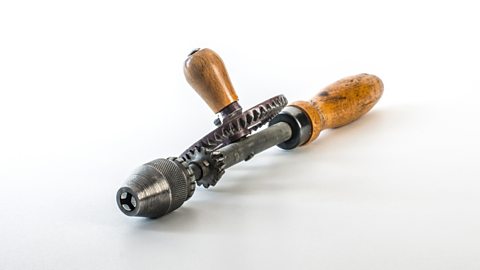
However, the two gears can vary in size to achieve a different gear ratio. An example of this is in a hand drill, where the drive gear is larger than the driven gear.
Rack and pinion
A A rack is a horizontal rail with teeth that fit the teeth of the round pinion. This arrangement turns rotary motion into linear. is an arrangement of a gear wheel and a rack that allows the rotary motion to be converted to linear motion.
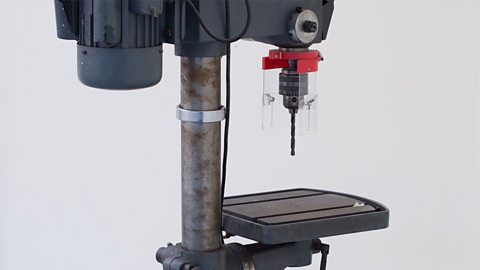
An example of this is in a pillar drill, where the table bed is moved up and down.
Crank and slider
Converts reciprocating to rotary motion or vice versa. and slider linkages change Circular movement around a pivot point. from the crank into a Repeated up and down or side to side movement in a straight line. of the slider. The crank and slider are connected through a connecting rod which helps convert the motion. The crank arm can be used as the driver in a car engine piston, the ignition of petrol by the spark plugs pushes the slider up, moving the connecting rod and turning the crank. Alternatively, the slider can be used as the driver in a steam engine where the wheels turn because of the pressure that moves the slider.
