Sources and origins
If a designer understands where Basic material that goods are made from such as crops, metals, wood and animal products such as wool and leather. come from, they can understand the environmental concerns associated with that material.
In the context of timber and man-made boards, the original source is a tree. Trees are grown all over the world - some are for timber produce, and others could be for paper. They can be categorised as hardwood and softwood.
Hardwood is harvested from deciduous trees. These types of tree lose their leaves in autumn and take a long time to grow, around 60 years (sometimes up to 100). Hardwoods include beech, oak, mahogany, balsa and jelutong.
Softwood is harvested from coniferous trees. These trees remain evergreen all year and take around half the time to grow, 25 to 30 years. Softwoods include Scots pint, Western red cedar and paraná pine. As trees are To cut down., it is important to plant new ones so that the timber source is A sustainable resource can be replaced once used. As a tree is chopped down, many more can be planted to ensure the use of trees can be sustained. .
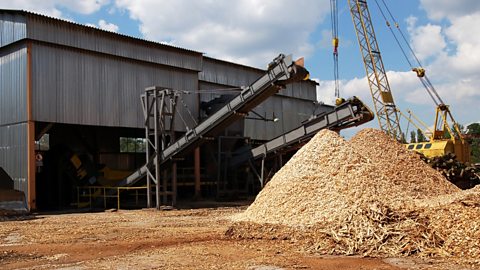
Manufactured boards are made from particles and fibres of natural timbers that are bonded together using resin to form sheets. Manufactured boards often make use of waste wood materials and inlcude plywood, medium-density fibreboard (MDF), chipboard and hardboard.
Once a tree has been chopped down, the branches are removed, so only the trunk of the tree remains. The full length of a tree might be too long to transport and work with, so the tree may be cut to a more manageable length. The tree trunks are transported to a sawmill, where the trees are cut to usable A piece of timber that is longer and wider than it is thick.. This process is known as Creating marketable planks of timber from the trunk of a tree..
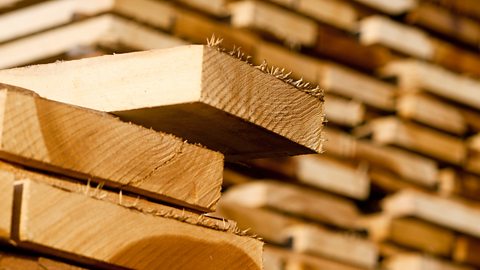
At this point the timber can be sold. If the timber has been freshly cut, it is sold as Timber that has been freshly cut and has a high moisture content. due to the high water content. If the timber has been dried out before being sold, then it has been ‘seasoned’. Some seasoning can be done by leaving it to ‘air season’, and sometimes the timber is Oven dried to remove moisture..
Plywood is made by gluing at least three layers of sheet timber together at 90 degrees. to each other - this is called Bonding layers of material together to improve strength. Plywood is considered to be a strong board as the grain of the timber sheets are glued together in different directions.
MDF is made from small timber fibres that are mixed with wax and A polymer that can be natural or synthetic. Resins can come from trees and plants or can be man-made to produce glues and varnish.. They are heated and Made smaller by squeezing together. so that a flat, usable sheet is produced.
Chipboard is a man-made sheet material, made from small Small piece of wood. of timber bonded together to produce a dense A way to describe that a material is normally much thinner than it is long or wide..