Properties
Each type of timber or board has different physical and How materials behave in different environments when subjected to changing conditions, eg force or temperature changes. that define their uses. Some timbers are hard and very A material that is closely compact., whereas others are lighter and softer to cut and work with.
| Hardwood | Physical properties | Working properties | Uses |
| Beech | White to pinkish-brown colour, close-grained | Hard, tough, warps easily | Furniture, flooring and tool handles |
| Oak | Light-brown colour, open-grained | Hard, tough | Interior woodwork, good-quality furniture |
| Mahogany | Reddish-brown colour, interlocking grained | Durable | Good-quality furniture |
| Hardwood | Beech |
|---|---|
| Physical properties | White to pinkish-brown colour, close-grained |
| Working properties | Hard, tough, warps easily |
| Uses | Furniture, flooring and tool handles |
| Hardwood | Oak |
|---|---|
| Physical properties | Light-brown colour, open-grained |
| Working properties | Hard, tough |
| Uses | Interior woodwork, good-quality furniture |
| Hardwood | Mahogany |
|---|---|
| Physical properties | Reddish-brown colour, interlocking grained |
| Working properties | Durable |
| Uses | Good-quality furniture |
| Softwood | Physical properties | Working properties | Uses |
| Scots pine | Pale-yellow colour, straight-grained | Tough, lightweight, soft | Construction, fencing |
| Western red cedar | Reddish-brown colour, straight-grained | Durable | Roof cladding, windows and internal linings of wardrobes as it is naturally antibacterial |
| Paraná pine | Pale-yellow colour, straight-grained, knot free | Hard, durable | Doors, staircases |
| Softwood | Scots pine |
|---|---|
| Physical properties | Pale-yellow colour, straight-grained |
| Working properties | Tough, lightweight, soft |
| Uses | Construction, fencing |
| Softwood | Western red cedar |
|---|---|
| Physical properties | Reddish-brown colour, straight-grained |
| Working properties | Durable |
| Uses | Roof cladding, windows and internal linings of wardrobes as it is naturally antibacterial |
| Softwood | Paraná pine |
|---|---|
| Physical properties | Pale-yellow colour, straight-grained, knot free |
| Working properties | Hard, durable |
| Uses | Doors, staircases |
| Manufactured board | Physical properties | Working properties | Uses |
| Plywood | White or pale-yellow colour, layered | Impact resistant | Flooring, vehicle internal bodywork |
| Medium-density fibreboard (MDF) | Pale-brown colour, wood fibres | Dense | Flooring, furniture |
| Chipboard | Pale-yellow colour, straight-grained, knot free | Hard, durable | Doors, staircases, flatpack furniture |
| Manufactured board | Plywood |
|---|---|
| Physical properties | White or pale-yellow colour, layered |
| Working properties | Impact resistant |
| Uses | Flooring, vehicle internal bodywork |
| Manufactured board | Medium-density fibreboard (MDF) |
|---|---|
| Physical properties | Pale-brown colour, wood fibres |
| Working properties | Dense |
| Uses | Flooring, furniture |
| Manufactured board | Chipboard |
|---|---|
| Physical properties | Pale-yellow colour, straight-grained, knot free |
| Working properties | Hard, durable |
| Uses | Doors, staircases, flatpack furniture |
Some physical properties of timbers can be changed, such as colour and texture, by applying a surface A protective or decorative layer added to a product such as varnish or paint. to the wood. The way a timber looks can be altered through several methods:
- To alter the colour.
- A protective treatment.
- A high carbon and hydrogen liquid that does not mix with water. Oil is usually rubbed into the surface of a timber to protect it and enhance the aesthetic quality.
- A solid compound at room temperature that contains fat. Wax is usually rubbed or brushed into the surface of a timber to protect it and enhance the aesthetic quality.
- A pigment suspended in a liquid. Solid forms need to be mixed with oil or water. Paint is usually brushed or sprayed onto a surface to alter the colour of the material.
- laminating
Timbers can have natural defects, which can affect the physical appearance of the wood. These include:
| Defect | Cause |
| Shrinkage | Occurs due to the timber losing moisture |
| Splits | Occurs when wood shrinks and becomes dry |
| Shakes | Cracks found in timber |
| Knots | Broken off or cut branches that reveal exposed wood |
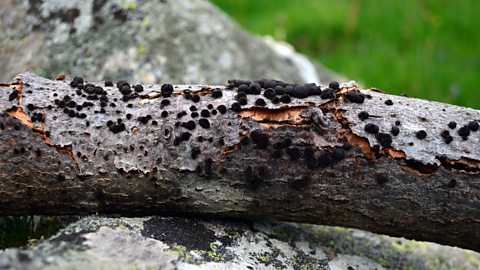
| Fungial attack | Plant organisms known as fungi live on and attack the timber causing it to rot or decay |
| Defect | Shrinkage |
|---|---|
| Cause | Occurs due to the timber losing moisture |
| Defect | Splits |
|---|---|
| Cause | Occurs when wood shrinks and becomes dry |
| Defect | Shakes |
|---|---|
| Cause | Cracks found in timber |
| Defect | Knots |
|---|---|
| Cause | Broken off or cut branches that reveal exposed wood |
| Defect | Fungial attack |
|---|---|
| Cause | Plant organisms known as fungi live on and attack the timber causing it to rot or decay |
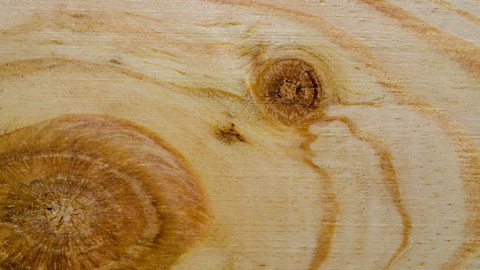
Image caption, Knots in wood
1 of 2
End of image gallery
