Reinforcing and stiffening
Forces act on materials all the time - even if a material appears stationary it still has a force acting on it. There are five terms used to describe what type of force can act on a material:
- Pulling force exerted by each end of an object such as a string or rope. - a pulling force
- Being squashed. - a pushing force
- A bending force is applied at an angle causing a material to be in compression and tension at the same time. - forces at an angle to the material
- A twisting force. - a twisting force
- A force across a material, eg scissors cut by applying a shear force. - forces acting across the material
Timber has good Tensile strength is the ability of a material to resist pulling forces without snapping, eg a guitar string has high tensile strength. and compressive strength because of its fibrous structure. The strength of natural timber is dependent upon the wood type, the An end view or area of a 3D form. area and the length of the section. Timber, if untreated, does not have good bending qualities and often snaps when bent. If a piece of timber has to be bent to shape, there are a few options to help prevent it from snapping. If timber is soaked in water or exposed to steam, it can become more flexible. Slots can be cut along the inside face of the timber to be bent allowing for the inside face to cope with the compressive force - this is called Slots cut in a material to aid bending.
To reinforce or strengthen timber there are a few methods to choose from. Plywood is strengthened by having the timber glued with the wood grain at right angles for each layer. It can also be reinforced with the number of layers. As the plywood becomes thicker, the less likely it is to flex at all. This is referred to as The ability to withstand flexing. and is a desirable feature.
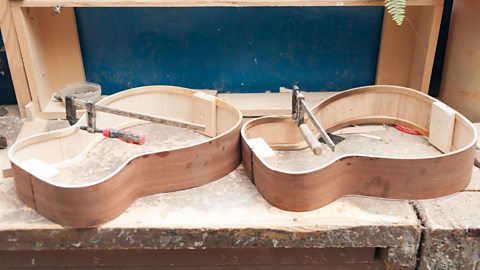
Manufactured boards can be made resistant to breaking by using a technique called Bonding layers of material together to improve strength.. Thin strips of timber are layered together with adhesive to produce rigid structures. While gluing, the strips can also be shaped using a jig.
Timber that has come from a tree that drops leaves in the autumn to prepare for winter. and Timber that has come from a coniferous tree that does not drop leaves in the autumn to prepare for winter. can be joined using a variety of temporary and permanent methods. The method used will depend on the function of the product, the strength required and the quality of the product. Temporary fixings will often be done using fastening components, such as screws or A type of fitting that can be put together easily by using basic tools, often used in flat-pack furniture., which are most commonly used in joining flat-pack furniture.
More permanent joins can be achieved with glue or nails, though these may lack strength and be rough-and-ready in appearance. The strength is also dependent on the choice of joint. If the joint is When two pieces of timber overlap or fit together to form a join., it will provide more structure to the join.
