Wastage and addition
Timber is a popular material to use in school Design and Technology lessons as it is generally not too expensive and it can be Marks made on an item before cutting or forming., cut and shaped with ease.
There are many different tools for marking out timber:
- pencil - the most popular, can go blunt with use and needs to be kept sharp
- marking knife - produces a fine crisp line that can be cut to, will produce many lines on timber before it needs to be sharpened again
The measuring tools associated with timber are used to measure lengths and angles. The most common tools are:
- ruler - for measuring shorter lengths, widths and thicknesses
- tape measure - for measuring long distances, particularly in the building trade
- try square - for marking out angles that are 90 degrees to an edge
- mitre square - for marking out angles that are 45 degrees to an edge
- sliding bevel - to mark an angle that you set to an edge
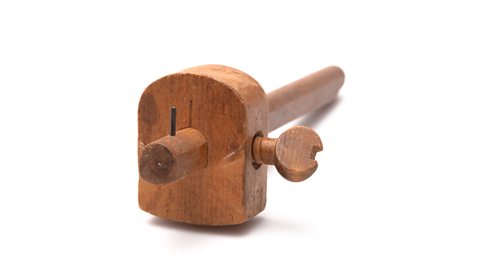
- marking gauge - to scratch a line that is parallel to an edge
- mortise gauge - to scratch a set of parallel lines to an edge

Image caption, Mitre square


1 of 4
There are a great many saws used to cut timber - some suit long straight cuts on thicker planks, and others suit curves and complex shapes:
- rip saw - for ‘ripping’ through and rough cutting thicker planks and boards
- tenon saw - for cutting straight lines with accuracy
- coping saws, jig saws and scroll saws - all for cutting thinner pieces of timber and they can cope with curves too
Timber can also be drilled by using a variety of different drill bits, which work by twisting into a piece of timber:
- twist drills - used to simply drill a hole of a fixed diameter into a piece of timber
- countersink bits - used to profile a hole so that the top of a screw can sit flush with a surface
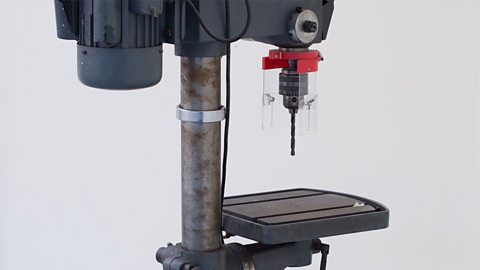
A Used to make round holes in timber and other materials. is used to improve production speed and to drill through various A straight line which joins two points on the circle and passes through the centre is a diameter. of timber. The drill bit is inserted into the Used to hold a drill piece in place on a pillar drill and tightened by using a chuck key. of a pillar drill. Once the material is secured, the lever lowers the drill bit into the timber, forming a hole.
To ensure accuracy, A tool used to aid the repetition of a process and/or to hold a work in place. and A solid shape that is often used to make a mould. can be used during the process of drilling, bending and cutting wood. Jigs and formers can also be reused to repeat the processes to produce identical products.
As well as marking, cutting and drilling, there are other skills to develop to shape timber:
- To remove timber with a sharp cutting tool. - used to remove timber, usually up to a cut or between two cuts, eg in the production of wooden joints such as dovetails
- To smooth with a sharp-bladed tool. - used to smooth the edge of a piece of timber by running a sharp blade in the direction of the grain, or can be used at an angle to produce a chamfered edge
- To rub abrasive paper to improve a surface finish. - used to achieve a profiled shape or smooth surface finish by removing fine particles, normally the final stage in shaping the timber and done by hand or with a machine (belt, disc or orbital)
Image caption,
1 of 2
