Scales of production
There are four terms used to describe the scale of production in relation to manufacturing a product:
- The first working model of a design used for testing, development and evaluation. or one-off production
- Where one group of identical products is made at the same time, before moving onto producing the next group.
- When the same product is manufactured many times.
- A production method that leads to many of the same product being made, continuously.
| Scale of production | Advantages | Disadvantages |
| One-off | High-quality craftsmanship, prototypes can be tested | Expensive, requires specialist labour, time consuming |
| Batch | Volumes are made for demand which reduces waste, templates and jigs can reused to produce identical products | Downtime between batches |
| Mass | High volumes can be produced, materials can be bulk purchased at cheaper rates, low-skilled workforce required | Expensive to set up because of specialised equipment, expensive machinery repairs |
| Continuous | 24/7 production using an automated system, high volumes can be produced, materials can be bulk purchased at cheaper rates, low-skilled workforce required | Expensive to set up because of specialised equipment, expensive machinery repairs |
| Scale of production | One-off |
|---|---|
| Advantages | High-quality craftsmanship, prototypes can be tested |
| Disadvantages | Expensive, requires specialist labour, time consuming |
| Scale of production | Batch |
|---|---|
| Advantages | Volumes are made for demand which reduces waste, templates and jigs can reused to produce identical products |
| Disadvantages | Downtime between batches |
| Scale of production | Mass |
|---|---|
| Advantages | High volumes can be produced, materials can be bulk purchased at cheaper rates, low-skilled workforce required |
| Disadvantages | Expensive to set up because of specialised equipment, expensive machinery repairs |
| Scale of production | Continuous |
|---|---|
| Advantages | 24/7 production using an automated system, high volumes can be produced, materials can be bulk purchased at cheaper rates, low-skilled workforce required |
| Disadvantages | Expensive to set up because of specialised equipment, expensive machinery repairs |
Prototypes and one-off production
There are many ways to produce a prototype - some are rough and look like models, and some function as intended and are well finished. Many architectural models are made from timber lolly sticks, matches or balsa wood. Model-making timber can be shaped easily and glued in place at speed.
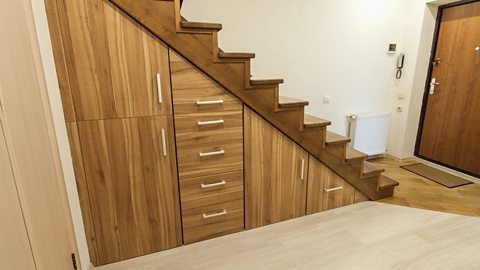
A custom-made or bespoke product that is made from timber could be based on a customer Document containing details of a product's required characteristics, and all the processes, materials and other information needed to design the product.. Products such as made-to-measure wardrobes or hand-crafted furniture are expensive because each piece of material has been designed and cut for that specific product, involving great skill and time.
Batch production
Batch production is where many items of the same product are produced. An example relating to timber is where a set of chairs is required to match a dining room set.
A A person that makes products from timber. could design the chair, and then cut all the timber at the same time to make the set. The carpenter would then have a kit to start making batches of chairs. If each part of the chair needed to be drilled in exactly the same place, the carpenter would make a drilling A tool used to aid the repetition of a process and/or to hold a work in place. that would hold the timber while each part was drilled. If a part of the chair needed the same shape The outside edge of a shape. from a plank of timber, the carpenter would make a A form used to ensure other parts are made to match the form. so that each part would be shaped the same.
Each time a product is made, the materials that are used have had to be bought. If just one product is made, quite often the cost is high because small orders are placed to supply the materials. When a product is built on a large scale, money is saved when compared with the cost of making a one-off product.
Mass production
Mass-produced products are manufactured in large volumes, often on A series of workers and machines in a factory by which a succession of similar items is progressively assembled. where workers fit standard components such as screws and hinges to parts. Examples of mass-produced timber products are A piece of timber that has a decorative pattern along its length., doors and pencils.
Continuous production
Continuous production takes place 24 hours a day, 7 days a week and, in some cases, 365 days a year. There is not generally the demand for a timber-based product to be made using continuous production, but stock sizes of timber and paper can be produced using continuous production methods.
