Joining methods
Permanent fixings
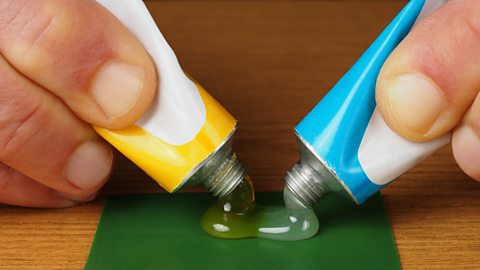
Materials are joined permanently by using A substance which bonds the surfaces of materials together., a substance that bonds surfaces together. Adhesives can range in bonding strength and types depending on the materials that need joining. Examples include:
- Polyvinyl acetate (PVA) - Used as a general purpose woodworking glue, and some PVA adhesives are water resistant. This is most commonly used to join wood but can also be used with papers and boards.
- Epoxy resin (ER) - Used for joining woods to other materials such as metals and plastics. It is waterproof but is a two-part glue that must be mixed up immediately before use.
- Contact adhesive - Used for joining a range of materials, such as fixing plastic laminates to a wooden base, and provides a strong bond. It needs to be applied to both materials and allowed to dry before joining.
Temporary fixings
Temporary fixings will often be done using fastening components, such as screws or knock-down fittings, which are most commonly used in joining flat-pack furniture. These types of fittings can easily be put together, or removed if needed, using basic tools such as a screwdriver.
Knock-down fittings and screws
Most knock-down fittings consist of corner blocks or bloc-joint fittings and are usually made from a plastic such as nylon.
All screwing needs two sizes of hole. The A hole through an object that is large enough to enable threads of a screw or bolt to pass through but not the shank of the screw or bolt. must be very slightly bigger than the The head of a screw or bolt. of the screw. This is so that the shank can move freely in the clearance hole. The A small hole drilled first as a guide to for a large hole or screw. must be smaller than the The main thickness of a screw. of the screw so that the core fits tightly into it. If the screw head is to lie flush with the surface of the wood, the hole must be enlarged or countersunk.
Screws come with different types of head. They can be flat or round-headed, and be fitted with a slot, crosses, or square holes for different screwdrivers.
Wood processes
Veneering
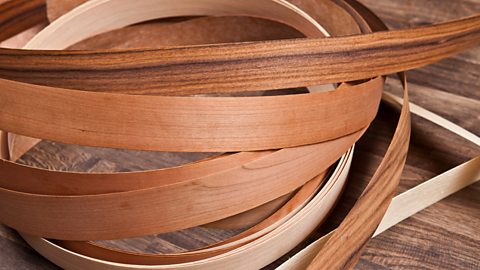
A thin decorative covering of fine wood applied to a coarser wood or other material. is the term used to describe a thin sheet of timber, usually made from an expensive Timber that has come from a tree that drops leaves in the autumn to prepare for winter.. Veneer is cut in the same way that a pencil sharpener works - the timber is rotated as a blade cuts a thin sheet of veneer from the trunk. Veneer is often used to cover a cheaper material such as Thin layers of wood glued at right angles to each other., A type of engineered wood made of compressed wood and fibre particles held together with glue. or sometimes a Timber that has come from a coniferous tree that does not drop leaves in the autumn to prepare for winter.. Quite often an ‘oak’ table will actually be an MDF table with an oak veneer - the table could still be considered expensive to buy, but would be considerably cheaper than a solid oak table.
Laminating
Wood is usually bent by Bonding layers of material together to improve strength.. This is done by cutting thin strips of wood, putting glue on the strips and clamping them into a former or jig. This technique is commonly used with plywood.
Steam bending
Wood can also be bent by applying steam. This technique involves thin strips of wood being heated in a steam box. The applied heat and moisture makes the wood Flexible and easy to bend. enough to easily bend around a A solid shape that is often used to make a mould. to create a specific shape.
