Impact on industry and enterprise
Impact on industry
Technology continues to be developed for manufacturing processes in order to improve quality and speed of making while maintaining customer satisfaction and reducing the impact on the environment.
Automation
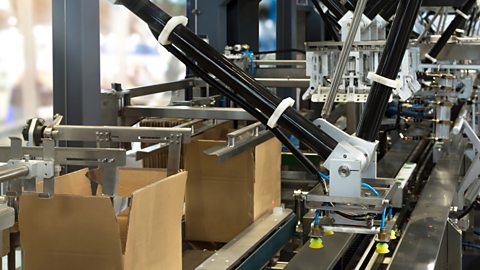
Using automatic equipment in production. has been developing in factories since the The process that transformed manufacturing from handmade to machine-made, mass-produced goods using water, steam and coal power transported by canal, rail and steamship. Britain was the first country to have an Industrial Revolution., with machinery being used to complete tasks previously done by humans. Automated machines are programmed to carry out a procedure multiple times, eg repeatedly creating the shape of a car door using a press, to improve production time. The cost of setting up machinery is high but, when they are operating, less waste is produced and running costs are lower.
Robotics
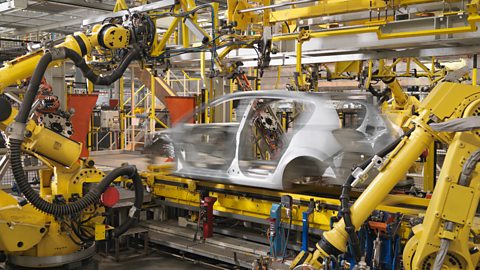
The use of robots is just one part of automation. The difference between robotics and automation is that robots use Use of computer systems to perform tasks that usually require human intelligence. to collect information and improve the performance of a particular procedure. Robotics has proven popular because of their ability to increase efficiency and handle harmful materials that humans can't, but they are very expensive.
Circular economy
Making the best use of resources and minimising waste. is an alternative approach to the Make, use and dispose.. The linear economy is an example of a modern Excessive production and overconsumption of disposable items over items that can be reused, repaired or recycled. and is best described as make, use and dispose - which can create negative effects on the environment.
A circular economy makes maximum use of resources with as little waste as possible, recovering and regenerating materials at the end of their life. It not only reduces waste, but also ensures we are more resourceful with materials and contributes to a Able to compete with other companies by offering a product or service that people want and will pay money for.. Examples of developments in the circular economy are the use of artificial turf, which can be recycled into items such as school bags and dog bowls, or the development of biodegradable food containers that break down into natural nutrients in the Earth’s soil where they can be used again.
Impact on enterprise
New ideas are continually emerging, but it is difficult to ensure these ideas are developed successfully. Several ways have evolved to support the development of new products and the growth of new companies.
Crowdfunding
Traditionally, new businesses would borrow money from a bank to raise enough funds to develop a project. This is risky and, with A fee charged for borrowing money, or money earned from savings. Calculated as a percentage. payments, can be expensive. Crowdfunding uses websites to advertise products as investment opportunities, where people can choose to back a project with a financial donation if they think it will be Something that will work successfully.. Backers are often rewarded with free gifts, discounts or a pre-agreed part of any The amount of money made after all expenses have been paid. if the product is successful.
Virtual marketing and retail
Promotion of products online and sharing experiences, reviews and recommendations has rapidly become part of the retail experience. A sequence of logical instructions for carrying out a task. In computing, algorithms are needed to design computer programs. can generate information about users’ buying habits and suggest relevant retail sites for them to try using Process of using techniques to improve return rate of a webpage when indexed by a search engine.. An online publication written by an individual or a group of individuals that covers a subject of their choosing, a contraction of the term 'web log'., A social media video. and social media all provide advertising platforms, and costs of retailing from a website are far lower than from a high street shop.
Cooperatives
Cooperatives are organisations with lots of people working together towards common goals. The cooperative is run and owned by members who share decision-making, profits and risk. The Co-operative Group and Nationwide Building Society are examples of successful cooperatives in the UK.
